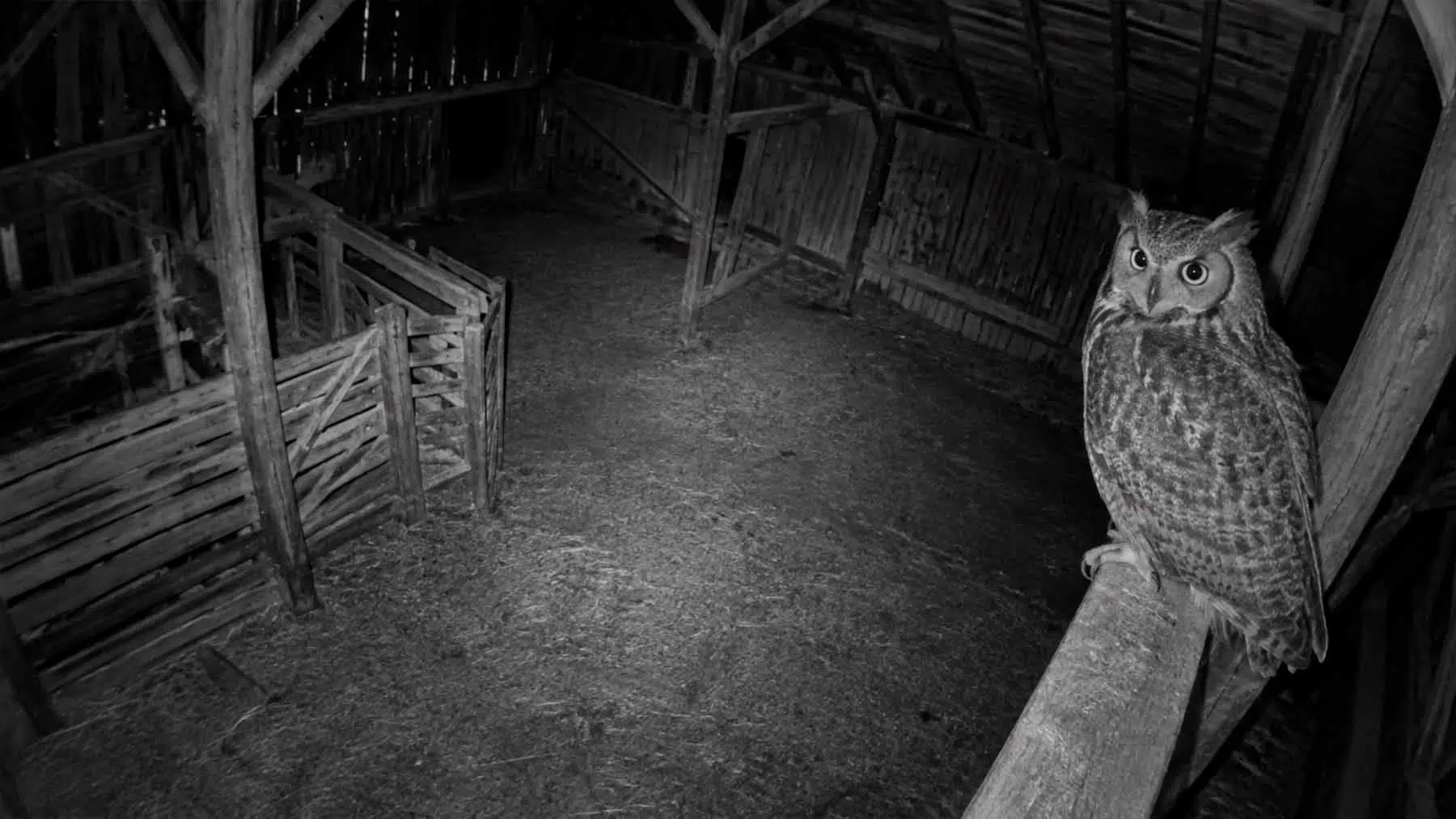
This spring, a livestream followed five barn owl owlets in a North Carolina nesting box.
But the camera captured something most people rarely see.
Around midnight on June 24, a large owl entered the barn. A great horned owl attacked and killed an owlet perched atop the nesting box.
According to biologists, it was heartbreaking but natural.
It came back again that week, and only two of the five owlets were left.
The barn had become a hunting area
The nesting box was located in an active farm building in North Carolina. During this year’s breeding cycle, five eggs hatched.
One owlet died shortly after hatching due to drought conditions, limited prey, and aggression from older siblings. This reduced the number of surviving owlets to four.
Afterward, three of the four females successfully fledged on June 15, making their first flight from the nesting box to other locations within the barn.
The fourth and last owlet to leave the nest made his first flight on June 20.
At least two of the owlets were actively hunting southern flying squirrels brought in by their parents.
Great horned owls are one of the primary predators of barn owls. The first recorded attack occurred near midnight on June 24 and resulted in the death of one of the females that fledged on June 15.
During the attack, the adult female barn owl defended herself on top of the nesting box, behavior biologists rarely witness on camera.
Approximately three days later, the great horned owl returned and killed again. This time the victim was another female banded with white and hot pink.
The two remaining young owls abandoned their roosts for a short period of time before returning to the barn.
When the great horned owl returned once again, it did not find any prey available.
Why the commission keeps watching
The North Carolina Wildlife Resources Commission runs the live camera for education and research.
Barn owl numbers have been dropping across the state.
The agency does not step in when predators attack. They say that when humans intervene, they take away the chance for young animals to learn lessons that will keep them alive later.
After the second killing, biologists plugged two holes in the barn that the great horned owl had been using to get inside.
But they won’t stop the predation itself.
Only 25 to 35 percent of barn owls typically survive to adulthood. Having two of the five original owlets still alive meant this nest was doing better than average.
What the two remaining owlets learned to do
Biologists monitoring the webcam observed behavior changes in both surviving owls when confronted with the predator.
When the great horned owl appeared, the young owls adopted defensive postures to appear larger.
They puffed themselves up and recognized the threat.
This was not simply instinctive behavior, but a response learned from watching their mother fight off the predator. By watching their mother fight, the young owls learned how to protect themselves or their own young, the North Carolina Wildlife Resources Commission noted.
Where the two survivors went next
Both surviving young owls left the barn for good by mid-July. The oldest owlet, a female banded with white and dark green colors, exited on July 13 at 92 days old.
Her younger sibling, banded with white and light pink colors, exited seven days later on July 17 at 89 days old.
Young barn owls can travel hundreds of miles when they leave the nest. Whether they survive to adulthood determines population size more than anything else.
These two left knowing more than most ever learn.
The question is whether that knowledge will be enough when they need it most.
Where those two survivors settle matters, because two orphaned owls hired as pest control showed they can thrive around human developments.
Read the whole thing?
Get the week's signal, not the noise
Our sharpest reporting on energy, climate and nature — free, once a week.