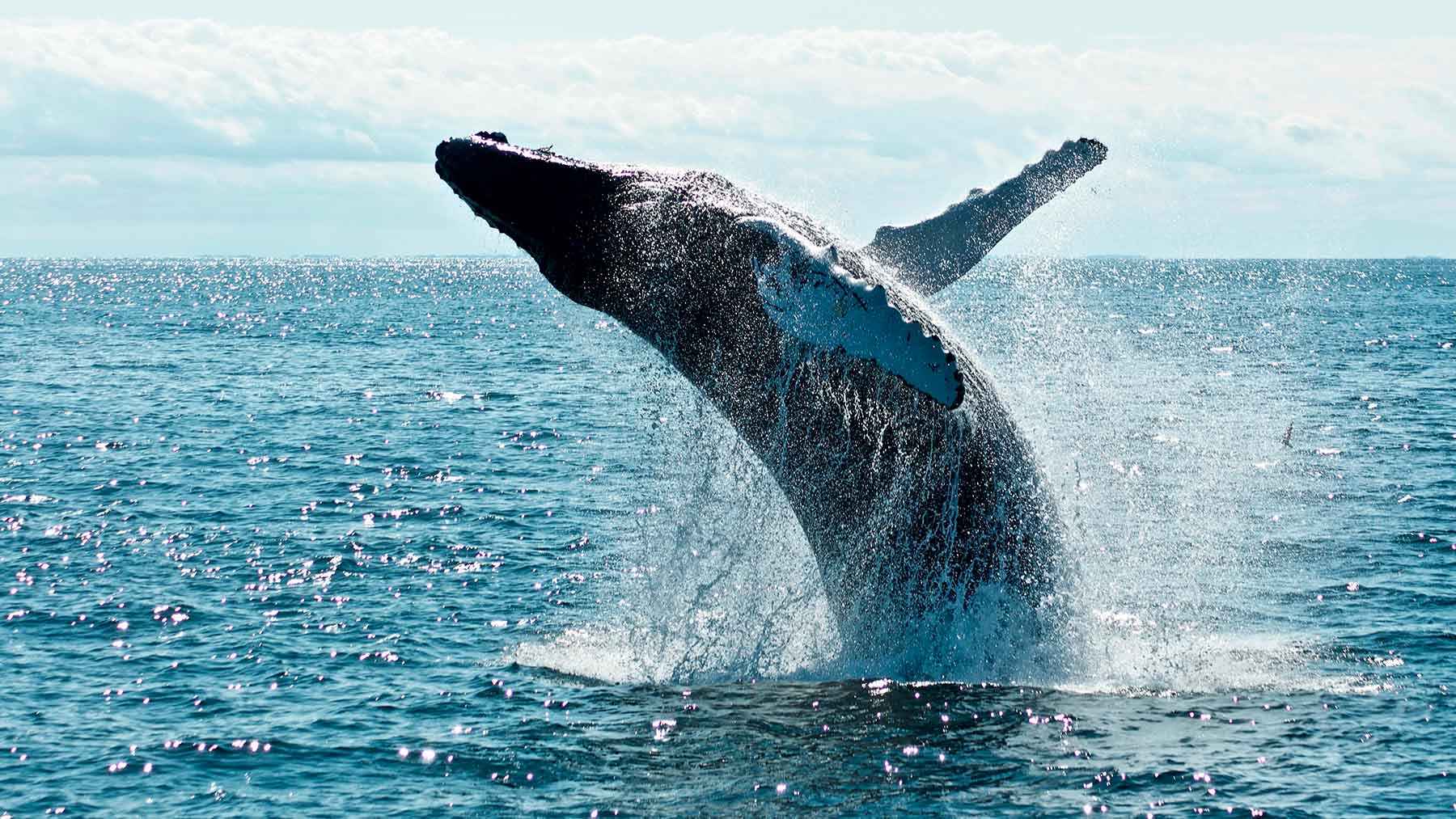
There shouldn’t be a Humpback Whale in these waters!
The reaction came after a whale named Rio left San Francisco Bay and headed east into the Sacramento-San Joaquin Delta, a network of waterways far from the Pacific Ocean.
Several days later, there was some good news.
Rio had turned around and was headed west again towards San Francisco Bay and possibly the Pacific Ocean.
The whale kept moving farther inland
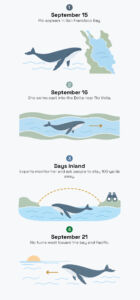
A Humpback Whale was first spotted in San Francisco Bay on September 15.
Instead of staying in the bay, the whale traveled East toward the Sacramento-San Joaquin Delta.
The next day it was seen still deeper in the delta near Rio Vista.
Researchers used photos to recognize the whale as CRC-11620 using identification records kept by Cascadia Research Collective.
This whale is known as “Rio”.
Humpback whales are not normally found in habitat like this.
Experts at The Marine Mammal Center coordinated with other organizations to visually observe what was happening.
They agreed that Rio seemed to be swimming under its own power but reminded everyone that Rio was traveling through an out-of-habitat area.
Therefore, wildlife responders needed to watch the whale carefully without changing its course.
Experts urged people to keep their distance
Conservationists advised boaters, kayakers, paddleboarders and shoreline observers to give Rio plenty of space.
While large marine mammals naturally attract attention, experts emphasized that giving Rio space remained the safest approach.
One piece of advice was easy to understand: stay at least 100 yards away from the whale and allow it to determine its own course.
Experts at The Marine Mammal Center agreed that they did not know why Rio swam into the Delta.
It was possible that the whale was just passing through and then continuing on its normal migration pattern.
Another possibility was that some type of unknown problem was causing Rio to swim into the Delta.
Since experts were unable to establish either conclusion based on existing data, they decided to rely on observational methods instead of trying to intervene.
Allowing the whale to continue on its own would provide experts with their best chance to find out if Rio could safely return to the ocean on its own.
Rio was not the first whale to make the journey
There have been a few instances of humpback whales visiting the Delta previously.
One notable instance occurred in 1985 when a humpback whale named Humphrey stayed in the Rio Vista area for approximately three weeks prior to returning to the Pacific Ocean.
In 2007, roughly twenty-two years later, a mother-calf pair entered the Sacramento River Delta.
The pair remained in the Delta for approximately twenty days before leaving and eventually making their way back toward San Francisco Bay and the Pacific Ocean.
Since both Humphrey and Delta and Dawn eventually returned to the ocean, observers hoped Rio would do the same.
The Marine Mammal Center responded to both of those earlier events.
In both cases, experts closely monitored the whales as events continued to unfold.
Rio was no stranger to researchers
Rio is no stranger. Rio has been sighted fifteen times over the last twenty-four years in waters off both California and Mexico.
Researchers have tracked Rio’s movements since 2002, with the most recent previous sighting recorded in Baja California in February of this year.
Based upon this documentation, researchers were able to immediately identify Rio once photographs became available.
On September 21, experts reported that Rio had been seen heading west through the Delta toward San Francisco Bay.
After days spent in places a humpback whale does not typically visit, the whale appeared to be heading back toward San Francisco Bay.
Read the whole thing?
Get the week's signal, not the noise
Our sharpest reporting on energy, climate and nature — free, once a week.