A small technological revolution has been developing over the horizon.
It is taking shape where rolling hills of farmland meet the wide-open skies.
Farmers for generations have used manufactured chemical products delivered from thousands of miles away. A revolutionary facility in the Midwest is changing how local farming utilizes fertilizers.
Rather than relying on massive industrial sites, it uses a compact demonstration facility to test localized clean manufacturing technology.
At this site, scientists are evaluating whether the natural components found within the local air, water, and atmosphere can be utilized.
The hidden economic burden on rural communities
Beyond normal operating costs, Minnesota agricultural producers spend up to $1 billion annually on synthetic nitrogen fertilizer. These annual expenditures represent one of the single highest operating expenses for corn and grain growers.
Despite the substantial costs associated with purchasing synthetic nitrogen fertilizer, the State of Minnesota has no commercial ammonia production facilities.
As such, nearly 100% of monies expended on synthetic nitrogen fertilizer leave the local economy.
These funds flow to remote locations containing large-scale chemical plants that utilize natural gas.
Due to the fact that conventional production relies heavily on natural gas, local farmers remain exposed to global market shifts. The resulting global supply chain renders local farmers extremely vulnerable.
They face constant exposure to fluctuations in international natural gas prices, transportation disruptions, and unforeseen geopolitical events.
Consequently, when international natural gas prices spike, a farmer’s fertilizer costs can double overnight. To break this cycle, local researchers looked to wind as the region’s most abundant resource.
They began using that renewable energy source to help reduce local agriculture’s exposure to external fertilizer-price swings.
Solving the wind problem in ammonia production
Historically, producing ammonia has been considered an industrial process that has necessitated a continuous source of electrical power.
When engineers attempt to convert chemical production facilities to renewable sources of electricity, they encounter significant challenges.
Wind does not generate electricity at a constant rate.
Others evaluated large hydrogen storage tanks in order to continue generating ammonia during periods of low wind activity. However, the additional costs associated with the implementation of these technologies rendered them economically unfeasible.
Why smart software beat out costly hardware
Chemical engineers spent nearly ten years developing control algorithms to resolve these challenges for the University of Minnesota – Green ammonia pilot.
Rather than investing millions of dollars in power storage systems, they implemented a computerized control system at the Morris facility.
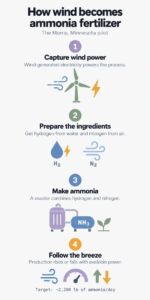
This system dynamically adjusts production levels in response to variations in wind speed.
During periods of high wind speeds, the electrolysis unit splits more water molecules into hydrogen and oxygen gases while extracting nitrogen from ambient air.
During periods of low wind speeds, the entire ammonia production apparatus automatically reduces its production level. It does so without being shut off or damaging any equipment.
Matching production to the daily breeze
Using wind power to produce ammonia creates an optimal operating system built specifically for rural areas. This provides local agriculture with the means to end its dependence on fossil fuels.
Researchers estimate that green ammonia could reduce the fossil energy footprint of farm activities by up to 90 percent under suitable adoption scenarios.
The facility is scaling toward a target production rate of approximately 1 metric ton per day as researchers continue preparing for full pilot operations. The clean fertilizer created at the Morris facility is transferred into nurse tanks parked immediately adjacent to the site.
Local co-ops then distribute the plant nutrients directly to surrounding farms.
Using locally produced fertilizers enables farmers to budget for their seasonally planned fertilizer requirements. Regional production may help reduce exposure to unexpected price fluctuations.
These independently owned, community-based facilities will be able to replicate the same successful operational configuration tested at the Morris demonstration site.
Read the whole thing?
Get the week's signal, not the noise
Our sharpest reporting on energy, climate and nature — free, once a week.