Material scientists in China have developed a slow-curing epoxy that gets applied to perovskite ink material.
Solvent-based solar cells usually form pinholes and feature uneven grain formation due to fast solvent evaporation over large surfaces.
By using a controlled cross-linking agent within the liquid semiconductor ink, one would be able to control the polymerization that takes place when the solvent is stripped off.
This novel method helps reduce internal electricity traps and demonstrated a certified efficiency of 21.07 percent within the paper-sized panel test under laboratory conditions.
Controlling fast solvent evaporation in printable photovoltaic inks
Perovskite ink-based solar panels transition from liquids to solids during the rapid evaporation of the solvents used.
High-speed solvent evaporation generally results in a random crystal growth and the formation of sharp interfaces that tend to trap mobile electrical charge carriers.
The scientists incorporated an epoxy resin with a low polymerization rate in the precursor liquid solution.
The epoxy molecules create a transient support matrix that slows down crystallization in the solution layer.
Polymerization control keeps crystals from clumping while the ink is distributed evenly over the smooth surface of the substrate.
Controlling the viscosity of the solution allows the even distribution of chemicals before the formation of the crystalline semiconductor layer.
Creating uniform crystal structures by controlled polymerization
The cross-linking reactions cause the ion precursors to align precisely to form dense perovskite crystal grains.
High-order crystals do not contain the small voids through which electrical charges normally dissipate as wasted heat energy.
No defects were detected in the lab.
Epoxies attached firmly to the exposed lead and halide ions on crystal interface boundaries.
Sealing the small void gaps does not prevent moisture intrusion, however.
The formation of defect-free interfaces provides electronic pathways for directing the electrical power to the collection grid electrodes.
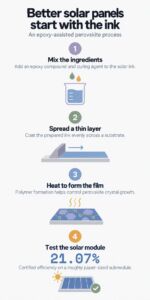
Scaling up printable perovskite inks to paper-scale experimental solar panels
Smaller lab-scale spin-coated cells demonstrate excellent conversion efficiencies, but increasing scale-up during manufacturing results in drastic drops in performance.
Engineers applied the solar ink-based polymer to paper-sized substrates via an automated blade-coating system.
A controlled curing process avoided the inconsistent crystallization that commonly occurs during the wide-area deposition process on flexible substrates.
Blade-coated test panels provided stable optoelectronic characteristics across the entire active semiconductor surface area.
Laboratory tests showed that peak power conversion efficiency reached 21.07 percent across the scaled panels.
Coating the larger surfaces might result in slight deviations in thickness, which do not result in the same levels of high efficiency as the smaller cell panels.
Evaluating industry manufacturing barriers to commercial solar panels
Laboratory tests show that step-growth polymerization suits paper-sized samples; however, commercial manufacturing will require faster roll-to-roll equipment.
It is vital to ensure the correct control of thermal and environmental conditions across a larger section of coating to prevent inconsistencies appearing on the edges of much larger panels.
The cost of the chemicals used for the synthesis of special epoxy additives is much higher compared to commercial precursors used for silicon current technologies.
There is a need to optimize the production line to prove that stability may be achieved under prolonged exposure to outdoor conditions.
It is essential if the technology is to be implemented on an industrial scale, since the technology itself is useless if it is not durable over years.
The move from laboratory testing to commercial application is the next major industrial achievement to strive for in the development of printable semiconductor inks.
However, there is still much work to be done before this happens.
The commercial success of the innovative Chinese solar ink depends on whether chemical suppliers will be able to reduce the costs of polymer synthesis.
The full study can be found here: Zhang, W., Wang, Z., Zhou, H. et al. Stepwise polymerization enables tailored perovskite ink for scalable flexible perovskite solar cells. Nat Commun 17, 10858 (2026). https://doi.org/10.1038/s41467-026-77703-w
Read the whole thing?
Get the week's signal, not the noise
Our sharpest reporting on energy, climate and nature — free, once a week.