
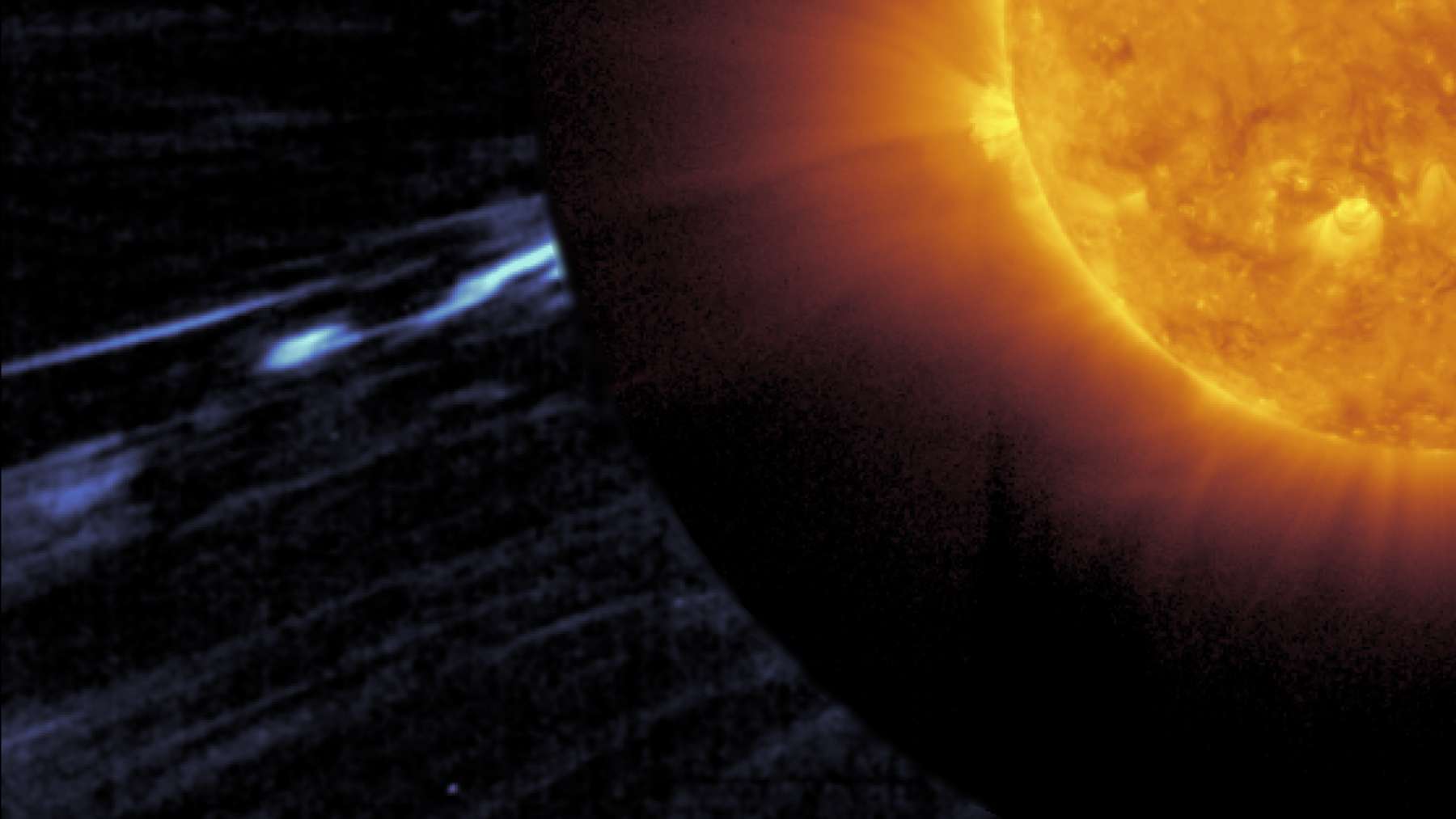
Tracking of solar wind streams by European Space Agency space probes revealed that the source of the magnetic switchbacks is none other than the loops of intense energy released on the Sun.
Space scientists have been arguing about the exact source of these abrupt reversals ever since they were found in the solar wind decades ago.
The high-definition images taken by the space probe revealed that the solar wind kinks are related to magnetic reconnection areas.
This discovery has solved a big problem in astrophysics concerning the behavior of coronal magnetic fields.
Tracing the magnetic switchbacks in the inner heliosphere
The instrumentation found on the space probe traversing the inner region of the solar system encounters highly strange magnetic switchbacks, which are basically the folding of the field lines of the interplanetary magnetic field on themselves.
The understanding of the formation of such a sudden directional reversal was a major focus for the scientists studying the solar wind phenomenon.
Using the information derived from the direct measurements taken during the recent closest pass, scientists traced back the affected plasma flows using magnetic mapping towards the point of origin of such a flow.
Using this technique, scientists were able to pinpoint the particular regions on the sun that are responsible for causing this sudden reversal in the magnetic field direction.
Identification of blazing coronal loops forming magnetic field
The extremely high temperature loop structures, which have been seen using extreme ultraviolet imagers, have been seen arcing across the solar atmosphere beneath the spacecraft.
The strong magnetic field lines embedded within these loops hold tremendous magnetic energy.
The thermal radiation mapping has shown that switchbacks have perfect alignment with the boundaries where different magnetic polarities meet.
These are known as coronal loops.
The bright loops give the physical structure required to eject the twisted magnetic material out into space.
Understanding the active structures in the atmosphere helps us understand the connection between solar eruptions and heliospheric disturbances.
Connecting magnetic reconnection to solar wind kinks
The complex interaction of the oppositely directed magnetic field lines causes reconnection to occur continuously in the boundaries of active coronal loops.
In case of magnetic reconnection, there is an abrupt release of energy, which throws plasma streams into the surrounding solar wind.
Supersonic expansion of magnetic bubbles drives sharp kinks away from the Sun’s surface.
Computer simulations have found that kinks having a distinctive S-shape, seen in observation, are formed due to magnetic snapping.
The physical explanation of reconnection occurring on the Sun’s surface corroborates the classical models of solar wind formation.
The observation of particle acceleration in the vicinity of magnetic structures
These energetic particles that move through the solar wind get accelerated when they come across these magnetic bends.
ESA Solar Orbiter reports that the shockwaves and turbulence around the switchbacks increase the speed of the ions to a level way above thermal speeds.
The instrument packs recorded spikes in the number of high-energy protons at the same time as the magnetic field reversals.
Particle acceleration gives us independent proof that there is an active energy transfer happening in the solar wind.
Understanding particle dynamics can help us know how star winds move destructive radiation through planetary systems.
Improving space weather predictions with solar wind origins
Advanced forecasting models require accurate data regarding how solar wind disturbances form and propagate toward Earth.
Understanding that switchbacks originate from specific coronal loops enhances our ability to predict geomagnetic storm intensities.
Operational space weather centers can incorporate these new surface connection metrics into real-time hazard warning systems, according to Nature Astronomy.
Space weather tracking is now more reliable.
Better predictive capabilities protect vulnerable satellite networks and ground-based electrical grids from severe solar disruptions.
Ongoing solar observations continue to bridge the gap between fundamental stellar physics and practical space infrastructure protection.
Read the whole thing?
Get the week's signal, not the noise
Our sharpest reporting on energy, climate and nature — free, once a week.


