
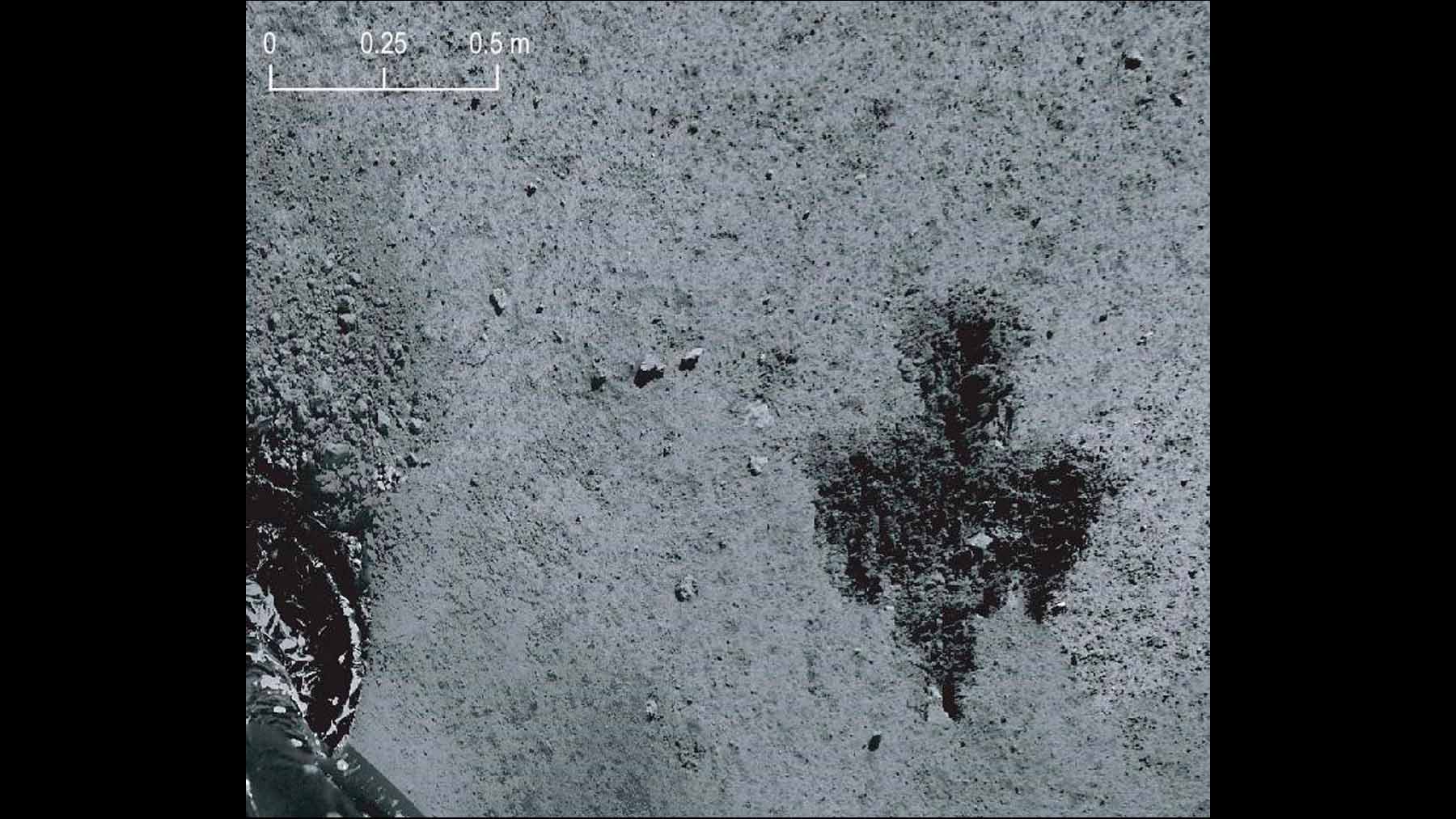
Moon glass from Chang’e-6 holds a rare iron mineral that recorded the Moon’s ancient magnetic field
The Moon has been magnetically silent for billions of years. Yet the soil it sheds tells a different story — one written in minerals that quietly froze a record of the ancient field before it disappeared.
Soil returned by China’s Chang’e-6 mission has handed researchers an unexpected key to that record. Hidden inside tiny beads of impact glass, scientists found something never before identified in natural lunar material — a form of iron so rare and so fragile that, by all conventional expectations, it simply shouldn’t be there.
A Moon that forgot its own magnetic field
The Moon today is magnetically inert. No global field wraps around it, no compass needle would respond to it. But that wasn’t always the case. Ancient lunar rocks and soils carry faint magnetic signatures — fingerprints of a dynamo that once churned inside the Moon and then, at some point billions of years ago, simply stopped.
Scientists study the minerals that preserved those signatures to piece together a timeline of how the Moon’s magnetic environment evolved. It’s painstaking work, depending entirely on what minerals happen to survive inside lunar material.
Chang’e-6 changed the scope of that search. The mission returned soil from the lunar far side — territory never sampled before — and gave researchers materials with no prior scientific history. What those samples contained surprised even the people looking.
A rare iron phase hiding inside impact glass
The research team, led by Prof. Haifeng Du of the High Magnetic Field Laboratory at the Hefei Institutes of Physical Science, Chinese Academy of Sciences, used focused ion beam preparation, transmission electron microscopy, and chemical analysis to examine the Chang’e-6 soil in detail. The techniques revealed hundreds of nanoscale iron particles embedded inside glassy material — the kind of glass that forms when meteorite impacts melt and rapidly solidify lunar rock.
Most of those particles were unremarkable. A subset was not.
Those outliers turned out to be face-centered cubic γ-Fe, a form of metallic iron never before identified in natural lunar samples. More striking, γ-Fe wasn’t a minor trace presence — it was the dominant iron phase in both impact-glass samples the team examined. That made the discovery impossible to dismiss as contamination or coincidence.

Why γ-Fe should not exist on the Moon’s surface
Here’s the problem: γ-Fe isn’t supposed to be there. Under ordinary conditions, this iron phase is only stable at very high temperatures, and as material cools, it converts into a different structural form called α-Fe. At the low temperatures of the lunar surface, γ-Fe simply shouldn’t persist.
Yet it does. The researchers proposed that the extreme conditions of a meteorite impact may create a narrow window in which γ-Fe can be locked in place before it transforms. Rapid cooling of molten rock, trace amounts of carbon and other elements, and the protective enclosure of the surrounding glassy matrix may work together to freeze the structure before it rearranges into the more stable form.
The Moon’s impact environment, in effect, acts as an accidental laboratory — one capable of preserving an iron phase that ordinary geological processes would erase almost immediately. The glassy tomb isn’t incidental. It may be the entire reason γ-Fe survived at all.
Nanoscale magnets that remember the past
Identifying a rare mineral is one thing. Showing it can actually record magnetic information is another. The team addressed this directly, using off-axis electron holography to probe the magnetic behavior of individual γ-Fe nanoparticles.
The results were unambiguous. Larger γ-Fe particles adopted a stable single-vortex magnetic state — a configuration that allows a particle to hold a consistent internal magnetic orientation over time rather than randomizing it. The particles also responded predictably when exposed to an external magnetic field. That combination of stable internal state and predictable external response is exactly what you want in a magnetic recorder.
“This tiny magnetic fossil may help us better understand the Moon’s ancient magnetic history,” said Dr. Long Li, a member of the research team. The particles, in other words, aren’t just curiosities. They may be microscopic archives.
What this means for reading lunar magnetic history
The discovery expands the known catalog of magnetic minerals in lunar material, and that expansion has practical consequences. Because γ-Fe and α-Fe form under different conditions and behave differently at the nanoscale, each mineral could potentially capture magnetic data from distinct stages of the same impact event — giving researchers two complementary recorders rather than one.
That opens a new analytical tool for paleomagnetic studies of the Moon, one that didn’t exist before Chang’e-6 brought its samples home.
The harder questions remain open. Future work will need to determine how precisely γ-Fe particles can be used to date and measure the Moon’s ancient magnetic field, and whether samples from other lunar regions contain the same mineral. Scientists still want to understand what drove the Moon’s dynamo to shut down entirely. These nanoscale iron grains, frozen inside glass for billions of years, may eventually help answer that.
More information is available here: Chinese Academy of Sciences Headquarters. “Chang’e-6 lunar soil contains a surprising magnetic time capsule.” ScienceDaily. ScienceDaily, 3 October 2026. <www.sciencedaily.com
Read the whole thing?
Get the week's signal, not the noise
Our sharpest reporting on energy, climate and nature — free, once a week.


