
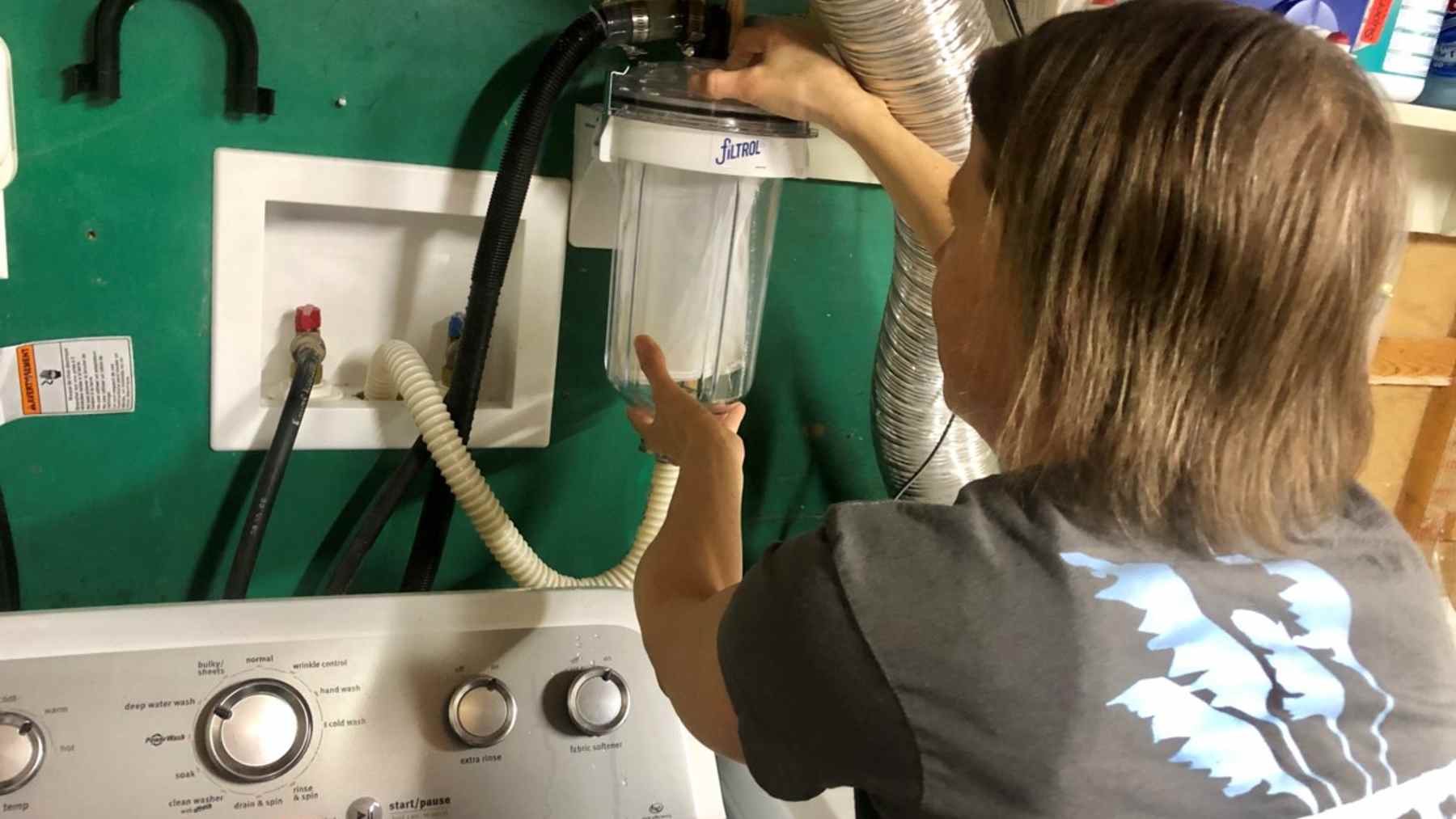
A laundry room in a small Ontario town does not look like a place where science happens.
But in Parry Sound, on the shore of Georgian Bay, washing machines in homes across town had a plain plastic cylinder clamped to the hose behind them.
Each one caught a damp gray mat of lint every few loads.
The households emptied them by hand.
Then the town’s wastewater plant measured what was leaving for the bay.
The drop was far bigger than the arithmetic allowed.
Why one home in ten moved a whole plant’s numbers
The hardware is unremarkable, an aftermarket cartridge clamped onto a washing machine’s discharge hose so that water passes through a fine mesh before it reaches the drain. The arithmetic going in was simple. If the filters caught most of the fibers from the laundry they were attached to, and those homes were about a tenth of the hookups, the plant’s output should fall by something close to a tenth.
What the plant actually showed was several times that. Fibers were still arriving from every other house in town, yet the overall treated effluent leaving for Georgian Bay dropped by a margin the household math did not predict. Something beyond simple capture was at work.
A cylinder on the hose did the actual catching
Each filter sat where almost nobody would look, low behind the washing machine or wedged beside a laundry sink, a housing with a removable cartridge inside. Water pushed through the mesh on its way to the drain, and anything larger than the weave stayed behind as a damp gray mat.
Mostly that meant broken bits of cotton, polyester and acrylic shed from ordinary clothes. Participants pulled the cartridges out themselves, and the lint was collected and weighed to produce an estimated microfiber count.
Capture varied by household. Larger households produced larger collections, and fleece or activewear loads shed heavily under agitation.
Forty one percent, four times what the model predicted
The pilot ran for two years in a town where roughly 1,050 households are connected to the municipal treatment plant. A total of 97 households took part, representing about 10 percent of those on the system. Researchers from a university laboratory worked with a Georgian Bay conservation charity on what was the first application of washing machine filters at a community scale, and the town was chosen because the whole of it drains into one municipal treatment plant.
Lab results had put the filters’ capture rate near 90 percent, so the team expected something close to a 9.9 percent reduction. Testing the plant’s water before and after installation instead showed a 41 percent drop in both microplastic and cotton fibers, work published in a marine science journal.
The volumes themselves are small and stubborn. Each filter captured about a quarter of an ounce of lint a week, diverting an estimated 179,000 to 2,707,200 microfibers per week. Parry Sound’s filters together held about 50 pounds of lint, and the team estimated 934 million to 14.1 billion microfibers were kept out of the plant each year by those households.
Where those fibers go once the plant is done
The jump beyond the modeled percent reduction is not fully explained. The project’s own report points to behavioral awareness campaigns running alongside the filters, with residents washing clothes less often, using cold water and buying fewer new items. That is a proposed explanation rather than a measured one, and a town sized design cannot separate it from the hardware.
Municipal treatment plants are not built to remove microplastics, so lint from a town’s wash otherwise ends up in the bay, reaching the environment through treated wastewater and, indirectly, through biosolids spread on land. That is the pathway a cylinder on the hose interrupts before anything reaches the sewer, a quieter version of the same pollution problem turning up at a Texas canal, where one site outweighed every other stray plastic count combined.
One home in ten is already changing the case for filters
The project’s coordinator, Brooke Harrison, called it “the first time a lab proven filter solution has demonstrated positive results in a real life application.” The program then expanded along the shoreline to 304 more households in a neighboring town, bringing the combined haul to about 177 pounds of lint and an estimated 2.25 to 34 billion fibers diverted.
None of this means every washing machine in the country needs a retrofit tomorrow. The model used in the study runs around $160, and almost one household in five lacked the space to mount or access the filter. Someone also has to remember to empty it.
Even so, the direction of the result is hard to dismiss. A plant serving roughly a thousand homes showed a measurable, repeatable drop after about a tenth of its machines changed, the kind of plain number that legislators weighing filter requirements can actually use. Long running monitoring elsewhere works the same way, including the counts of returning steelhead tracked far upstream in Oregon.
The lint in those jars, gray and unremarkable, is the evidence that a small object clamped behind a washing machine changed what reached the water.
Read the whole thing?
Get the week's signal, not the noise
Our sharpest reporting on energy, climate and nature — free, once a week.


