A sweeping barred spiral galaxy commands the frame in a new Hubble image — but the real scientific prize sits quietly in the corner. There, a distant galaxy has been stretched into glowing arcs by the gravity of another galaxy sitting between it and us, acting as a natural magnifying glass built from warped spacetime.
This isn’t a one-off curiosity. NASA’s Hubble Space Telescope has been deliberately collecting images like this one across the universe. The reason points toward a telescope not yet fully operational — and a much larger scientific effort quietly taking shape.
A cosmic lens hiding in plain sight
The gravitational lens in that Hubble image isn’t just visually striking — it’s a precisely documented cosmic event. The foreground object is an elliptical galaxy roughly 4.5 billion light-years away. Behind it, nearly twice as distant at around 8 billion light-years, sits a background galaxy whose light has been bent into something almost unrecognizable.
That bending produces what astronomers call an arc-counterarc pair. One arc appears large and bright to the upper left of the foreground galaxy; the other is a smaller, flipped version of the same source, visible to the lower right. Both images come from a single background galaxy — just routed around the foreground galaxy’s gravity along different paths.
The light from the foreground galaxy began its journey when our solar system was still forming. The background galaxy’s light is even older. What looks like a quiet corner of a Hubble frame is actually a window into the deep past.
How gravitational lensing works — and why it matters
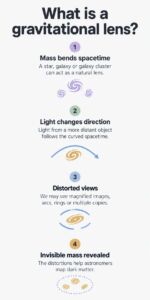
Mass warps spacetime. That’s the core principle. When a massive object — like a galaxy — sits between us and something farther away, its gravity bends the path of light traveling around it, producing a natural magnifying glass built not from glass but from curved space itself.
These events require precise alignment. The foreground galaxy, the background galaxy, and the observer all need to line up closely enough for the bending effect to register. That geometry doesn’t happen just anywhere, which makes each confirmed lens a somewhat rare find.
The strength of the effect depends on mass. A more massive foreground galaxy produces a stronger lens, bending light more dramatically and creating greater distortion in whatever lies behind it — and that relationship between mass and distortion turns out to be scientifically useful well beyond the image itself.
Reading dark matter through distorted light
When researchers study how much a background galaxy has been distorted, they can work backward to calculate the total mass of the foreground galaxy responsible. It’s a form of cosmic weighing — indirect, but mathematically grounded.
The visible matter in the foreground galaxy — stars, gas, dust — isn’t enough to explain the degree of distortion observed. Something else is contributing mass. That something is dark matter: the invisible substance that accounts for the majority of mass in the universe but can’t be seen directly, only inferred from its effects.
Gravitational lensing is one of the few tools that can actually “weigh” dark matter. No direct detection required. It only needs a measurement of what gravity does to passing light — and that’s exactly what these images provide.
Hubble and Roman: a two-telescope strategy
Hubble and the Nancy Grace Roman Space Telescope are built for fundamentally different tasks. Hubble delivers sharp, high-resolution views of individual objects. Roman offers a vastly wider field of view, designed for panoramic surveys of large sky areas rather than close-up portraits.
That difference shapes how the work gets divided. Hubble examines gravitational lenses one at a time, capturing the fine detail needed to understand each individually. Roman will sweep broad stretches of sky, detecting far greater numbers of lenses than Hubble ever could alone. Right now, astronomers are using Hubble’s sharp images to train a computer model — one designed to help interpret the large-scale data Roman will eventually produce.
Building the map before Roman arrives
The image described here is just one of many gravitational lens observations Hubble is systematically collecting ahead of Roman’s science operations. Each new lens adds another data point, another calibration opportunity, another piece of the analytical toolkit.
Hubble’s role won’t end when Roman begins its surveys. The plan calls for Hubble to follow up on the most compelling lenses Roman flags — zooming in where Roman’s wide view can’t resolve fine detail on its own. It’s a genuinely collaborative arrangement between two instruments that were never designed to be redundant.
The broader ambition is significant. Together, the two telescopes aim to build a comprehensive map of dark matter distribution across the cosmos. Roman hasn’t yet reached full operation, but the work of preparing for it is already well underway — one carefully chosen gravitational lens at a time.
Read the whole thing?
Get the week's signal, not the noise
Our sharpest reporting on energy, climate and nature — free, once a week.