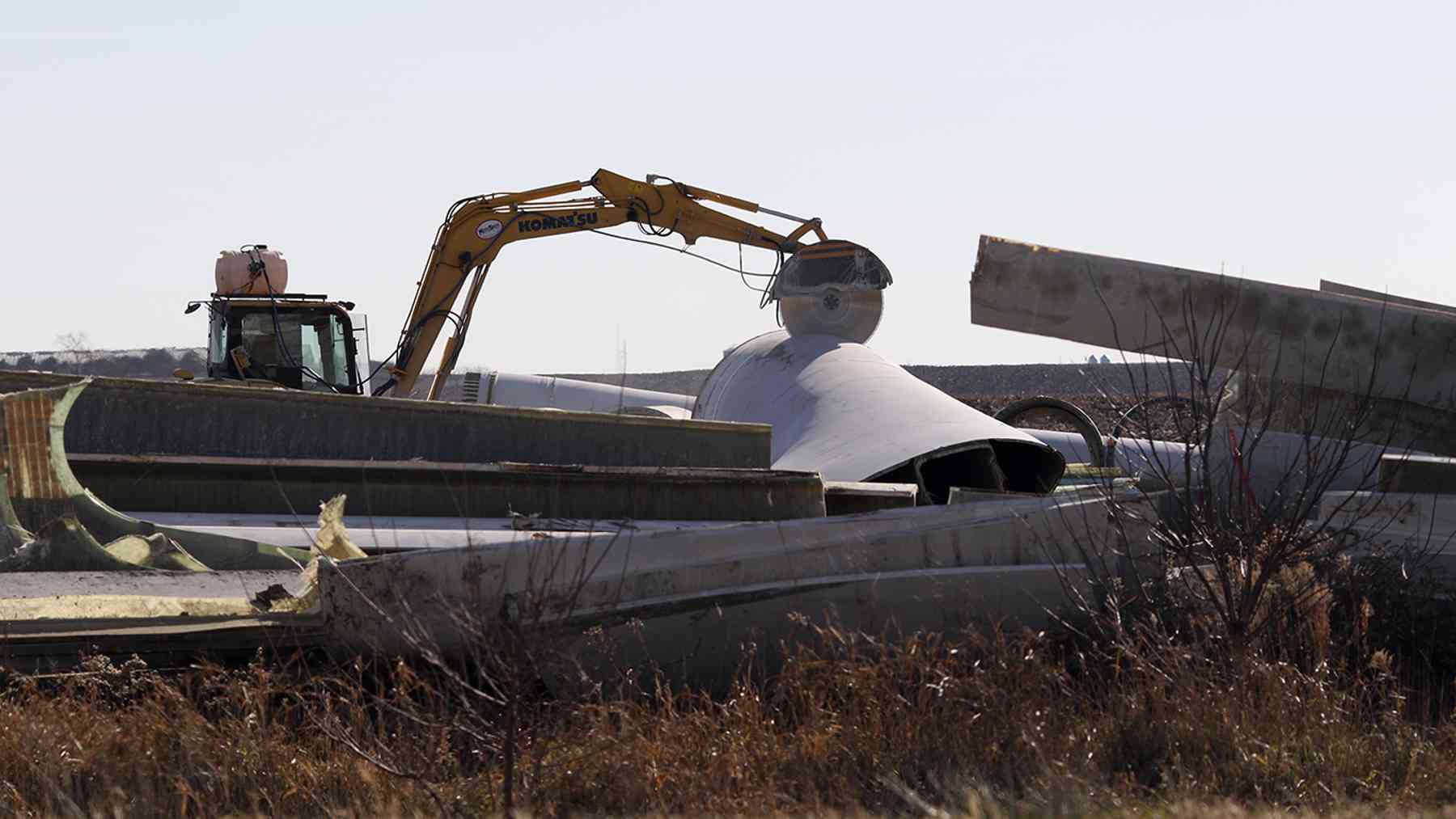
Sections of white shell lying in a harvested field, stacked and settling into the dirt.
Rain had run down them in long stains and corn stubble had packed into the open ends.
By the end of 2021 a saw on a boom was working through the pile, and a dust plume blew sideways out of every cut.
They had been lying there since the year before. Nobody had taken them anywhere.
Not because they were dangerous, and not because they were hard to move.
Which is the part worth sitting with. What makes a pile like that simply stay?
Why no scrapyard bids on 1 blade
Every other part of a wind turbine has somebody waiting for it.
Steel towers, copper windings, cast iron and gearbox parts all have a daily price, because a furnace does not care what they used to be. A dealer works out what a field of them is worth before the first cut.
A blade has none of that. The resin holding the glass fiber is thermoset, which means it was cross linked when it cured and heat will not soften it back. It chars instead.
So nothing bids on it. The material leaves as an invoice rather than a payment, and an invoice depends on a contract with somebody willing to take it.
Now add the quiet part. A stack of cured composite is inert. It does not leach, does not catch, does not smell and is not hazardous waste, so nothing forces it off private ground.
Remove the contract and the pile does not become a crisis. It just stops being urgent.
400 blades and a saw on an excavator
The field sits outside Ellsworth, in central Iowa, flat ground surrounded by row crops.
About 400 blades were stacked on it, taken down when the machines carrying them were repowered with larger ones, and the utility that owned them had seen its original disposal arrangement fall apart.
Moving them again meant cutting first. A Texas contractor brought in a saw mounted on a modified excavator and reduced the blades to lengths that fit an ordinary truck.
From there the pieces went to Knoxville, Tennessee, roughly 800 miles southeast by road.
By late in 2021 the job was about three quarters finished and expected to wrap up early the following year.
One pile, emptied one truckload at a time.
99.9 percent, and 2 numbers that disagree
What waited in Tennessee is a process called pyrolysis, and the federal energy department has published the figures.
Intense heat in the absence of oxygen breaks down the organic part of the composite and separates it from the inorganic glass, which comes out mechanically intact rather than melted. The organics leave as oil and gas.
The department credits the company with 99.9 percent purity, and that figure describes the recovered fiber, not the blade. Blades are typically about half fiber composite by weight.
Funding was roughly 2.4 million dollars since 2019 through the wind office and the small business program, with the state university in Knoxville.
The tonnage is where it gets untidy. One department page says a few thousand tons have been upcycled so far. Another says more than 100 tons.
Neither gives a time period.
A plant due in 2023 and 20 blades a day
The full scale facility was planned for Kingston, outside Knoxville, on ground that supported Manhattan Project work.
One department page said it was expected to open in 2023 and to handle 20 blades a day by 2025, at about 5,000 blades a year weighing roughly 10 tons apiece, in the way that a recovery plant or a cleared hillside reads later as a solved problem.
The same department article elsewhere puts the planned throughput at around 220 tons a year for 5,000 to 7,000 blades, and the federal page carries both.
Those two cannot both hold. Five thousand blades at 10 tons is 50,000 tons, while 220 tons across 5,000 blades is about 80 pounds a blade.
And the public record thins out after 2022, while the local coverage of the Iowa clearance stops at the trucks.
No later confirmation of an opening turned up.
What the field says and the plant does not
Clearing one stockpile is a real thing and it is not the same as a system working.
Federal projections put cumulative American blade waste past 2 million tons by midcentury, which is thousands of fields like this one arriving over twenty five years.
The reason most blades are still buried has not changed either. Burial is cheaper, and nothing in the chemistry fixes that.
What would fix it is the thing the Iowa field was waiting for the whole time.
Somebody on the other end who wants turbine blades enough to pay for them.
Until then they keep waiting.
Read the whole thing?
Get the week's signal, not the noise
Our sharpest reporting on energy, climate and nature — free, once a week.