Most close encounters between stars and nearby worlds follow a predictable path.
They either remain in stable orbits or move close enough for one object to consume the other.
For some time now, a system appears to have emerged that falls somewhere between those two possibilities.
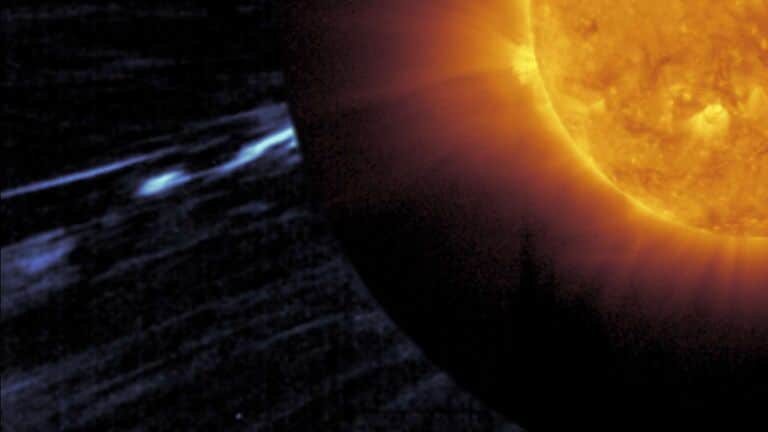
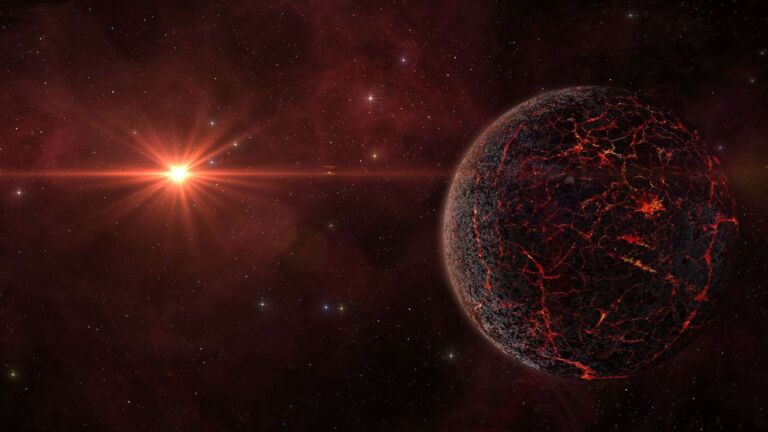
A red dwarf is located about 300 light-years from Earth and is pulling mass off a brown dwarf companion.
The unusual part is not that material is changing hands, but that the process may continue for far longer than expected.
This is not how these encounters are supposed to end
Brown dwarfs occupy an unusual middle ground between planets and stars. That creates different expectations for how they should behave around a larger stellar companion.
When small, mass-rich objects drift too close to a star, the usual prediction is straightforward. The smaller object is expected to eventually be destroyed.

That assumption made this newly discovered system instantly peculiar.
A strange pattern kept refusing every explanation
The discovery began when the Zwicky Transient Facility detected an anomalous brightening pattern. Its shape resembled more of a triangle shape than the typical patterns seen during known stellar events.
A pattern that repeated itself numerous times before a reasonable explanation emerged.
At first, the signal appeared consistent with a black-widow binary system, where one object slowly consumes another. However, subsequent data analysis did not support the notion of a black-widow binary.
The anomaly persisted until additional measurements confirmed the identity of the system and revealed the truth behind the enigmatic signal.
Closer inspection revealed something even less expected
Subsequent observations clearly indicated that the source consists of a red dwarf and a brown dwarf in an extremely close binary relationship, according to astronomers from MIT.
The brown dwarf completed an orbit around the red dwarf in approximately 87 minutes.
Furthermore, if the total size of both components of the system were measured side by side, it would be roughly equal to the diameter of our sun.
The system consisted of two relatively low-mass objects in an extremely tight orbit around one another.
That raised the possibility that material could be flowing from one object to the other. If so, evidence of that transfer should be visible.
Proving the idea required following the missing material
Astronomers decided to combine observational data with simulated predictions to determine if matter was indeed flowing between the two objects, an analysis described in the Nature Astronomy study.
Simulations demonstrated that matter was flowing from the brown dwarf to the red dwarf.
But unlike what happens in black-hole systems, matter from the brown dwarf was striking the red dwarf directly.
This impact created hotspots on the surface of the red dwarf. As the two objects orbited each other, those hotspots moved in and out of view.
The unusual triangular signal finally received a physical explanation.
The measurements changed what this system meant
What remained unexpected was the speed of the process. While material loss from the brown dwarf was apparent, the exceptionally slow rate was not.
At that pace, mass transfer could persist for hundreds of thousands or even billions of years. This may represent a prolonged phase of development spanning enormous intervals of time.
Ultimately, this discovery represents a significantly different type of outcome than the rapid consumption event previously predicted for such systems.
Not every close companion appears destined for rapid destruction
Before this observational evidence, stable mass transfer from a substellar object to a main sequence star existed primarily as a theoretical possibility. Evidence from this discovery confirms that systems of this type exist.
The identification of this unique configuration indicates that close stellar companions don’t necessarily need to rapidly reach their demise.
On occasion, close stellar companions can spend long periods of time slowly transferring material while maintaining their structural integrity.
Read the whole thing?
Get the week's signal, not the noise
Our sharpest reporting on energy, climate and nature — free, once a week.