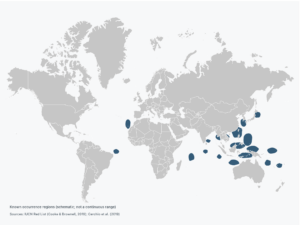
Scientists know relatively little about where Omura’s whales spend their time at sea.
Visual encounters with the species are exceptionally rare, making it difficult to study through traditional surveys.
A recent study analyzed nearly two decades of underwater audio records taken along western Australia’s northwest coast to locate and record Omura’s whales without relying solely upon sight.
Underwater recordings of whale calls revealed a pattern that helped explain the whales’ seasonal presence and the ocean conditions they appeared to prefer.
Those recordings began to reveal a larger pattern
The whales’ distribution was not consistent across each season.
Based on detection, the whales were more likely to be located between September and May when ocean temperatures were generally warmer.
In addition, detections of the whales decreased in certain sections of the study area during winter months.
This discovery suggested that the whales were tracking favorable ocean conditions rather than remaining in the same locations throughout the year.
Tracking the species was never particularly straightforward
Identifying the pattern was not simple.
Omura’s whales are one of the least understood baleen whale species in existence today and are listed as “Data Deficient” on the IUCN Red List.
Unlike many larger whale species, they do not undertake long-distance migrations.
Instead, they spend their lives in tropical and warm-temperate waters, making their movements much harder to track than those of many other whale species.
The changing conditions offered an explanation
The study demonstrated that there is a direct correlation between whale presence and environmental conditions.
Whale detection was found to be more probable when sea-surface temperature (SST) reached approximately 27.5°C.
Additionally, findings from Curtin University showed that the whales were associated with regions that exhibited enhanced levels of oceanic productivity.
Increases in whale detection typically occurred approximately one month subsequent to increases in productivity indicators.
Stronger wind conditions also correlated positively with increased whale detection.
Therefore, collectively the data suggest that both warm and productive waters represent essential components of Omura’s whales’ habitat.
Some of the most important questions remain unanswered
Although this study answers some questions related to the species, it does not provide all of the necessary information regarding the species.
The hydrophone technology utilized in this Marine Mammal Science study only detects vocalizing whales.
Consequently, silent or non-calling individuals within the acoustic monitoring array remain undetected.
Population estimates cannot be derived directly from analyzing whale calls alone.
Other aspects of the species’ behavior, such as how different social units utilize specific areas of habitat, also remain unresolved.
As a result, the study provides a significant initial framework for further investigation, as opposed to providing a comprehensive perspective regarding the species.
That uncertainty does not limit its value
That framework is critical since scientists continue to develop knowledge of the fundamental ecological requirements for the species.
It also enables researchers to evaluate vital habitats. These ocean zones provide the essential resources and environmental conditions necessary for critical biological functions like feeding.
Ultimately, a clearer understanding of the species’ habitat could help guide future conservation decisions.
When considering the impacts of human activity, specific habitats can be evaluated alongside targeted management strategies.
What has been found may be only the beginning
Future investigations can build upon this foundation by examining how whales respond to changing ocean conditions over time.
Potential additional studies may include determining if similar trends exist in other portions of the species’ range.
Additional habitats supporting the species throughout the year may also be identified.
Future acoustic monitoring could reveal whether whales alter their distribution in response to changing ocean conditions.
Monitoring these changes against shifting climate baselines may reveal how marine ecosystems adapt to a warmer Indian Ocean.
Read the whole thing?
Get the week's signal, not the noise
Our sharpest reporting on energy, climate and nature — free, once a week.