Betelgeuse is one of the brightest shining stars in the universe.
For around 100 years, astronomers have wondered if it has a hidden partner.
Could there be another star even brighter by its side?
A telescope in Chile has just captured the clearest image yet of a potential partner star. It could even be two to three times larger than our Sun!
So why did it take so long to find?
Betelgeuse’s unexplained brightness changes, now explained?
Betelgeuse is around the 10th brightest star in the night sky, found in the famous constellation of Orion.
It is a red supergiant star, found in the hunter’s shoulder, that can be seen with the naked eye.
Humans on Earth have been watching Betelgeuse for thousands of years.
It is, in fact, the most studied red giant out of all of them, possibly due to the fact that its brightness is constantly changing.
It rises and falls in a cycle that lasts about 6 years.
Astronomers have pondered what could be the cause, and no one has yet been able to explain it.
Is there another star involved?
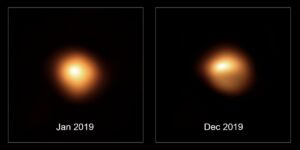
Does Betelgeuse have a hidden partner?
A few years ago, researchers started reinterpreting Betelgeuse’s six-year cycle to see if a companion star could explain it.
The researchers also predicted when this potential partner would be the easiest to spot in the sky.
They found that in December of 2024, it should sit farthest from Betelgeuse, and therefore be able to be seen.
The team of researchers, led by Miguel Montargès, used the European Southern Observatory’s Very Large Telescope to try to spot this mysterious star, named Betelgeuse B.
It was no easy feat.
With Betelgeuse and its harsh glare, trying to find the faint light of a potential companion could easily be missed.
Montargès had his doubts, wondering whether their technology would be able to detect it.
On December 6, 2024, the long-awaited observations occurred.
Discovering what’s been hidden for all these years
However, the universe likes to hide its secrets and did not reveal anything right away.
After the initial imaging, there had to be several months of processing for the researchers.
They made use of glare removal software around Betelgeuse to detect what was not just random noise.
And after months of processing, a faint spot was finally found.
Montargès says he actually jumped from his seat when he saw the images, excitement racing.
They had finally identified the spot, 52 milliarcseconds from the famous Betelgeuse, that was another star!
The fact that it exists is not the only revelation.
Based on its brightness, it is thought to be of enormous mass, some 2.6 to 3.1 times that of our Sun.
It is so massive, and so hot, that it is categorised as blue-white, which is far hotter than the orange supergiant that it is found next to.
To validate their findings, the team measured how far the possible partner star is located from Betelgeuse in this new image.
They found it to be about nine times the Earth-Sun distance.
Using this, their calculations gave an orbit of at least about 5.5 to 5.9 years which matches Betelgeuse’s dimming pattern!
So, as predicted, the brightness cycle that repeats roughly every six years could very likely be due to this companion in orbit every 5.8 to 5.9 years.
These results are not confirmed yet, and the team calls the star just a candidate in its research paper.
They will look again in about a year, when the potential partner star should be on the opposite side of Betelgeuse.
If this occurs, then little doubt will remain. A new star will have been discovered! Just like this new star, other discoveries like this mysterious lava world are changing how we see the universe.
Read the whole thing?
Get the week's signal, not the noise
Our sharpest reporting on energy, climate and nature — free, once a week.