
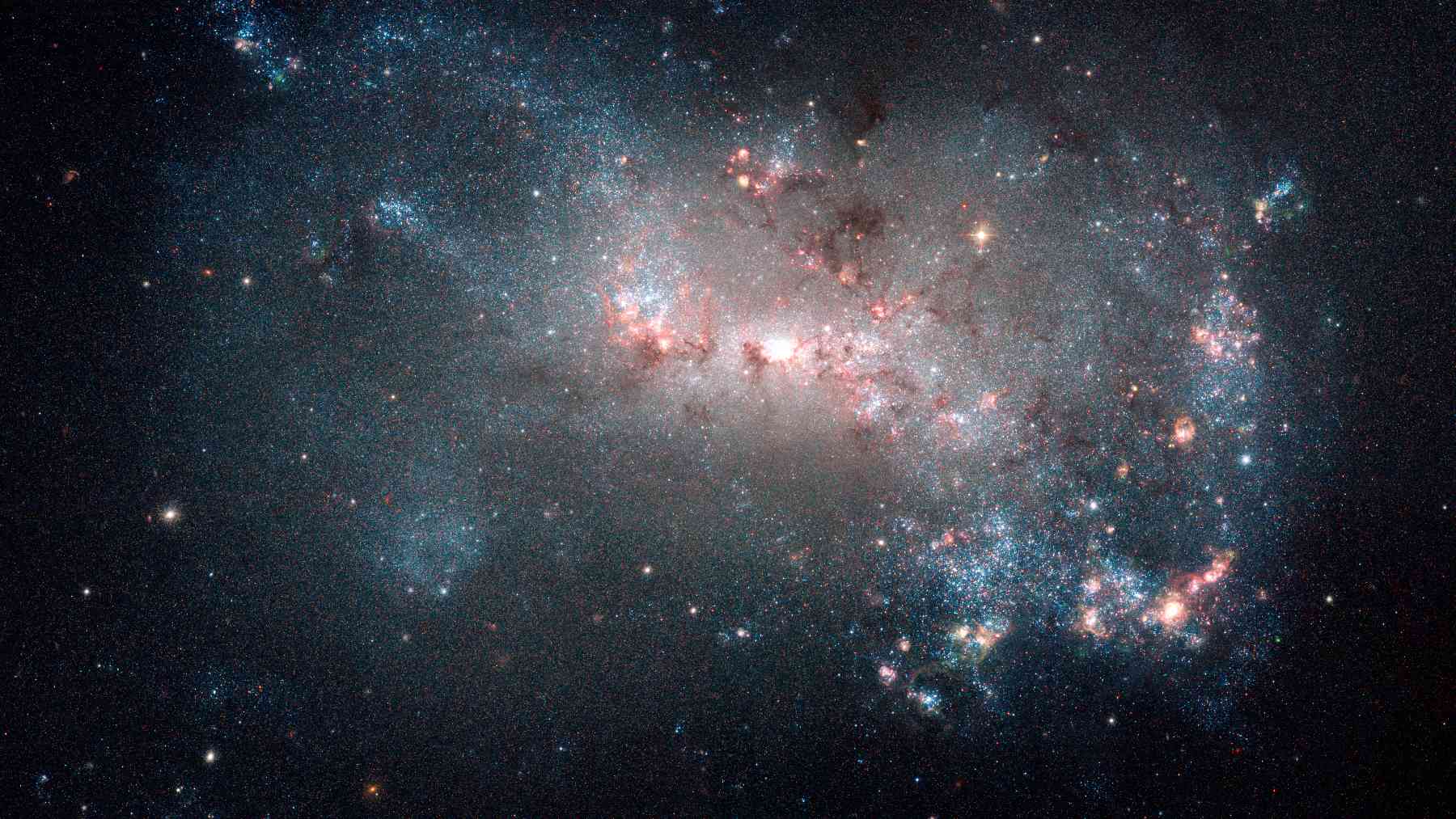
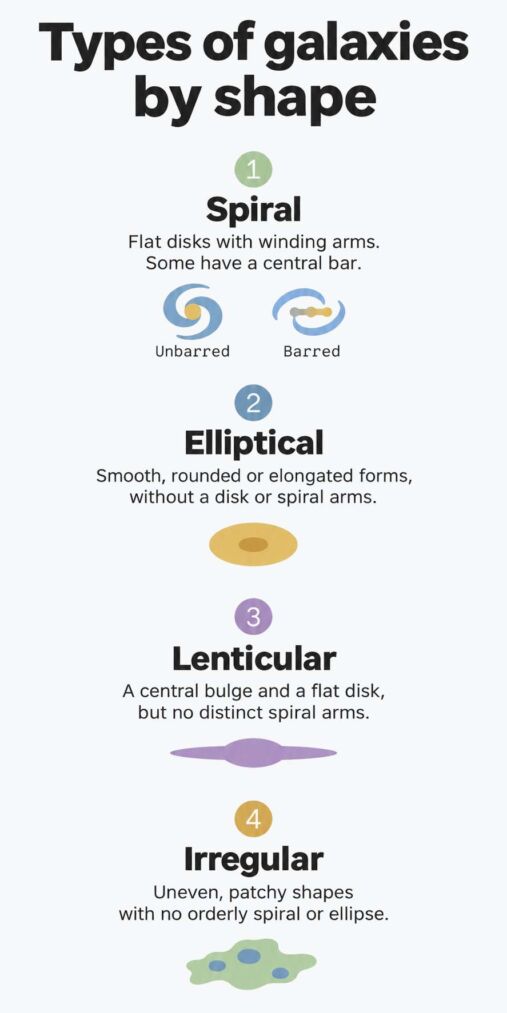
NGC 4449 looks like a smudge of light — a dwarf irregular galaxy, small and scattered, home to perhaps a few hundred million stars. Hubble has photographed it in striking detail. But a closer look reveals something harder to explain than its shape.
When researchers trained Hubble on 37 nearby dwarf galaxies, including NGC 4449, they expected to find a predictable chemical record — oxygen forged across billions of years of stellar activity. Instead, a significant portion of that oxygen simply wasn’t there. Where it went, and why, is the question these galaxies are now forcing astronomers to answer.
Small galaxies with a big chemical mystery
Dwarf galaxies may be small, but they punch above their weight scientifically. Containing anywhere from a few thousand to hundreds of millions of stars, they offer a relatively clean window into how galaxies form, evolve, and manage their chemical ingredients over time.
Oxygen is one of the most important elements to track. Stars produce it through nuclear fusion, then scatter it into surrounding gas when they die. Over billions of years, a galaxy should accumulate oxygen steadily — making it a reliable chemical fingerprint of a galaxy’s entire stellar history.
The Hubble study focused on 37 nearby dwarf galaxies, using the telescope’s instruments to measure how much oxygen each one actually holds. NGC 4449, one of the better-known dwarf irregulars in the sample, served as a vivid example of what researchers were examining across the full dataset.
What astronomers expected to find
The standard model of chemical enrichment is fairly straightforward. Stars fuse lighter elements into heavier ones — oxygen among them — through nuclear fusion. When massive stars die in supernova explosions, they release that oxygen into the interstellar gas, enriching the galaxy’s overall chemical composition.
Scientists can estimate how much oxygen a galaxy should contain by looking at its star formation history. More stars formed over more time means more oxygen produced and released. The math isn’t simple, but the framework is well-established and has held up across many galaxy types.
Dwarf galaxies are considered ideal test cases precisely because they’re simpler — fewer stars, less complex dynamics, more straightforward structure. Predictions should be more reliable here, not less. That’s what made the results so surprising.
A shortfall that spans dozens of galaxies
When researchers compared their predictions to actual measurements, the oxygen wasn’t adding up. A significant portion of what should have been present — based on each galaxy’s star formation record — was simply missing.
This wasn’t a quirk of one unusual galaxy. The shortfall appeared across all 37 dwarf galaxies in the sample, a pattern too consistent and too widespread to dismiss as a fluke or a measurement artifact.
The scale of the discrepancy matters. When a single galaxy shows unexpected chemistry, there are plenty of local explanations to reach for. When dozens show the same gap, something more fundamental is likely at work. NGC 4449’s detailed Hubble imagery gives the finding a concrete visual anchor, but the mystery belongs to the entire dataset.
Where could the oxygen have gone?
Several hypotheses are on the table, though none has been confirmed. The most discussed involves supernova-driven winds. When massive stars explode, they don’t just release oxygen — they also generate powerful outflows of gas. In large galaxies, gravity is strong enough to hold much of that material in. Dwarf galaxies, with their lower mass and weaker gravitational pull, may simply lose the fight.
Another possibility is that the oxygen is still present but hidden — locked inside dust grains, or existing in cooler gas phases that standard observational techniques struggle to detect. What looks like missing oxygen might instead be oxygen in disguise.
There’s also a third option: the oxygen has been blown outward into the intergalactic medium, the diffuse gas between galaxies, where it becomes extremely difficult to trace. The mystery, for now, remains genuinely open.
Why this matters beyond dwarf galaxies
Dwarf galaxies aren’t just interesting in isolation. Many astronomers believe they closely resemble the earliest galaxies in the universe — small, low-mass systems that formed when the cosmos was young. Understanding how they manage their chemical evolution helps reconstruct what that early universe looked like and how it changed over time.
Missing oxygen also complicates broader models of galaxy evolution. If dwarf galaxies are consistently losing or hiding significant amounts of oxygen, those models may need revision across cosmic timescales.
Hubble’s role in this survey is a reminder of the telescope’s enduring scientific value, decades into its mission. The next chapter, though, likely belongs to the James Webb Space Telescope, which could probe these galaxies in new wavelengths and with greater sensitivity — potentially revealing whether the oxygen is truly gone, or simply waiting to be found.
Read the whole thing?
Get the week's signal, not the noise
Our sharpest reporting on energy, climate and nature — free, once a week.


