A study found that most of the frog species in the Peruvian Amazon were nearly identical to one another.
Many belonged to species groups that researchers had been unable to distinguish for years.
Researchers could see much more variation among the frogs than originally expected.
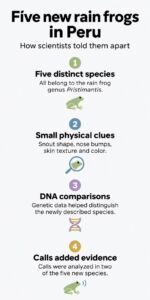
The frogs in question all belonged to a genus of mostly small, tree-dwelling frogs called Pristimantis.
Finding the differences was not as simple as it sounded
Members of this genus are characterized primarily by their coloration and shape, making it difficult to differentiate between the various species using these traits alone.
In fact, many appear nearly identical yet represent entirely separate species.
Additionally, like many of these species, many of the species found in this region of the world live in the same type of rainforest environment.
However, because physical characteristics can be extremely subtle, relying on appearance alone makes it difficult to determine which species a particular frog represents.
The first clues were hiding in the details
To overcome this obstacle, researchers used other strategies to identify the various physical differences present among the frogs.
For instance, some species had tiny variations in the shape of their nostrils. Others had ridges or protrusions around the nose or forehead.
When collecting samples from different regions of the frog’s known range, researchers found slight differences in skin texture and body size.
While the differences were subtle, together they suggested the frogs represented multiple species rather than variation within a single population.
Using physical characteristics alone was insufficient to establish the identity of the frogs.
More answers emerged once the frogs started calling
Each of the frogs also produced its own unique sounds.
Researchers utilized spectrographic analysis to compare advertisement calls made by male frogs for the purpose of attracting females.
Advertisement calls contain a wide array of characteristics, including note structure, frequency, and time intervals.
Calls also varied in tone, length, and rhythm.
To human listeners, certain calls may be indistinguishable from each other.
For biologists attempting to define the boundaries between species, however, these minute auditory distinctions can serve as strong indicators.
Therefore, the calls functioned as an independent method for separating frogs that appeared to be almost indistinguishable from one another strictly based on their physical appearance.
One question remained before the picture was complete
Finally, the investigation turned to genetic material.
Collectively, morphological characteristics, bio-acoustic information, and genetic data provided an unambiguous picture.
Results of the study were formally reported in Zootaxa.
Among the newly described species were Pristimantis aisatipoki, P. basicordellum, P. culmecordellum, P. rhodocanthus, and P. solitarius.
What else has been hiding in plain sight across the Amazon
This research exemplifies the magnitude of our lack of understanding of the remarkable diversity present in the Amazon basin region.
Furthermore, several of the frogs mentioned above reside in geographically confined habitats in the Peruvian Amazon and Andes mountain foothills.
A multitude of hidden species likely remain misclassified as familiar populations throughout the region until formal scientific study reveals their true identities.
Recognition may prove just as important as discovery
Species described above exhibit relatively narrow geographical or elevation distributional ranges.
Given their limited distributional ranges, species are generally considered to be highly susceptible to loss due to habitat destruction, environmental alteration, or local pressures exerted on the last remaining habitat.
When a small population occupies a shrinking pocket of remaining land, rapid land-use changes can drive it toward extinction very quickly.
Therefore, accurately identifying a species is essential to assess its status correctly, as well as to protect it.
Until scientists acknowledge that a species exists, there is nothing to assess or protect.
Read the whole thing?
Get the week's signal, not the noise
Our sharpest reporting on energy, climate and nature — free, once a week.