
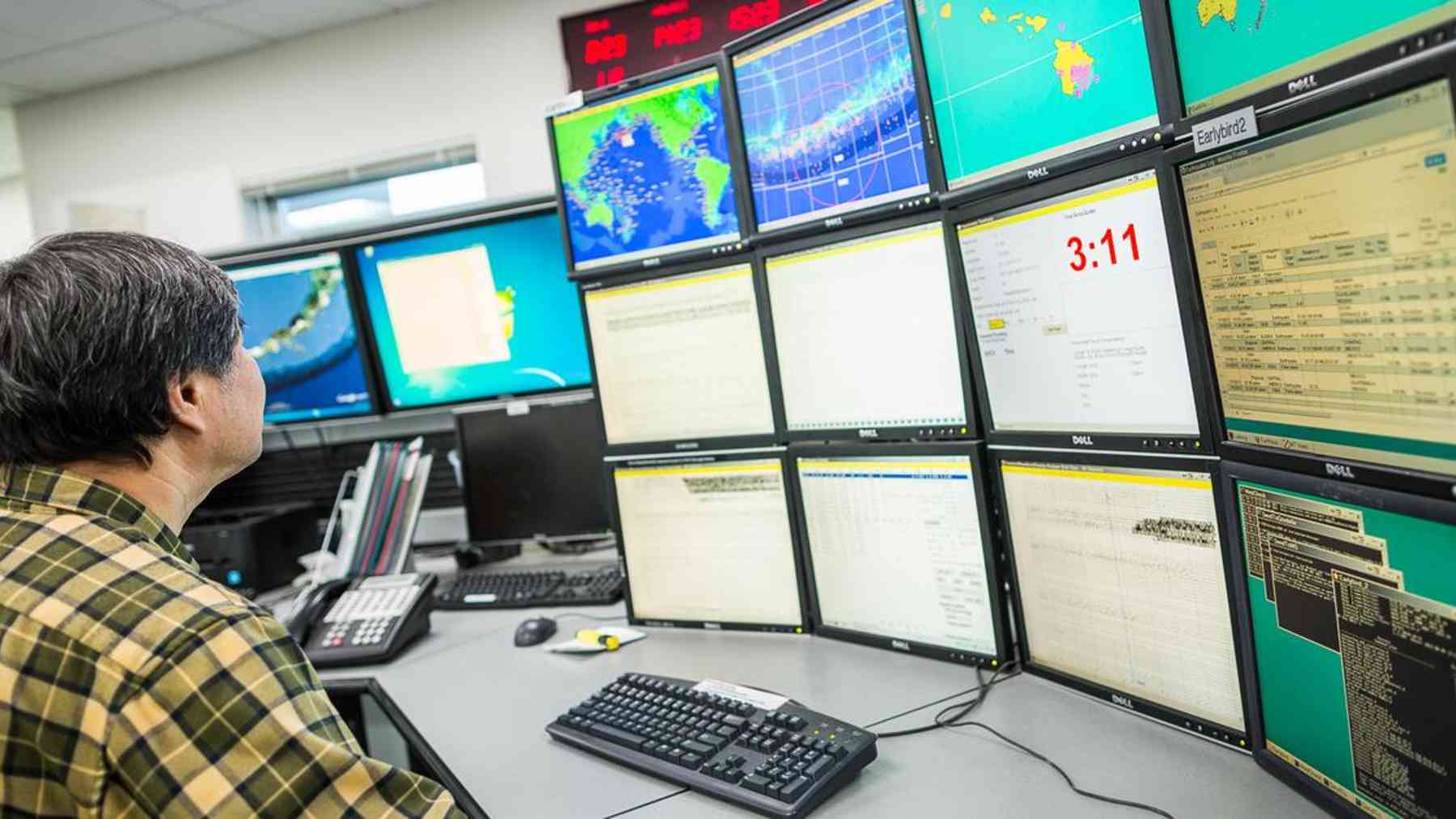
The phones at the coastal warning centers lit up before most of Panama felt the shaking stop.
A magnitude, a depth, a set of coordinates, moving out across the Pacific.
Nobody on the beach in San Diego or Astoria felt a thing.
Instruments offshore were already doing the only work that mattered.
They were asking one question.
Would any of that energy reach the US coastline at all?
The seafloor’s vertical motion decides the verdict in minutes
A tsunami check begins the instant seismometers register a strong quake near open water, and this one came fast. The rupture broke under the southern end of Panama’s Azuero Peninsula at a reviewed magnitude of 7.7, with its focus about eight miles down. Shallow, violent and close to the coast is the combination that earns an automatic look from the system covering the whole Pacific basin.
Forecasters did not wait for a visible wave, they modeled the fault. What matters is whether the rupture shoved the seabed up or down enough to displace the water above it, and a quake that slips mostly sideways, or that breaks beneath land rather than under open water, can be enormous and still leave the ocean nearly flat. This one was attributed to movement on the Azuero Sona Fault, with its epicenter in the southern part of Herrera Province, on land.
That modeling, not the magnitude alone, is what narrows the question in the first minutes. Even a large, shallow quake can turn out to be the quiet kind for coasts an ocean away.
Nine countries got a warning with waves up to 9 feet possible
The alert that went out was not a shrug. The US tsunami warning system said hazardous waves could reach parts of the coasts of Panama, Colombia, Costa Rica, Ecuador, Peru, Nicaragua, Guatemala, El Salvador and Mexico within three hours of the quake, and forecasters put possible waves in Panama at 3 to 9 feet.
Then distance takes over. Southern Panama sits nearly 3,000 miles from Southern California by open ocean, and tsunami energy spreads and thins across a basin that size the way ripples flatten across a pond. A wave that threatens a nearby beach can arrive at a far coast as a change in sea level too small to notice.
Hawaii sat in the uncertain column at first, with an early message warning that a threat existed for parts of the Pacific closer to the quake and that it was too early to judge the risk to the islands. Less than an hour later that reversed: the Pacific Tsunami Warning Center said a destructive Pacific wide tsunami was not expected and there was no tsunami threat to Hawaii, and the bulletins for the mainland said the same. The National Tsunami Warning Center stated there was “no tsunami danger for the West Coast.”
Seafloor sensors measured a wave just inches tall
The hardest evidence comes from seafloor pressure sensors tethered to surface buoys across the Pacific, built to feel a tsunami passing overhead in open water long before it nears any shore. Out there a destructive wave might be only inches tall, stretched over a wavelength of many miles, nothing a passing ship would register.
That is why the measurements are reported in fractions of a foot. After a magnitude 7.3 quake south of the northern Aleutian Islands, the only tsunami observed was two inches, recorded at Sand Point, Alaska, a real tsunami by definition, and nowhere near damaging.
The Panama sequence moved at that same clipped pace. The warning center ended the tsunami threat later the same day, and the US Geological Survey revised the magnitude several times, from an initial 8.0 down through 7.6 before settling at 7.7. A magnitude 5.8 aftershock followed near El Cacao, about 27 miles from the epicenter.
Three dead and 300 homes rebuilt after the real damage
The ocean was never the threat here, and that is not the same as saying nothing happened. A month after the quake, three people were dead and nearly 30 injured, with some 2,700 people still living in about a hundred shelters while the government built 300 replacement homes, after a state emergency and a $100 million allocation. Civil protection authorities counted 13,985 homes damaged and 3,390 destroyed.
Water can do the violent work when the geometry lines up. Researchers have described a record breaking wave in a fjord near Juneau that ran about 1,580 feet up a mountainside, the second highest tsunami ever recorded. Panama’s fault never had that geometry working for it.
Weeks later a very different hazard hit the Tennessee line, where the Ocoee River crested at a record 18.05 feet at Copperhill, passing the previous mark of 17.8 feet set thirty six years earlier. Depth, distance and fault orientation all have to align for a quake to become a basin crossing threat, and usually at least one ingredient is missing.
A fast review built to look like an overreaction
What the Panama quake tested on this side of the ocean was the review itself, the reflex that treats every qualifying earthquake as a potential threat until the data says otherwise. That reflex produces a lot of calm all clears, and that is the design rather than a failure of it.
Each one still takes real work, including fault modeling and buoy monitoring, plus coordination between centers thousands of miles apart, compressed into minutes. The system is imperfect, and distant quakes can still surprise forecasters.
But on the US coast the sequence ran as intended, even as Panama was digging out from the shaking itself.
Read the whole thing?
Get the week's signal, not the noise
Our sharpest reporting on energy, climate and nature — free, once a week.


