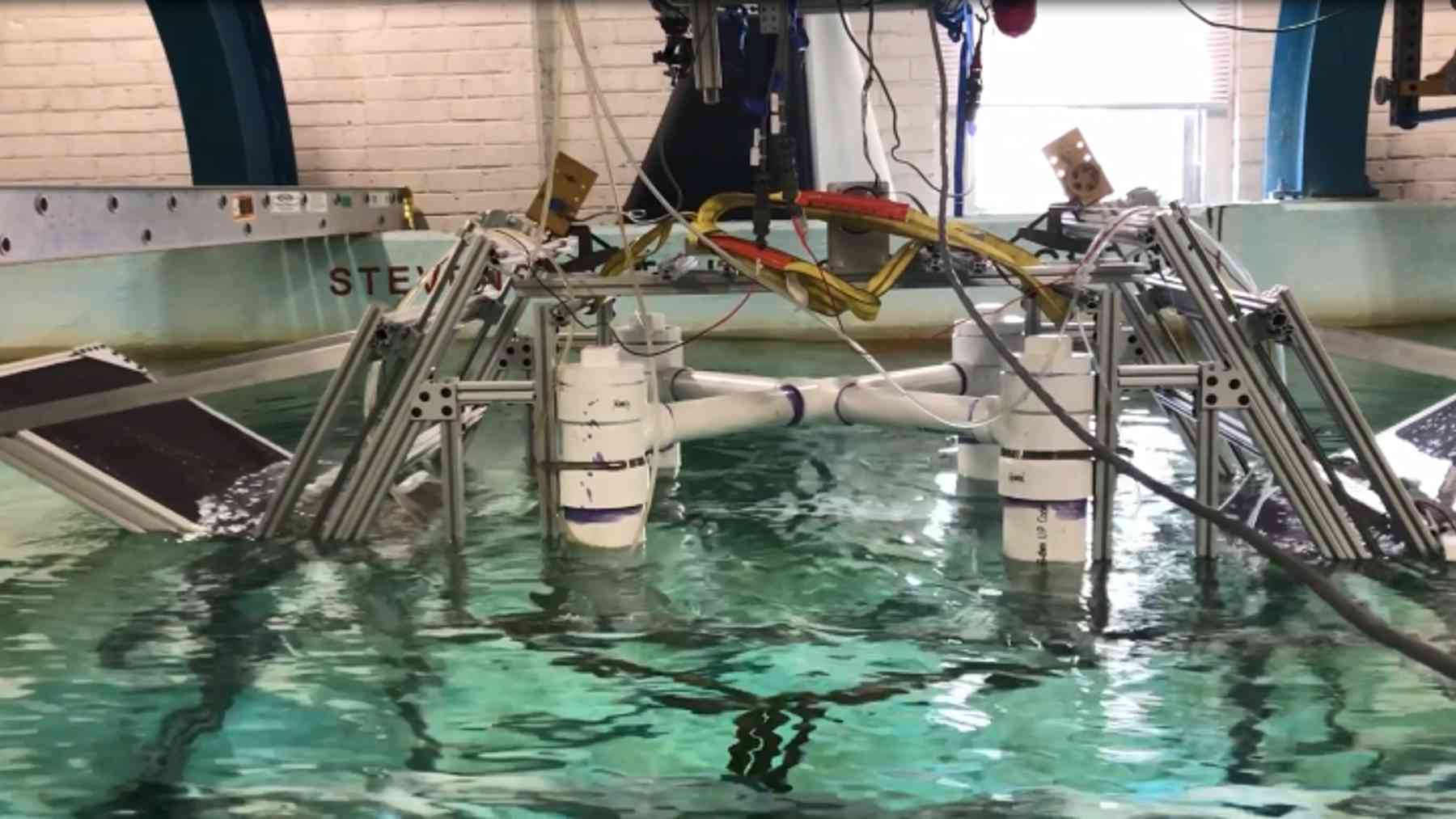
The model is small enough to lift with two hands, a plain hull with no engine and no propeller.
It floats in a wave tank in Hoboken, New Jersey, where a wavemaker at one end sends ripples down the water.
Two cones hang upside down beneath it on cables, one on each side.
Engineers tilt the hull, release it, and watch it rock itself still.
Nothing about the setup looks like it could light a bulb.
So what makes that small hull refuse to rock in a hurry?
Trapped seawater makes the barge behave as if it were heavier
Wave energy converters tend to oscillate faster than the sea that drives them. Their natural frequencies sit well above the dominant frequencies of real ocean waves, which is exactly why the long slow swells that roll in over many seconds slide under a quick moving device without shaking it hard enough to produce much.
The fix here is two inverted cones slung beneath the hull on cables. As the barge rolls, the cones entrap seawater on the upward stroke, increasing the system’s effective added mass and lowering its natural frequency until it sits near the frequency of the swell above it. That is resonance tuning done with shape and water rather than with sensors and actuators.
No motors are involved. The cones also drag against the surrounding water as they swing, adding hydrodynamic damping, so the platform behaves as though it were both heavier and slower to be thrown around by a passing wave.
A doubled roll period that did not cost the platform its stability
The striking part of the result is not only that the roll period roughly doubled, but that nothing obvious was given up to get there. The tuned hull stayed stable across every static test, which matters for a structure meant to sit offshore for years rather than for an afternoon in a tank.
That slower rhythm also points the concept somewhere specific. The team behind the work argues it suits tropical waters, where wave heights are relatively small and wave periods are long, the conditions that leave most record breaking wave machines built for rougher seas barely moving at all.
A slower hull, it turns out, can be a more useful one.
Tank runs near 52 percent capture pushed the concept forward
The concept was built as a 1 to 40 scale model and tested in the wave tank at the Davidson Laboratory at Stevens Institute of Technology, following standard ITTC and MARINET tank protocols. One base case without cones was compared against four cone configurations that varied in size and in how far the cables suspended them from the hull.
Free decay tests, in which the hull is tilted to one side and let go, produced the headline figure: the cones more than doubled the natural roll period, so the hull now rocks at roughly half its former speed. In the cleanest regular waves, the device reached a capture ratio near 52 percent, as reported in the published experimental study.
Irregular waves, meant to stand in for a messier sea, pulled that down to roughly 21.5 percent, with the tuned device holding above 20 percent under random excitation. A companion conference paper from the same group records one configuration harvesting about 345 milliwatts from a wave half an inch high with a period of 1.25 seconds, at 55 percent efficiency.
A 1,200 ton version is projected at 178 kilowatts
Small tank numbers only matter if they scale, and that is where the concept makes its case. The full scale design behind the model is a 1,200 ton barge tuned to a natural roll period of about 13 seconds, projected to produce 178 kilowatts of mechanical power in beam waves of roughly 5 feet in the Pacific. That figure is a calculation, not a measurement.
What makes it interesting is the parts list. A flat bottomed barge and a pair of suspended cones call for nothing exotic, just steel, cable and seawater doing the tuning work that control electronics would otherwise have to do, on hulls that ordinary yards already know how to build.
That simplicity is also the pitch. Hulls like these could sit alongside the kind of hidden infrastructure that already crowds American waterways, including the reservoirs behind the nation’s dams that quietly hold back billions of pounds of fish.
The next phase still needs a generator bolted to the hull
For all the promise in the roll numbers, the tank work measured motion and mechanical power, not electricity delivered to a cable. The researchers list developing a real power takeoff system as a next step, alongside refining the cone geometry and adding nonlinear effects to the model.
Even short of that, the tank result stands on its own. A barge nobody would look at twice, with two plain cones dangling beneath it, slowed itself down enough to keep time with the ocean instead of fighting it.
It is the same patient, simple instinct that has pushed river ice barriers toward lighter designs, and that echoes other engineering wins like the reinforced Mount Rainier panels that kept working through heavy snow. As one engineer involved in offshore wave testing put it, matching a device to the rhythm of the sea around it, rather than fighting that rhythm, is usually the cheaper problem to solve.
Read the whole thing?
Get the week's signal, not the noise
Our sharpest reporting on energy, climate and nature — free, once a week.