
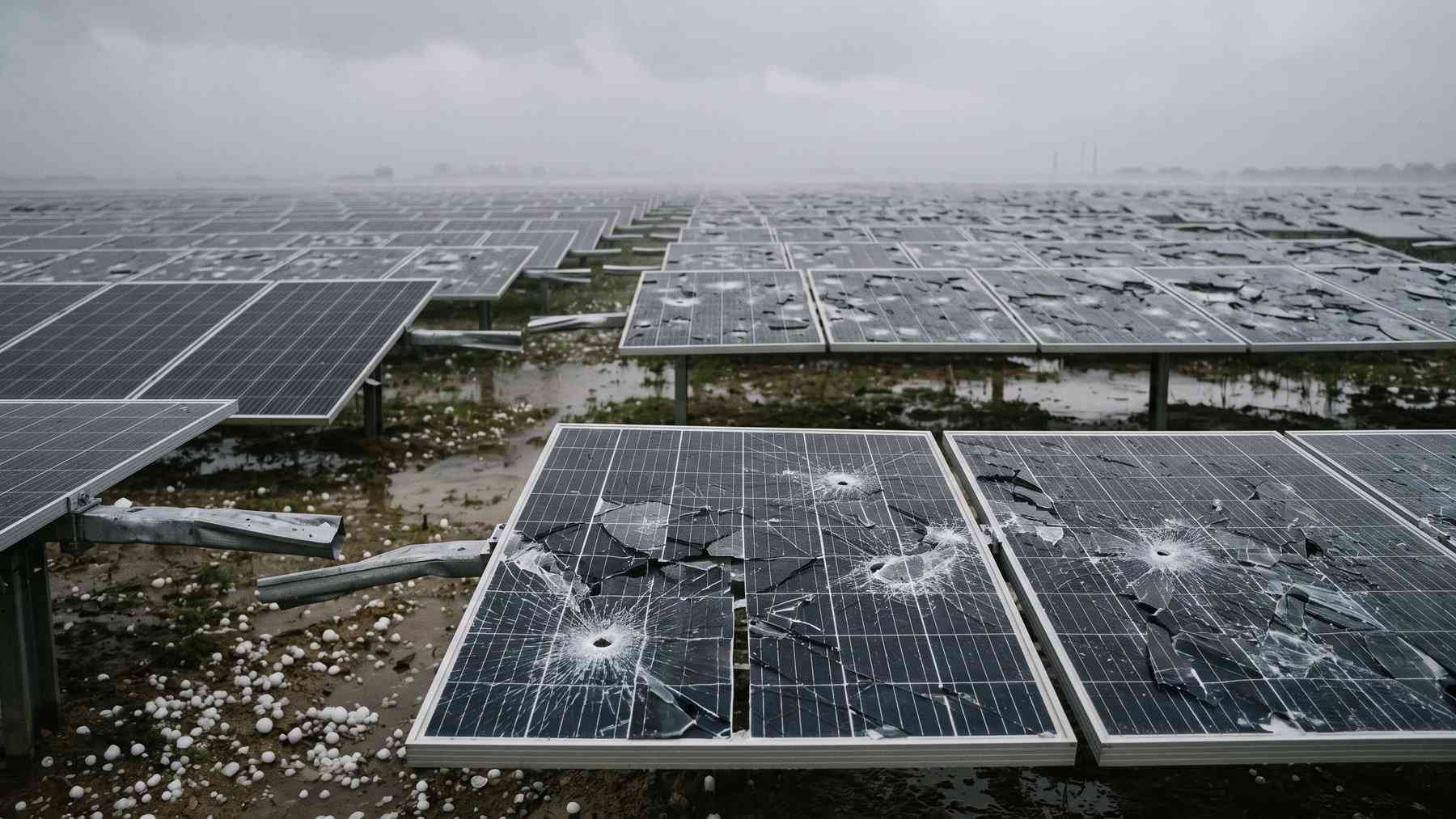
A storm crossed a solar field in northern Thailand one night.
By morning, two sections of the plant had gone quiet.
Thousands of panels sat dark.
The rest of the field kept generating.
Engineers had to work out why.
A gap in the lightning protection let the surge reach two sections
The site is an eight megawatt field in northern Thailand, divided into eight substation units of one megawatt each. Lightning struck at night, and the modules in units one and five were left damaged and unable to generate electricity. The engineers who went through the site afterward concluded that the lightning protection design was incomplete.
A protection and earthing network is meant to offer a strike an easier route to ground than the one running through a module’s circuitry. Where that route is missing or only partly built, a surge can couple into the array’s own wiring instead. That is the destruction mechanism the investigating team proposed, reconstructed from the damage pattern rather than measured as it happened.
So it would explain why the loss clustered in two units instead of spreading across all eight. The uneven protection layout left parts of the field with a clear path to ground and two sections without one.
Roughly 4,209 modules stopped working overnight without the field looking damaged
The count from the site is the part that stays with you: roughly 4,209 modules damaged and no longer able to generate electricity. Nothing in the record describes a fire, a collapse or a broken row. The plant simply came out of the night with two of its eight blocks producing nothing at all.
Electrical damage of this kind tends to hide. A surge can take out a module’s internal bypass diodes or microcrack the cells behind glass that still looks perfect.
And a technician walking the rows has little chance of spotting it from a distance. That is the practical problem with a surge event rather than an obvious, violent hit. A disabled module sitting in a healthy looking row can produce nothing for a long stretch before the output figures give it away.
A single storm night exposed the gap across all eight units
The investigation was not a walk through the rows. Inspections and diagnostics were carried out against the plant’s own engineering data, including the solar farm design and the lightning protection system.
The team then set out a module damage diagnosis, a destruction mechanism, an overvoltage test and lightning protection guidelines in its published investigation. Because the eight units were not identical in their defenses, the plant became its own comparison. Only units one and five are recorded as losing modules, while the rest of the field came through the same storm unharmed.
That contrast, unit by unit, is the clearest evidence the case offers. It turned an ordinary storm night into an unplanned experiment, the kind engineers elsewhere stage deliberately when they test how a panel’s internal layers behave under electrical stress far beyond normal operating conditions.
Two idle sections left a working eight megawatt plant short
Replacing modules on that scale is not quick work. Thousands of units have to be sourced and swapped, and the protection scheme has to be reworked across a live field while the undamaged sections keep exporting power.
The case is a useful reference for anyone designing a plant in the same conditions, because a protection system is only as good as its least complete segment. A field divided into separate units can behave like separate buildings in a storm, each one only as safe as its own wiring.
Which is why the slow, sequenced repair work that follows is familiar from other kinds of recovery, including the long effort in which crews processed millions of gallons of contaminated water after a very different plant failure.
Thirty strikes per square kilometer a year left the field exposed
What this case leaves behind is a documented mismatch between the protected and unprotected parts of one site. It argues that uniform grounding standards matter as much as the height or placement of any single lightning rod.
The exposure is not unusual either. Thailand sees roughly 30 lightning strikes per square kilometer each year, close to 78 per square mile, and solar farms spread across open, flat ground precisely because it is cheap and sunny, the same qualities that leave them standing alone under a storm.
The design response to that is documented in the standards work on large Thai plants. Even so, the fix going forward is consistency rather than drama, the kind of check that never makes headlines until a night like this one forces the question. For now, the unremarkable work of completing grounding networks continues, section by section, long after the clouds have cleared.
Read the whole thing?
Get the week's signal, not the noise
Our sharpest reporting on energy, climate and nature — free, once a week.


