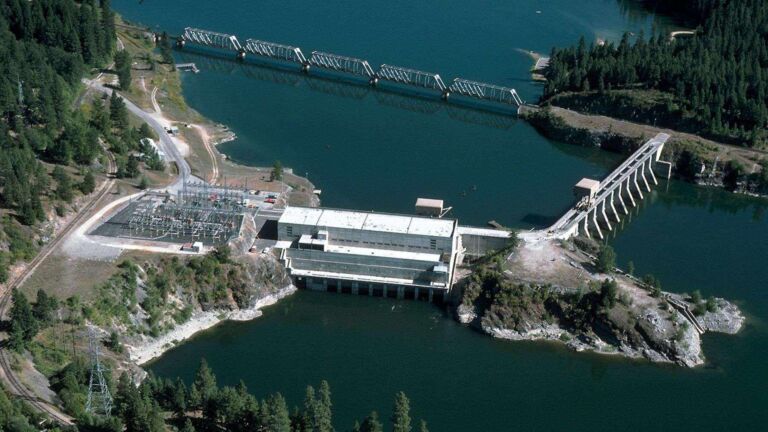
The ladder at Lower Granite Dam should have been busy this fall.
Instead, the count kept running behind.
Every year, biologists on the Snake River watch fish pass a lit window set into the dam’s ladder and tally them one at a time.
This fall the tally kept coming up short.
By late November, Idaho’s fishery managers were working with a number far below the one they had planned around, and the question of where those fish went is still open.
A forecast built on survival rates from years earlier
A preseason steelhead forecast is not a guess pulled from thin air. It is built from juvenile counts taken years earlier, when young fish first slid past the same dams on their way to the Pacific. Biologists track how many smolts left, then apply survival rates drawn from past returns to estimate how many adults should come back.
That is how the Idaho Department of Fish and Game arrived at its number for this run. Chris Sullivan, the agency’s anadromous fish coordinator, said managers were projecting about 52,250 fish to Lower Granite Dam.
The forecast was never a wild hope. It was arithmetic built on fish that had already left the river and were presumed to be on their way home. Yet the ocean between leaving and returning is where almost all of a steelhead’s life happens, and it is the part nobody can count directly.
One gate on a 39 mile reservoir catches every fish
Lower Granite is the last dam a Snake River steelhead has to climb before reaching Idaho water. Behind it, Lower Granite Lake extends 39 miles east to the confluence with the Clearwater River at Lewiston, Idaho.
Every adult fish bound for Idaho’s interior rivers passes the same ladder and counting station on its way toward spawning gravel in the Salmon, Clearwater and Snake drainages. That makes the dam count the cleanest measuring stick fishery managers have.
Each fish swims past a lit window, where a camera or a counter logs it by species and by whether its adipose fin has been clipped, the mark that separates a hatchery fish from a wild one. Because the tally happens at one choke point, a shortfall there is not a rounding error. It is the number of fish that actually made it home, out of however many left years before.
25,000 hatchery fish arrived where 52,250 were expected
When the season’s numbers were added up, the gap was stark. Sullivan said the actual return for hatchery fish was expected to be around 25,000, about half of what was projected preseason.
Wild fish fared worse against their own forecast. The wild steelhead forecast called for more than 19,000 fish, but Sullivan said it would be closer to about 6,000, roughly a third of the expectation. The state agency describes this year’s steelhead return as one of the lowest on record.
So the dam count did not just miss by a little. It missed by tens of thousands of fish across both hatchery and wild runs, in a system where every one of those numbers feeds directly into harvest rules and hatchery spawning targets.
None of it showed up as a single dramatic event. It showed up as weeks of counts that never caught up.
Regulators cut limits within weeks of the shortfall
Because dam counts update through the season, Idaho’s commission did not wait for a full year of data before acting. Reduced bag limits, including record breaking restrictions limiting anglers to release only fishing on the Clearwater River and its tributaries, will continue into next year after the Idaho Fish and Game Commission, meeting in Lewiston, voted to carry the current limits into the spring season.
Sullivan said the limits should help ensure hatcheries meet their spawning goals and wild fish are protected while allowing fishing seasons to continue. That balance is the whole job in a low year: keep enough fish on the spawning ground and in the hatchery racks without closing the river outright.
The dams themselves are aging infrastructure, built decades ago around fish runs that looked nothing like today’s, and keeping them turning means long overhauls with heavy lifting equipment. Power engineering also has a long memory of machines that never scaled. Neither explains this year’s shortfall, since managers had expected a low return and not one this steep.
A roughly 2 point survival gap cannot explain the loss
Ocean conditions are the leading suspect, and Sullivan called them “really the smoking gun” for the collapse. He noted that hatcheries in the Snake River Basin met their juvenile release goals for the fish now returning as adults, which was not enough to account for the poor returns.
The agency is careful about how far that reasoning goes. It says there is no single factor that clearly explains why the return is so poor.
Its own accounting shows the freshwater leg looked ordinary. Average survival from hatchery release sites to Lower Granite Dam was approximately 75 percent, compared with a 10 year average of about 77 percent, a difference far too small to swallow tens of thousands of missing adults. A forecast built from juvenile counts can be precise about how many fish left the river, yet say almost nothing about temperature, predators or food supply hundreds of miles offshore.
Which is why biologists keep watching the same glass window every fall, counting whatever actually swims past rather than what the spreadsheet predicted months earlier. The answer, if one comes, will likely arrive the same way the shortfall did, one season of real counts at a time.
Read the whole thing?
Get the week's signal, not the noise
Our sharpest reporting on energy, climate and nature — free, once a week.