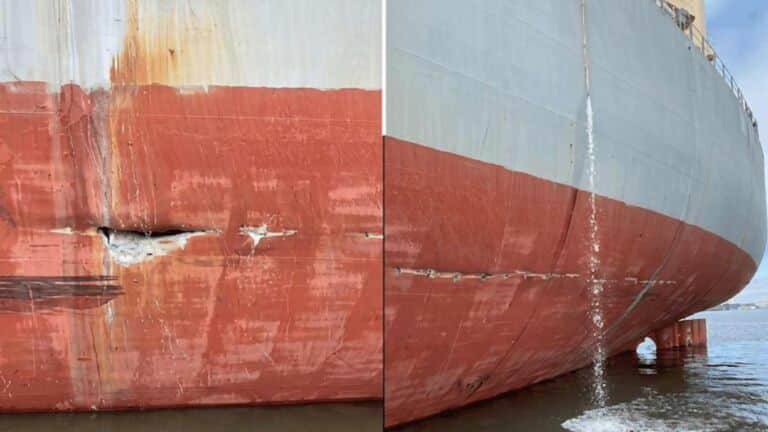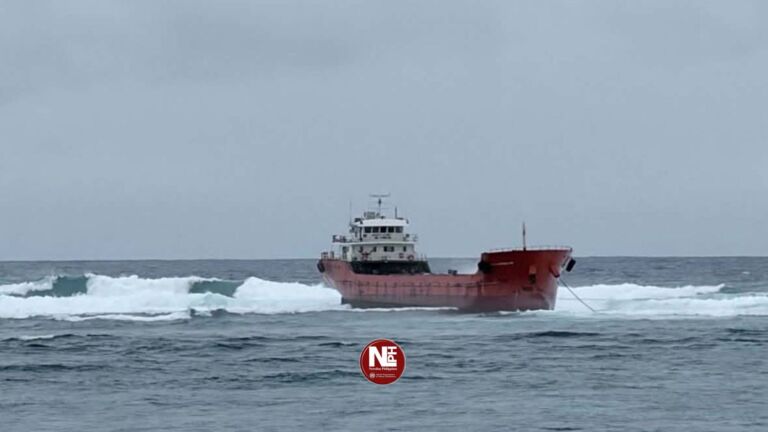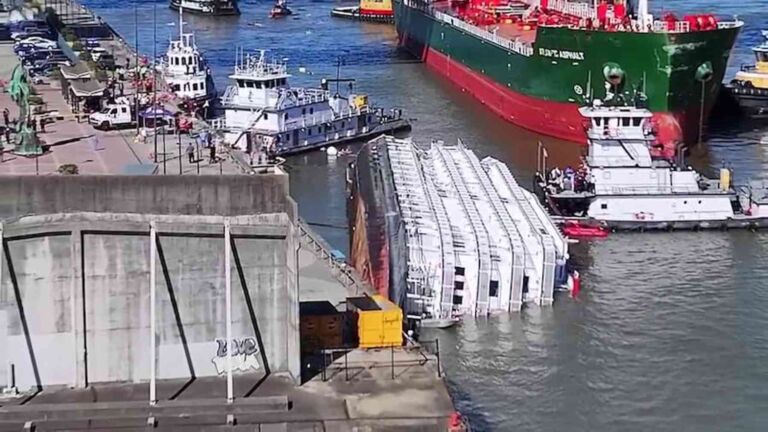
A towboat eases two tank barges away from a Galveston dock, lined up end to end instead of side by side.
The tide chart says the current should be gentle.
Minutes after the tow clears the breakwater, the water pushing against the hull feels nothing like the chart promised.
A coupling breaks, a wire parts, and one loaded barge drifts free toward a bridge.
Nobody gets hurt.
What decided the outcome was a choice made at the dock, long before the current ever showed its hand.
A current nearly twice the forecast overwhelmed the strung out tow
The towing vessel LCPL Phillip C George pushed away from the Texas International Terminal on the west end of Galveston’s port with two loaded tank barges, lined up end to end rather than lashed side by side. That strung out arrangement leaves a tow longer, thinner and slower to swing, and it was the configuration the captain was comfortable with because the predicted current looked mild.
Before getting underway, the captain checked the weather and checked in with the Coast Guard’s Vessel Traffic Service, and found nothing alarming in either. No assist tug came along for the short run out of the terminal.
Then the tow cleared the shelter of the breakwater. The water outside was moving at roughly double the speed the captain had planned around, and the long thin tow had almost no room left to correct.
The tow lost its grip minutes after leaving the breakwater
The lead barge had barely entered open water before the current took hold. About three minutes after the towboat got underway, the head of that barge passed the breakwater and entered the Galveston Channel at a forward speed of just 2.8 mph.
That slow speed left almost no margin once the flood tide began shoving sideways against the tow. The captain tried to counter it, bringing the propulsion full ahead and working to swing the tow clear.
She could not beat the current before the towboat’s port quarter struck a terminal dolphin, a fixed cluster of pilings at the edge of the berth. The impact broke the port coupling and the centerline connecting the barges, leaving the lead barge attached by a single starboard wire, now holding a loaded 321 foot tank barge against a current nobody had predicted from the dock.
One wire failed, then the barge hit a bridge
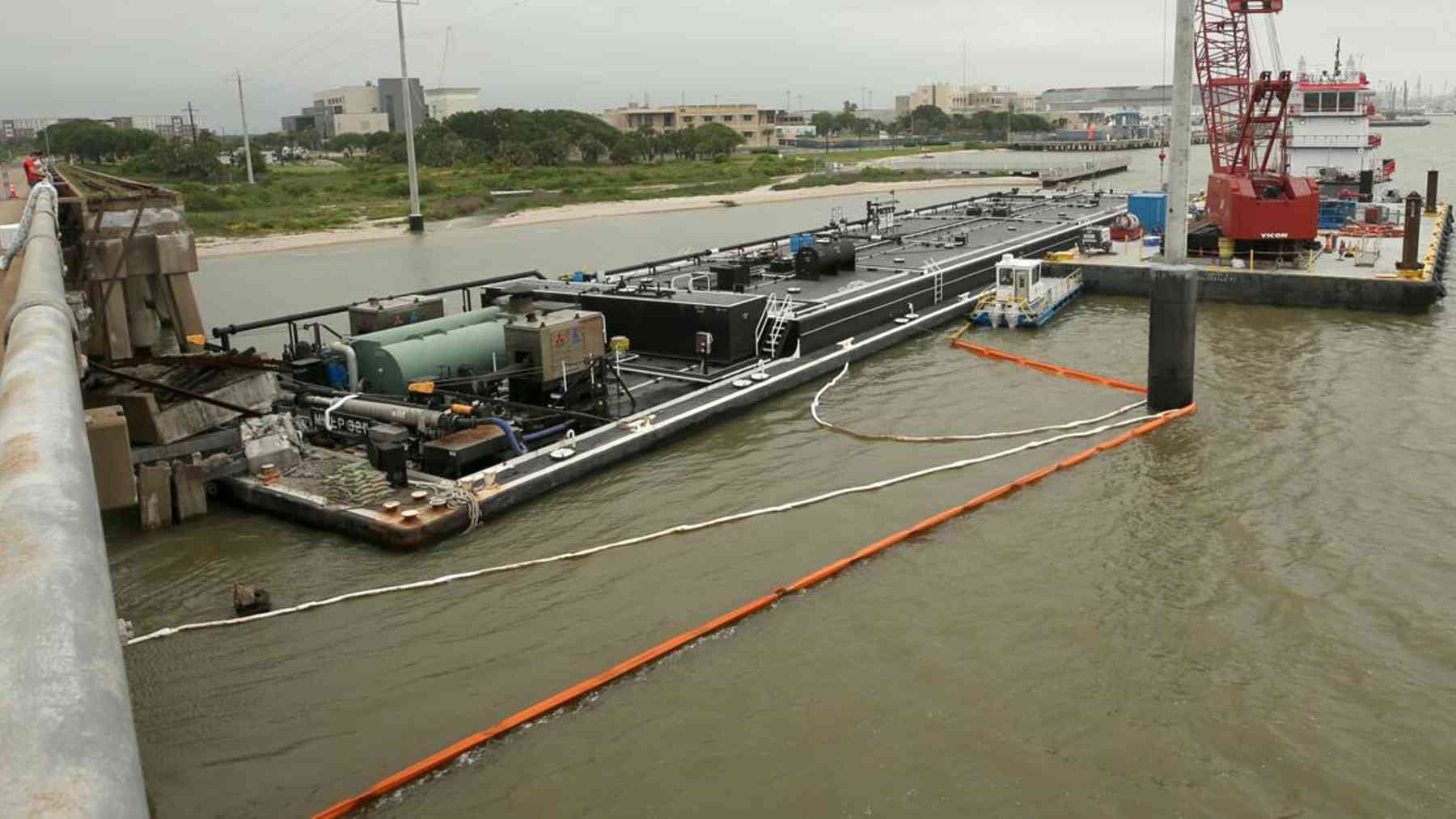
The investigation that followed pinned down how little margin remained once that wire took the strain alone. On the morning of May 15, 2024, the lead barge swung broadside, and at about 9:46 its aft port corner struck a power transmission pole, dropping sparking cables onto the deck and into the water. The last wire parted on that impact, and the barge drifted free into a pier shared by the Pelican Island Bridge and the abandoned railroad bridge beside it.
A deckhand was still aboard when the barge came loose. A boat from Texas A&M University at Galveston recovered him, uninjured, at about 9:51 and returned him to the towboat, while the captain broadcast a radio warning and reported the drifting barge to the traffic service.
The spill followed the collapse. Falling concrete from the rail span punctured a cargo tank and released about 20,000 gallons of vacuum gas oil, a heavy petroleum feedstock bound for Corpus Christi. Damage, salvage, lost cargo and cleanup came to an estimated eight point four million dollars, with responders later recovering all but roughly 129 gallons of the oil.
Three flood tide casualties in 18 months forced new departure rules
The formal conclusion landed on the mismatch between forecast and reality. The safety board determined the probable cause was the captain not being able to overcome a tidal current stronger than predicted as the strung out tow left the protection of the terminal breakwater. The predicted current at departure was about 0.6 mph; the measured current was 1.12 mph.
A different tow pushing 29 loaded barges met its own bend in the Mississippi, showing how often river current, not driver error, decides these outcomes.
This was not a one off. Investigators counted three casualties tied to the same docks within an 18 month window, all on a flood tide, and in February 2025 the traffic service wrote terminal restrictions into its policy: no strung out tows on flood departures, an assist boat for all flood movements, and no transits when the flood runs stronger than 0.5 knots, about 0.6 mph.
Those limits have since been adjusted. A 2026 dispatch permits flood arrivals and departures up to 1.0 knot in daylight while keeping the 0.5 knot ceiling at night, with strung out barges still barred and an assist vessel still required.
Galveston Channel keeps testing the same margin
None of this makes the Galveston Channel unusual among American waterways. Tidal currents everywhere run ahead of or behind their printed schedules, and a towboat squeezed between a bridge, a bay and a breakwater has little room to discover that gap in real time.
The same pressure plays out on a docked riverboat that rolled after a passing tanker misjudged its own margin.
What stands out is how ordinary every decision looked beforehand. A weather check, a call to the traffic service, a tow configuration that raised no concerns at the dock. It was the water itself, moving faster than the prediction the captain had planned around, that turned a routine departure into a bridge strike and a spill.
The rules at that one terminal will not fix every tide table in the country, but they mark a case where repeated casualties in the same stretch of water changed how a tow is allowed to leave the dock. For now the lesson travels with every towboat on the Gulf coast, that the tide chart is a forecast, and the channel does not always read it.
Read the whole thing?
Get the week's signal, not the noise
Our sharpest reporting on energy, climate and nature — free, once a week.