
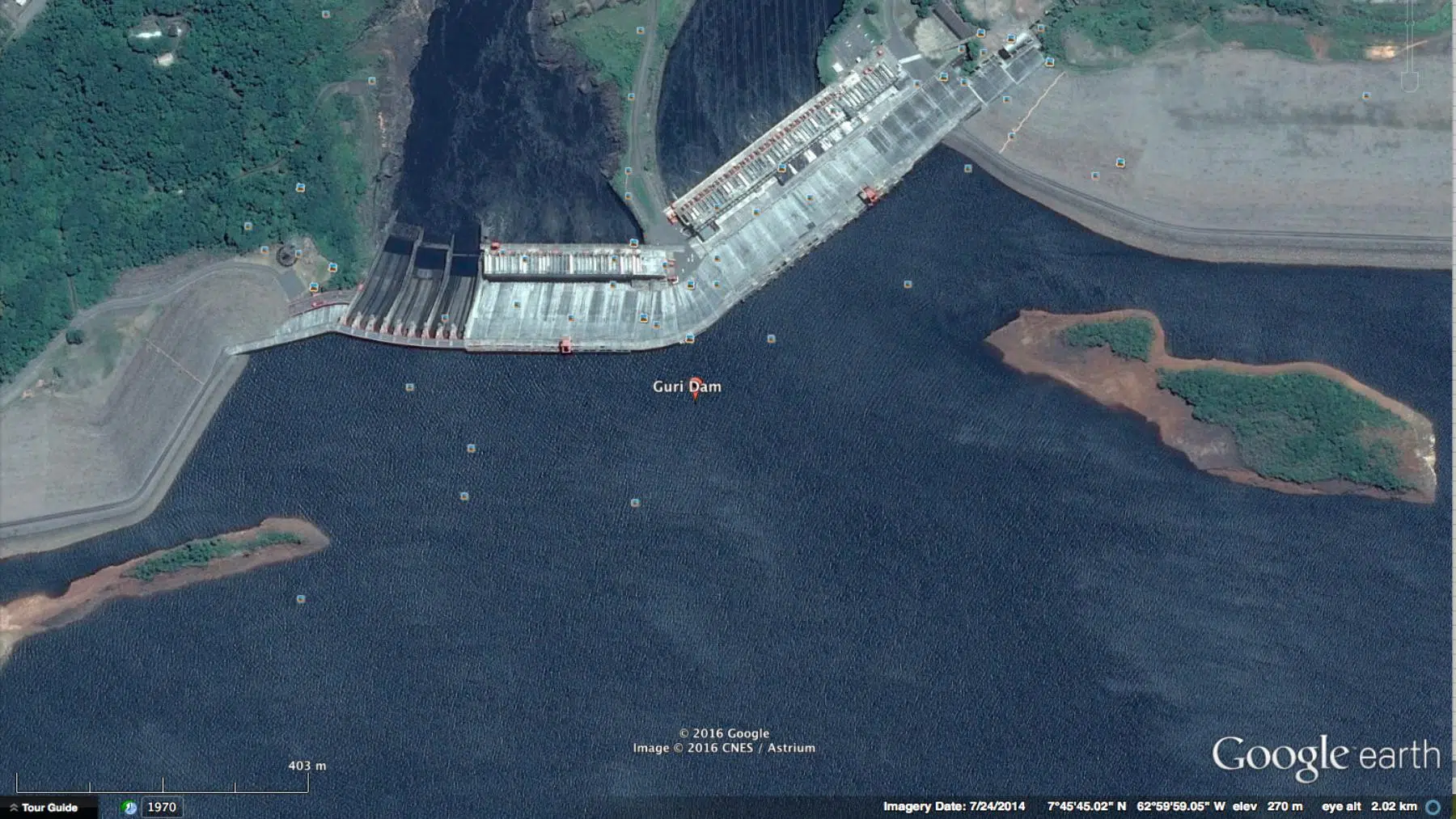
South America is home to some of the world’s biggest natural and manmade phenomena. From the Angel Falls to the Andes mountains and the Amazon rainforest, this continent almost has it all. Thanks to the 27 million liters per second, this country is the heart of energy in South America. It is much older than you think and has been the foundation for this South American country since the beginning.
This heart of energy is older than you think
Venezuela is a beautiful country on the northern coast of South America. This country boasts spectacular natural scenes, as well as the foundation of the continent’s energy. The Guri Dam, locally known as the Simón Bolívar Dam, is one of the world’s biggest hydroelectric power plants and has a flow rate of 27 million liters per second.
This South American country turned to renewable energy as early as the 1960s, when the Guri Dam’s construction officially kicked off. The goal of the dam was to decrease Venezuela’s reliance on fossil fuels. In 1969, the dam was 348 feet in height and 2,264 feet in length, marking the completion of its first stage of construction. At the time, the dam produced 1,750 MW of power.
Energy demands increased, which resulted in the second stage of construction in 1976. After ten years, the dam was 531 feet and from the top view, a whopping 37,222 feet. The dam produced 10,300 MW of power by 1986. In 2007, plans were initiated to modernize the dam. Thanks to agreements with companies such as Andritz Hydro and Alstom Hydro, the power plant’s turbines, generators, and control systems were upgraded with features to keep up efficiency.
South America’s heart of energy is very powerful
The Guri Dam is certainly South America’s heart of energy. The dam plays a crucial role in flood control and power production. According to Britannica, the dam’s current storage capacity is a maximum of 109,446,281 acre-feet, which is significantly bigger than China’s Three Gorges Dam storage capacity of 31,900,000 acre-feet.
It took more than 8 million cubic yards of concrete to construct the Guri Dam, highlighting how big this dam truly is. And this dam isn’t just big, it’s powerful. Annually, the Guri Dam provides nearly 50,000 GW/h, meeting 73% of Venezuela’s energy demands. The hydroelectric power plant presently comprises 10,300 MW of installed capacity, which is divided into two powerhouses.
With great power comes great sacrifice
With great power comes great sacrifice, and in the case of the Guri Dam, one must consider all the advantages and disadvantages of depending on renewable energy such as hydroelectricity.
Advantages of Guri Dam
- Advanced features, including industrial video and control units with leakage identification
- Improved general safety and operational integrity
- Advanced fire protection
- Water treatment plant
- Improved industrial development and stability
- Provides clean energy to energy-intensive sectors
- An architectural wonder
- Increased job opportunities
- Crucial factor of Venezuela’s energy sector and economy
- Decreased dependence on fossil fuels
Disadvantages of Guri Dam
- Dependency on one energy source limits the power supply in certain cases
- Low river levels result in power disruption and rationing (such as in 2010, 2016, and 2019)
- Construction led to physical changes in the environment
- The aquatic dynamics of the area were altered, and construction of the dam flooded the village of Guri
- Uncustomary feedstock reliance results in various environmental issues
The advantages and disadvantages must always be considered when turning to new energy sources, even though they are renewable. When managed effectively and efficiently, hydroelectric power plants may play a crucial role in local communities, not only by lowering the dependency on fossil fuels but also increasing the safety of villages prone to flooding. An example includes the Three Gorges Dam, which can intercept 8.2 billion cubic meters of potential floodwater.
Read the whole thing?
Get the week's signal, not the noise
Our sharpest reporting on energy, climate and nature — free, once a week.


