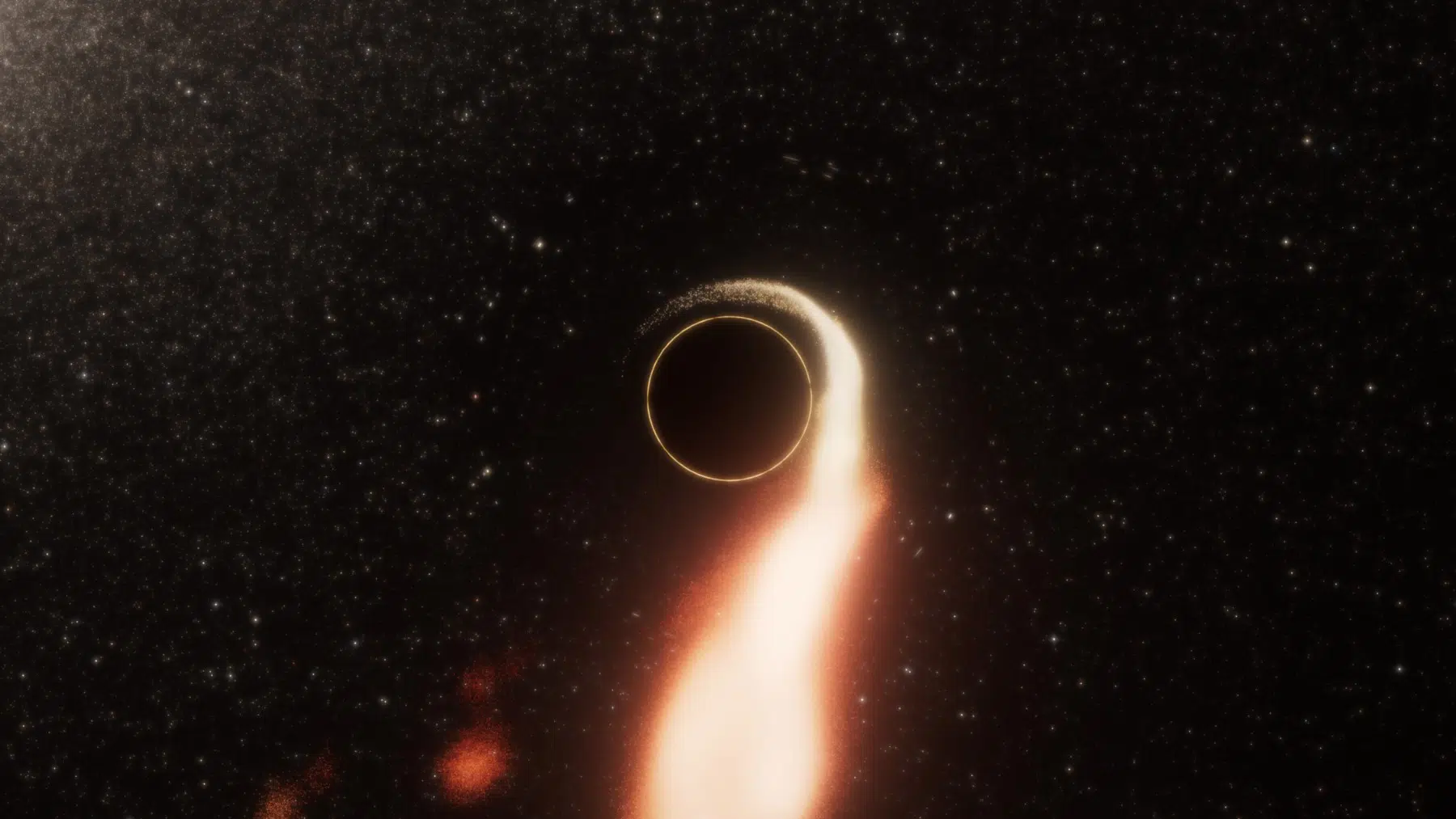
NASA has just spotted something that seems to come out of a science fiction movie. Black holes have always surprised those who dream about how everything in the universe would eventually come to an end. The idea of a cosmic monster that even light cannot escape, consuming everything in its way and cannot be stopped, is fascinating, but such a phenomenon is hard to observe as they sometimes occur thousands of light years away. On the other hand, we might have just witnessed something.
Humans can’t explore space and come back for now
Even though there are enough telescopes in space to help search for these cosmic destroyers, sometimes barely seen, and as we peer into the skies, we are always looking at the past because of the time light takes to travel to Earth. Which means that if something happened 10 million light years away, this is the time it took to get to Earth.
Albert Einstein created one of the fundamentals of physics as he introduced the theory of general relativity, which states that sometimes the time in the universe passes differently from Earth’s. This is one of the reasons why NASA’s astronauts and cosmonauts might never be able to travel to another planet far away from here and return – once they return, everything would be changed, even though for them, they only left for a while.
NASA has found a cosmic phenomenon offset from the center of the galaxy
Now, NASA can study the cosmos without having to send anyone far away, as the space telescopes like the Hubble and Chandra X-Ray are making new discoveries constantly.
A supermassive black hole was caught on camera by several space telescopes, drifting through space and doing the unthinkable — tearing apart a star and swallowing it whole. The scene unfolded some 600 million light‑years from Earth, offering a rare chance to watch what happens when a massive, hidden object shreds a star out in deep space.
The star’s fiery end lit up the surrounding space in bright flashes of radiation, what scientists call a tidal disruption event, or TDE. These moments briefly illuminate black holes, making them visible for a short while as they consume their target. But this one stood out for more than its sheer energy — it came from an unexpected place.
The Hubble Space Telescope was used for this discovery
Scientists at the University of California, Berkeley, were the first to spot the event, which they’ve called AT2024tvd. They used the NASA/ESA Hubble Space Telescope, combined with data from NASA’s Chandra X‑Ray Observatory and the Very Large Array, to pinpoint its location. It wasn’t where black holes usually reside.
The black hole in question is roughly a million times the mass of the Sun. Yet, instead of sitting quietly at the center of its galaxy, it was found about 2,600 light‑years away from the more massive black hole at the galaxy’s core — a relatively short distance in cosmic terms.
This is the first time an offset tidal disruption event has been identified
Meanwhile, a much larger black hole, roughly 100 million times the Sun’s mass, still rules the heart of that galaxy. This massive black hole is wrapped in swirling gas, lighting up its galaxy as a blazing, active core. The smaller one, though, is a wanderer, according to researchers. This is the first time scientists have caught a tidal disruption event significantly offset from a galaxy’s center. Up until now, every one of the roughly 100 known cases came from black holes right in the heart of their galaxies.
Read the whole thing?
Get the week's signal, not the noise
Our sharpest reporting on energy, climate and nature — free, once a week.