
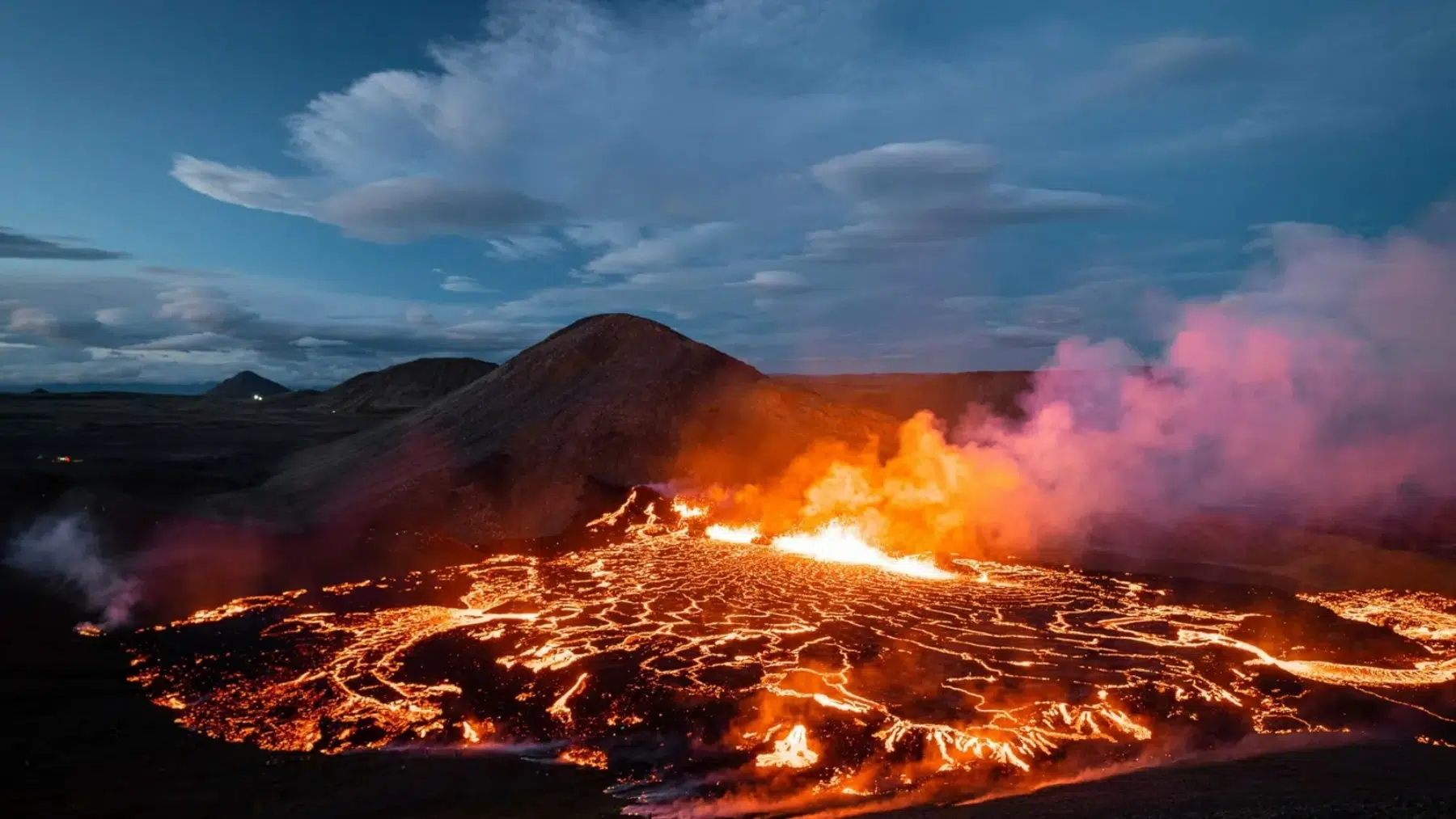
The Roman god of fire, Vulcan, was the inspiration behind the blazing mountainous structures we know as volcanoes. Volcanoes are a bit of an oxymoron, as they can destroy life with their blazing hot lava, but this lava can also create new land as it flows and cools. The magma is another story, as an international team of scientists has done what no one has dared to do in history: Finding the future of energy within volcanoes.
Scientists are targeting this volcano
There is a Nordic island nation known to many as the “Land of Fire and Ice.” This nation is known for its cold and icy landscapes, but it also has nearly 130 volcanoes. One of its most active volcanoes is the Krafla, which has had over 30 eruptions in the last 1,000 years. If you still have not guessed which Nordic island nation we are referring to, then drumroll, please!
The Krafla is a giant volcanic crater and rift zone located in northern Iceland. Now, Krafla is getting the world’s first magma research facility from Krafla Magma Testbed (KMT). The company plans on building this facility above one of Krafla’s magma chambers to observe, test, and trial the magma in its original state. This has never been done before in history.
This is why scientists want to drill volcanoes
Scientists plan on drilling a hole straight into Krafla’s magma reservoir to gain advanced knowledge about volcanic activity. It would assist scientists to predict eruption risks, as well as revolutionize geothermal energy by harnessing the unlimited and hot power of the volcano. KMT plans on drilling the first hole for the facility in 2027, which will be approximately 1.2 miles beneath the surface.
“It’s like our moonshot. It’s going to transform a lot of things. We’d like to instrument the magma so we can really listen to the pulse of the earth.” – Yan Lavallée, a professor of magmatic petrology and volcanology at the Ludwig-Maximilian University in Munich, and head of KMT’s science committee
According to Professor Lavallée, two crucial elements to explore are the pressure and temperature of magma, which is why the team will be adding pressure and temperature sensors to the magma. This should help them make predictions in good time. As the BBC reports, nearly 800 million people live within proximity to hazardous active volcanoes. The researcher from KMT hopes their research will thus aid in saving lives and money.
Gaining so much more than knowledge
A second hole will be drilled to create a testing site for next-generation geothermal power plants powered by the blazing temperature of magma. Geothermal sources are responsible for 25% of Iceland’s power and 85% of its households’ heating. This is done by harnessing the underground hot water and creating steam to power turbines and thus produce power. According to the BBC, the Krafla power plant already provides hot water and power to approximately 30,000 households.
“Magma are extremely energetic. They are the heat source that power the hydrothermal systems that leads to geothermal energy. Why not go to the source?” – Prof Lavallée.
However, locating magma underground proves to be a difficult task. Thankfully, engineers accidentally discovered it in 2009 while drilling, when the task had to be stopped immediately as they came across magma. Its steam was 452°C, and the chamber was nearly 900°C.
“This well produced about 10 times more [energy] than the average well in this location. Just two of these could supply the same energy as the power plant’s 22 wells. There is an obvious game changer.” – Mr Pálsson, the executive director of geothermal development at national power provider, Landsvirkjun
The future of geothermal energy lies within magma, and Iceland plans on exploiting it as much as possible. Thankfully, they will also gain life-saving knowledge!
Read the whole thing?
Get the week's signal, not the noise
Our sharpest reporting on energy, climate and nature — free, once a week.


