
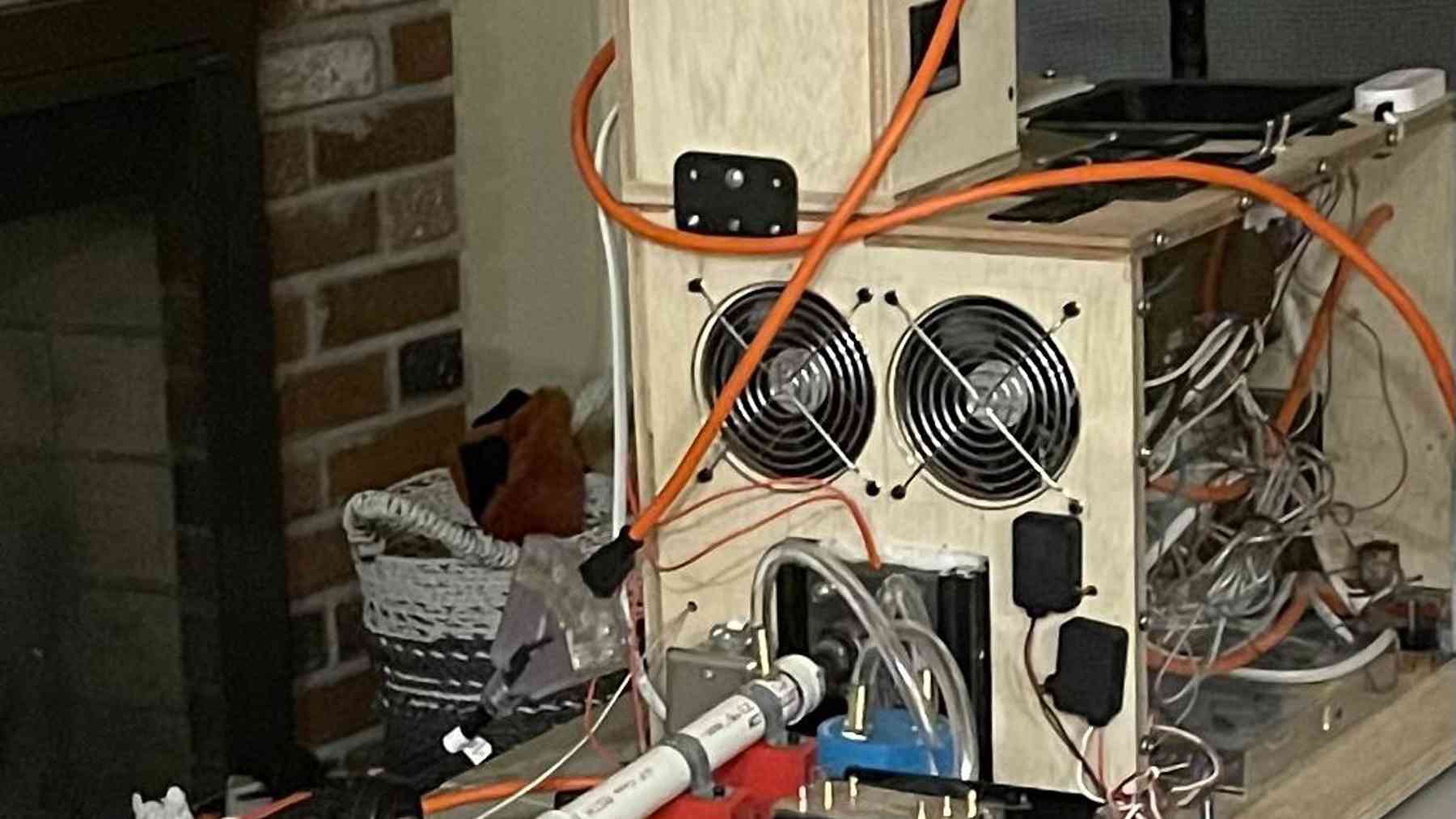
A failed 3D print lands in the trash still warm from the nozzle.
In a home workshop in Massachusetts, one of those failures became a question instead.
What if the plastic never had to leave the house at all?
A teenager kept answering that question with hand built parts and repeated rebuilds.
The machine he ended up with turns old filament back into new filament.
So how does a desktop box remelt plastic without ruining it?
How pultrusion and extrusion work together to remake old plastic
The heart of the machine is two plastic shaping techniques that almost never share a single device. Extrusion, the more familiar half, melts shredded or ground plastic and pushes it through a heated die to form a continuous strand, but filament made that way tends to come out uneven and brittle, often needing a second run through the extruder just to be usable.
So Benjamin Davis, the Bishop Feehan High School student behind the project, paired extrusion with pultrusion, a technique borrowed from composites manufacturing where continuous fiber is pulled through resin and a shaping die. He was after filament that held its shape without that second melt, since pultrusion normally belongs to an entirely different industry and here it reshaped a strand extrusion had already made, drawing it to a consistent width instead of remelting it.
That second pass is the whole idea behind the two stage design. In his project abstract, Davis describes the pairing as theoretically more energy and time efficient than extrusion alone.
A home workshop that looked nothing like a factory floor
The build happened at home rather than in a lab, with no clean room and no assembly line in sight. Davis, who is from Wrentham, Massachusetts, attends Bishop Feehan High School in nearby Attleboro, and the project grew out of his school research work, scaled for someone with one printer rather than a production floor.
Because the first attempts did not work cleanly, he kept taking the machine apart and putting it back together. Each pass fixed one jammed feed or one uneven strand and created a slightly different problem to solve next.
The feedstock was never pristine. It was genuinely messy waste, the stringy leftovers that pile up next to any printer running for hours, material that rarely has a route back into a printer at all.
The numbers behind a prize in Columbus
By the spring of last year, the machine had a name and a working prototype. Davis entered it in the Regeneron International Science and Engineering Fair in Columbus, Ohio, a competition that drew nearly 1,700 finalists from more than 60 countries, regions and territories, and he finished second overall, earning a $75,000 Regeneron Young Scientist Award.
Getting there took a long grind. By his own account, Davis logged over 800 hours on the project and cycled through more than 50 iterations of its components.
The organizers cite a striking figure behind the work: up to 67 percent of filament used in a typical 3D printing project may end up as waste. Davis reports his combined process ran roughly 45 percent more efficient than existing approaches used separately, and he built his unit for about 90 percent less than commercial machines aimed at the same job. Those numbers are his own measurements from a science fair project, not independently verified results.
Where a cheap die still runs into limits
No desktop recycler solves every kind of plastic waste, and this one is no exception. The machine was demonstrated on PET bottles, failed prints and printer purge material specifically, not the full range of plastics a household throws away, so its reach stops well short of a curbside bin.
Early versions also struggled with consistency, which is why Davis kept redesigning the feed and die assembly across dozens of iterations. A strand that comes out too thick or too thin jams a printer instead of feeding it.
So reliability mattered as much as raw output ever did. Even the most finished version is still just a prototype, with real testing still ahead.
What one home built machine hints about plastic nobody wanted
Despite those limits, the project points at something bigger than one teenager’s workshop. Davis has said he is planning the next phase, making the extrusion and pultrusion machine more efficient and commercially viable, and developing a separate machine aimed at high temperature composites.
A similar instinct for recovering value from overlooked material shows up elsewhere too, like a Texas refinery built to pull gold from scrap circuit boards nobody else was equipped to refine, or a Georgia battery plant where recovered material comes out at 99 percent purity.
None of it guarantees a commercial product within a year or two. But a desktop box that turns trashed filament back into usable filament, built at home rather than in a factory, is already doing something a landfill never could.
Read the whole thing?
Get the week's signal, not the noise
Our sharpest reporting on energy, climate and nature — free, once a week.


