
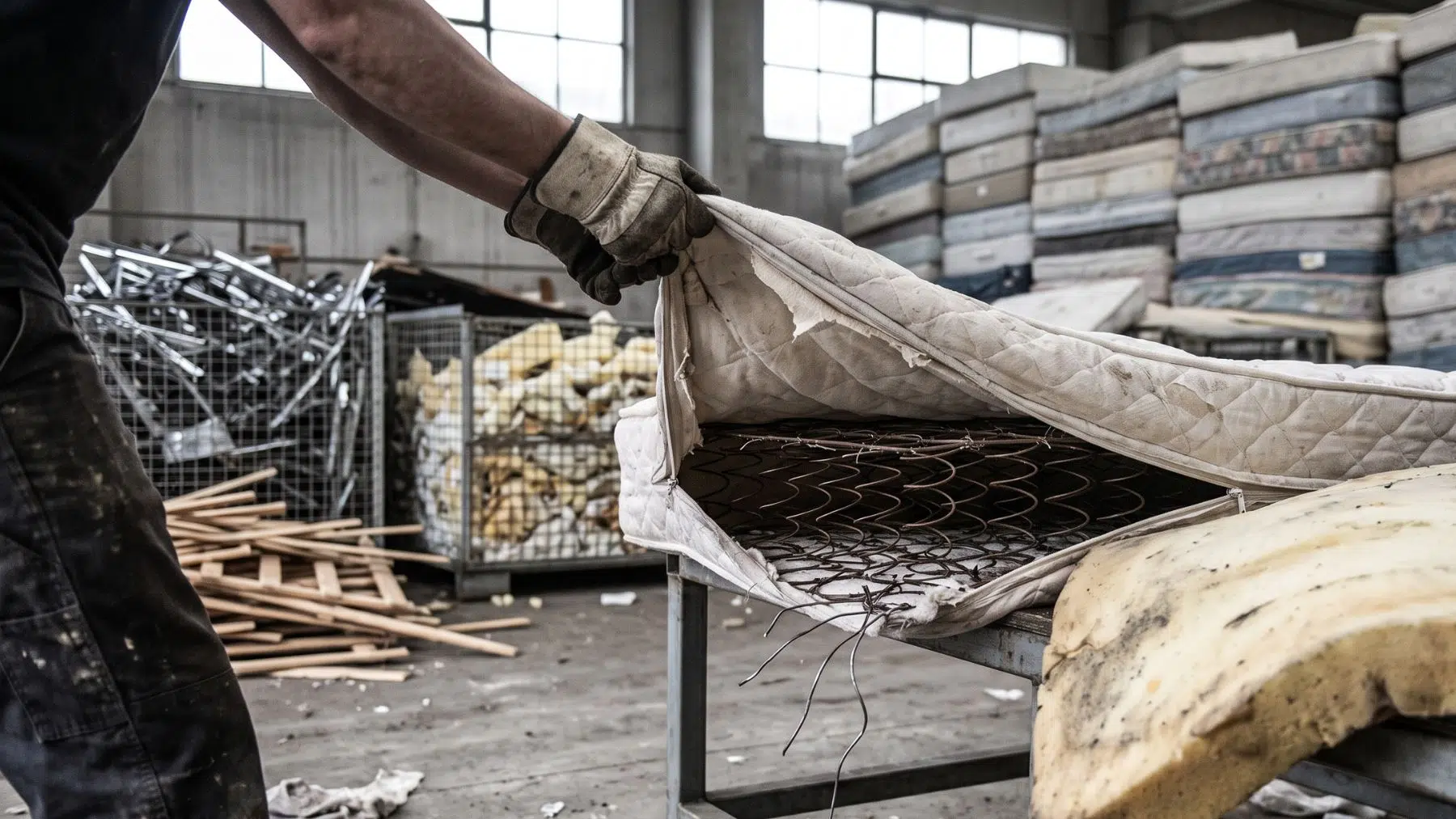
A mattress is the largest single object most households will ever throw away.
Americans set roughly 50,000 of them on the curb every day, which works out to about 18 million a year.
Nearly all of those discarded mattresses go into the ground whole, cover and coils and foam still bolted together.
Yet more than 80 percent of what sits inside one is material a recycler would happily take off your hands.
Two states have already built the machinery to prove that, and the rest of the country has not.
A pile that refuses to compact
Start with the physics, because that is where the trouble begins.
A landfill runs on compaction, since every cubic foot of air a machine squeezes out is a cubic foot the operator can sell again.
But a mattress does not cooperate with that logic at all.
Even after a compactor has finished with one, it still occupies somewhere around 23 cubic feet.
That is roughly the volume of a small refrigerator, sitting there permanently.
Multiply the figure by 18 million units a year and the arithmetic stops being about trash and becomes about real estate.
And landfill space is the one commodity no county can manufacture more of.
The part that wrecks the machinery
Then there is what happens when the compactor actually bites down.
Innerspring coils do not crush the way cardboard or drywall does. They tangle instead.
Steel wire wraps itself around the shafts and drums of the equipment, and somebody has to climb down with cutters and free it by hand.
Operators lose hours to that, and the same coils damage the processing equipment at waste to energy plants.
Beyond the machinery, the buried units create voids and air pockets that make the surface above them settle unevenly for years.
None of that is speculative. It is the reason state agencies started writing mattresses into their disposal rules in the first place.
So the object is a problem before any chemistry enters the conversation.
The part that matters for a crib
Then there is the chemistry, and one finding in it is worth more than all the rest.
Body heat and body weight both increase what polyurethane foam gives off, and a small child sleeps pressed directly into it for twelve hours at a stretch.
Researchers publishing in Environmental Science and Technology in 2019 measured 18 compounds coming off these mattresses.
For adults, almost everything they found sat below the cancer and non cancer reference levels regulators use.
For infants and young children, a few of them reached levels of concern.
That is the number to carry, and it is not the one that circulates. The lists claiming 61 compounds trace back to a consumer book, not a laboratory.
Same with the flame retardants. Production of the pentaBDE and octaBDE compounds people still name ended in the United States on the last day of 2004.
So they belong to the old mattresses already buried, not to the one delivered to your door last spring.
Two states that stopped burying them
Which brings the story to the part that actually works.
Massachusetts banned mattresses from disposal outright on 1 November 2022, and the state guidance is blunt about why, noting that more than 75 percent of the components can be reused, as the state lays out.
California went a different route, funding collection through a small fee charged at purchase when its program began in 2016.
By late 2023 that program had taken apart more than 10 million mattresses and recovered over 380 million pounds of steel, foam, fiber and wood.
Connecticut, Rhode Island and Oregon run versions of the same idea, and the states with programs report recycling rates that dwarf the national figure of roughly 19 percent, according to the reporting.
The pattern repeats across infrastructure, where the hardware is rarely the obstacle, whether the argument is over a solar site or an offshore project.
What decides it is whether somebody built a way to pay for the collection.
What it takes to keep yours out of the ground
Because the barrier is logistics, the fix is unglamorous and local.
There are only about 61 dedicated mattress recycling operations across the United States and Canada, which is why coverage is uneven.
Where one exists, the process is simple. A worker cuts the cover, pulls the foam, and the steel coils go to a scrap dealer.
Foam is shredded and reborn as carpet padding, the cotton and fiber become industrial filters or insulation, and the wooden frame is chipped for mulch or fuel.
So the practical move is to check for a takeback offer before the delivery truck arrives, since many retailers will haul the old unit to a recycler for a small fee.
Failing that, a call to the county solid waste office usually turns up a drop off site or a scheduled pickup day.
None of this asks anyone to sleep worse. It asks that the bed you finish with go somewhere other than underground.
Read the whole thing?
Get the week's signal, not the noise
Our sharpest reporting on energy, climate and nature — free, once a week.


