
Researchers analyzing continuous environmental monitoring data from an active marine energy project in Scotland recently reviewed 14,998 subsea camera files.
Located in Bluemull Sound in the Shetland Islands, the Shetland Tidal Array uses underwater monitoring systems to track marine wildlife around submerged turbines.
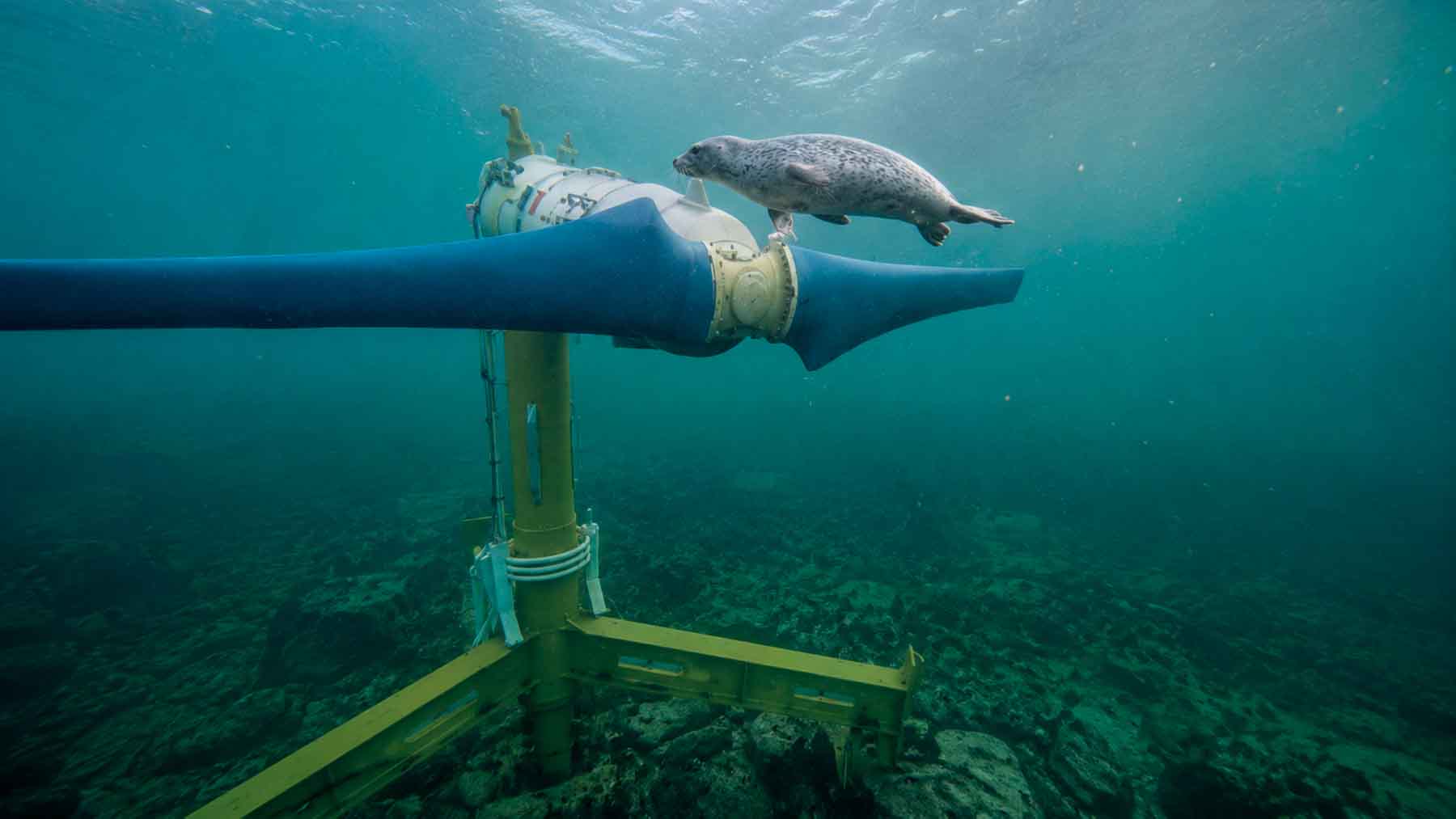
The monitoring report details a seal near the T5 turbine when conditions of ebb were low. The turbine blades were not moving during the encounter.
How to formulate a subsea monitoring framework and camera dataset
Nova Innovation developed the Shetland Tidal Array. It is submerged in Bluemull Sound, which lies between Unst and Yell in the region of the Shetland Islands.
There are strong tidal currents in the channel, so the location is ideal for the generation of clean energy from the ocean. It also makes data collection challenging.
Operators installed an integrated monitoring setup. It involved motion-activated cameras under the water, and also hydrophones attached to the subsea parts of the turbines.
Between July 2024 and June 2025, the environmental monitoring system recorded 14,998 individual video files.
Marine scientists manually screened each high-resolution video clip to document animal presence, transit behavior, and potential proximity to rotating turbine blades.
The dataset ended up being 14,998 motion-triggered clips taken between dawn and dusk. Only turbines T5 and T6 were looked at when images were adequate quality. Researchers were able to formulate an empirical record of how marine mammals behave around the energy array.
Harbor seal observations and recorded movement patterns
When the 14,998 video files were looked at in detail, it was noted that marine animals went near the turbines on several occasions. One encounter showed a harbor seal (Phoca vitulina) swimming around a turbine.
The recording showed the seal coming up near the top of the turbine frame. Then it dove toward the seabed.
The animal reached the seafloor around the turbine foundation, decided to reverse, and swam back up to pop up at the surface again.
The seal was able to maintain a controlled trajectory even though the water was turbulent. It never made contact with any part of the turbine equipment.
There was nothing in the footage, like physical collision, contact with the structure, or evasive action, that indicated that the animal was in distress.
Footage revealed a harbor seal near the T5 turbine during low-water slack, occurring while the turbine’s rotor was not operating.
Environmental assessment findings and collision risk conclusions
The harbor seal was recorded while it surfaced past the nacelle, then went down to the seabed, then reappeared near the surface. We cannot assume that this is regular behavior, even though the sequence has been recorded.
The environmental monitoring dataset was compiled from July 2024 to June 2025. It has contributed valuable data to how marine mammals are being monitored for collision risk.
Zero harmful interactions logged
Across all 14,998 subsea camera files evaluated during the 12-month reporting period, field researchers did not report any harmful interactions at all.
The monitoring report documented no collisions or near misses between marine mammals and the subsea tidal energy infrastructure in Bluemull Sound.
The video footage gathered underwater under real-world ocean conditions indicates that marine mammals can coexist with tidal stream turbines during operation.
These findings support the evidence that there is a low risk of collisions for marine mammals from tidal arrays. It supports the deployment of commercial renewable energy projects in coastal channels that are considered sensitive.
For all the details of the study, read here: Smith, K. (2025). Shetland Tidal Array Monitoring Report July 2024 to June 2025 (Report No. STA-016). Report by Nova Innovation. Report for Scottish Government Marine Directorate.
Read the whole thing?
Get the week's signal, not the noise
Our sharpest reporting on energy, climate and nature — free, once a week.


