Picture the seabed off the coast of Taiwan: flat, sandy, and almost empty.
For millions of years, the stretch of ocean floor near Miaoli County held very little for a fish to shelter behind or feed from.
Then, a few years ago, enormous steel legs began dropping out of the sky and into the water.
They were built to catch the wind, not to grow a reef.
But something completely unplanned happened on the way down.
The ocean floor that had nothing suddenly had something
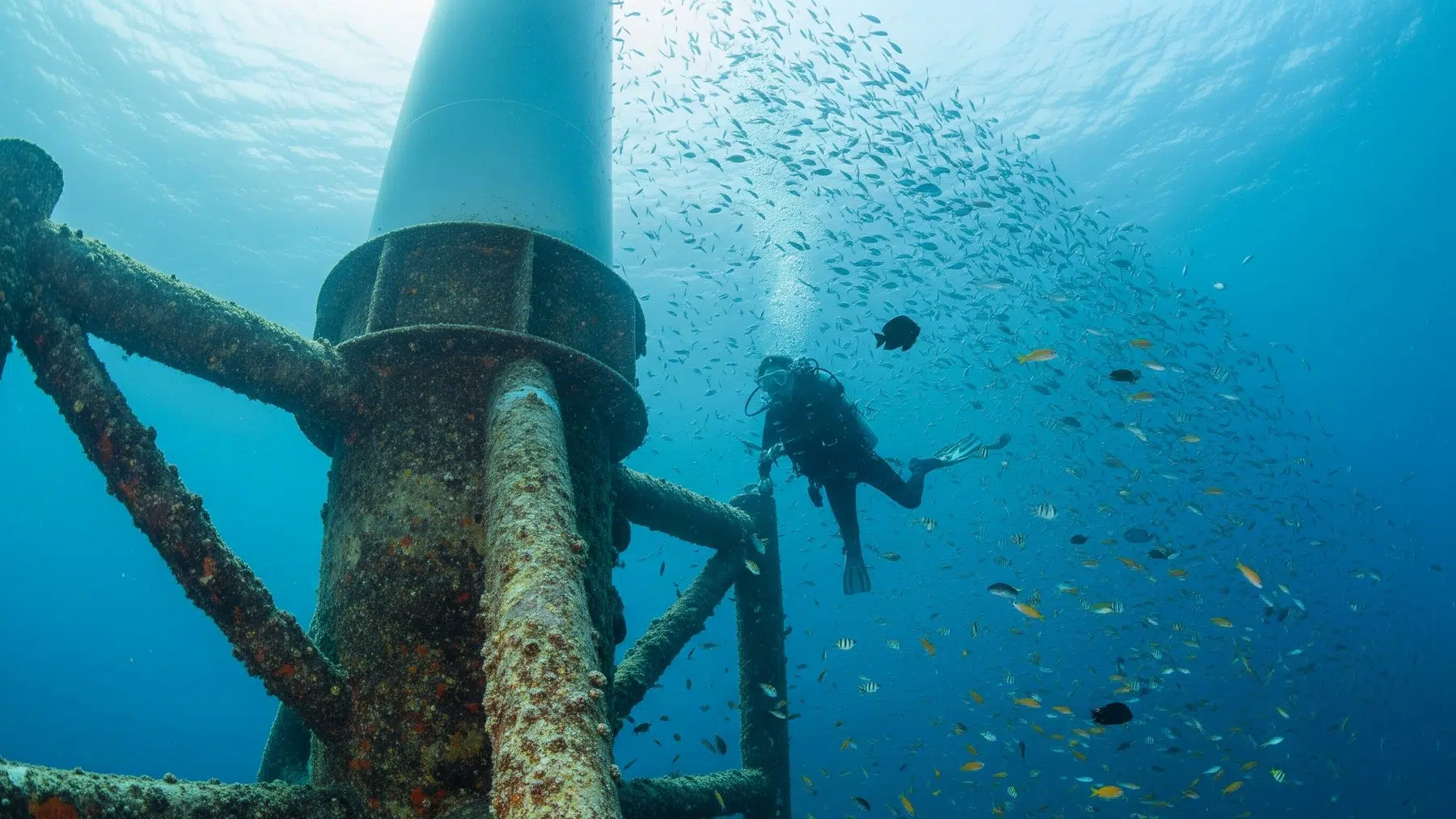
When engineers sink a wind turbine foundation into sandy seabed, the structure instantly becomes the most interesting object for miles in every direction.
There is nothing else like it down there: a vertical column of steel rising from the floor all the way to the surface, roughened by welds, bolted flanges, and the ring of protective boulders piled around its base.
To a fish, that is not industrial infrastructure.
That is a cliff face.
Reef species, the kind that evolved to hug rock walls and coral heads, have nowhere to go in open sandy water.
A single steel leg changes that equation entirely, and an offshore wind farm drops dozens of them into the same neighborhood at once.
The first arrivals came within months
Construction crews barely had time to pack their tools before the colonization began.
Within a few months of turbine construction being completed, invertebrates such as barnacles, sponges, and corals attached themselves to the surface of each turbine’s underwater structure.
That layered community of small creatures created habitats for shrimp, crabs, bristle worms, and gastropods.
It is a food chain being written from scratch.
Mussels and barnacles coat the steel, feeding filter-first on the current.
Whelks and starfish arrive to eat them.
And then, drawn by the noise and the smell of all that life, the fish begin to show up.
High-value species such as groupers, snappers, and lobsters moved in to search for food and to lay eggs.
Researchers described the turbine foundations as functioning as sustained reef habitat for marine resources, a role that once belonged only to natural rock formations and purpose-built artificial reefs.
Scientists watched the change unfold year by year
What made the Taiwan story different from a hopeful guess was the data.
A team of marine scientists decided to track one specific wind farm from the beginning, returning to the same turbine foundations again and again with SCUBA gear and survey equipment.
They focused on the Formosa Wind Farm, located off the coast of Miaoli County, conducting SCUBA surveys at turbine foundations in 2017, 2018, and 2025.
The 2025 data allowed a direct comparison with nearby purpose-built artificial reefs.
Year after year, the community around the steel legs grew richer and more layered.
The progression was steady and remarkable.
The open sandy plain surrounding each turbine remained as bare as ever, as if the foundations existed inside their own invisible boundary, a living island in a featureless sea.
86 species of fish that were never here before
When the divers tallied the full results from the Formosa Wind Farm surveys, the number stopped them cold.
The investigation documented 86 species of reef-associated fishes exclusively within 50 meters of the turbine foundations.
Not one was caught in the surrounding sandy areas or found in any previous fishery records for that location.
Every single one of those 86 species was a newcomer to the record books for that patch of ocean.
By 2025, although species composition still differed between the wind farm and the established artificial reef sites, key ecological measures such as species richness, diversity, and trophic structure showed no significant difference from established, purpose-built artificial reefs.
Broader research on offshore wind farms and fish communities has consistently found that hard vertical structures act as attractants, resulting in locally increased abundance and diversity of reef-associated species, while the soft-bottom assemblages beyond the foundations remain largely unchanged.
The same effect has been documented in other regions, where wind energy structures have drawn in species that nobody planned for and almost nobody predicted, as explored in research on offshore wind and unintended ecosystems.
A reef that keeps growing, and a question worth sitting with
The Formosa Wind Farm spans roughly 90 square kilometers of ocean and holds 69 turbines, each one now wrapped in its own living sleeve of marine life.
The vertical structures of the turbine foundations extend from the surface to the ocean floor, functioning as upright artificial reefs that attract fish of the surface, middle, and bottom layers simultaneously.
Nothing purpose-built does that so efficiently across the entire water column.
This implies that offshore wind energy production can serve as a tool to combine climate change mitigation with local biodiversity conservation.
The honest caveat is that scientists still debate whether these structures create genuinely new fish populations or simply draw existing fish away from other areas.
But the species showing up at Formosa were not recorded anywhere nearby before the turbines arrived, which suggests something more is happening than simple redistribution.
A steel leg was sunk to turn wind into electricity.
Eight years later, a grouper is raising young inside it.
The ocean, it turns out, does not much care what the structure was built for.
Read the whole thing?
Get the week's signal, not the noise
Our sharpest reporting on energy, climate and nature — free, once a week.