The horn came first, long and insistent, rolling across the water before anyone on the wharf understood why.
A tanker far too big to stop was swinging toward a riverboat tied up on the New Orleans riverfront.
Passengers were already walking down the gangway.
Within minutes the deck behind them was no longer level.
Investigators have since narrowed the sequence to one system aboard the tanker.
So what knocked a ship that size off course in a working river channel?
A steering failure left the rudder stuck and the tanker stopped answering its wheel
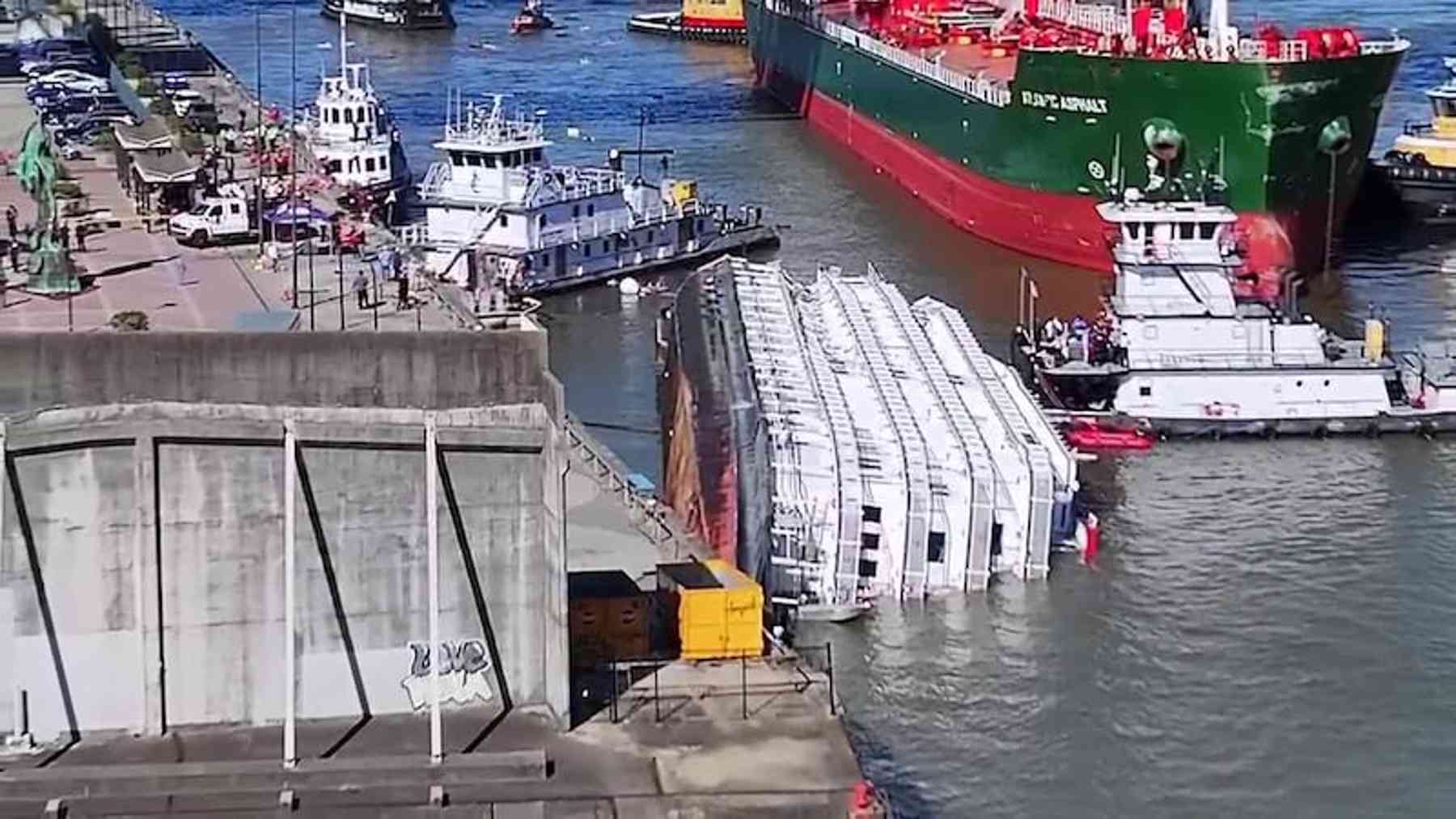
The tanker Atlantic Asphalt was under way on the Lower Mississippi with a river pilot aboard when its steering failed. Information recovered from the tanker’s voyage data recorder shows that at 12:26 p.m. the ship experienced a steering casualty that left its rudder stuck to starboard. Federal investigators have not said why the steering failed.
A ship that size does not simply drift to a stop. It carries the momentum of a loaded tanker and hands that momentum to whatever current and geometry decide next. The tanker veered toward the river’s east bank, and just two minutes later it rammed the riverboat, which heeled over and capsized.
The bridge team was not idle in that gap. Audio from the recorder registered the ship’s whistle, warnings broadcast over marine radio, and commands to deploy the anchors as part of a full emergency sequence. None of it changed where the bow was already headed.
The riverboat took the hit while passengers were going ashore
On the other end of that swing sat the American Heritage, a paddlewheel riverboat tied up along the Port of New Orleans riverfront near the Crescent City Connection bridge. It had been docked for roughly two hours when the tanker struck. Passengers were disembarking at the time, which is why so many of them were on open decks and gangways rather than inside.
Investigators put 190 people aboard the riverboat, 140 passengers and 50 crew. No one was injured on the tanker, which carried a crew of 19 and one local pilot.
A passenger described the sound before the impact. Joe Knab, visiting New Orleans from Wichita, told WDSU the tanker was “blasting its horn” as it drifted toward the riverboat. There was no maneuver left for the smaller boat, tied to a fixed wharf and facing something with no brakes, only mass and current.
Twenty two minutes turned a dock collision into a capsize
The strike itself did not sink the riverboat outright. Preliminary federal information has the boat capsizing in about 22 minutes. That gap between impact and rollover was the entire window rescuers had, far shorter than most people assume for a vessel of that size to go over.
Harbor police said 87 passengers and crew were able to get off before the American Heritage went over. It then took roughly 30 to 45 minutes for rescuers to pull the remaining people from the river and account for everyone. About 100 people ended up in the water.
Tugboat operators, nearby workers, police and other rescuers rushed to help, and good Samaritans from nine private vessels joined the response. People were dragged from the 66 degree river onto nearby ships. The improvised fleet did much of the work the shoreline could not.
Thirty six people went to hospitals and everyone aboard was accounted for
By the time crews finished pulling people out, the toll was injuries without any deaths. Investigators reported 36 people hospitalized, with everyone accounted for. Four people, all passengers, remained hospitalized this week, one listed as serious and three stable.
Mayor Helena Moreno described the outcome as a “miracle on the Mississippi,” crediting coordinated responders and nearby vessels that joined the rescue on their own. A separate wreck in Maine showed how fast a routine haul turns into a total loss once momentum and gravity take over. This same river has its own history of close calls, including a tow pushing loaded grain barges that lost control upstream.
Even so, the river did not simply return to normal once the passengers were ashore. The Coast Guard established a temporary safety zone through December 11 as salvage crews prepare to recover the riverboat, formalizing restrictions first imposed November 13. The zone covers a one mile stretch between mile markers 95.5 and 96.5, extending 500 feet from the east bank, and does not amount to a monthlong shutdown of the river.
Salvage crews now have a capsized riverboat to right before winter
With the safety zone in place, the next job belongs to the salvage teams rather than the rescuers. Crews must first extract 16,000 gallons of fuel by hot tapping, with divers placing a line inside the tanks so it can be pumped out. The ship is stable and resting on the river bottom at a depth of 23 feet.
Righting a capsized paddlewheeler against a working wharf is slow, deliberate work. The Coast Guard has said fuel removal alone could take a week before salvage begins.
The safety board has indicated a preliminary report could come within 30 days. What caused the steering to fail is still open, and that answer will shape how pilots and operators handle similar vessels on this stretch of river. For now the channel stays restricted, the boat stays where it rolled, and the Mississippi keeps moving past both of them exactly as it always has.
Read the whole thing?
Get the week's signal, not the noise
Our sharpest reporting on energy, climate and nature — free, once a week.