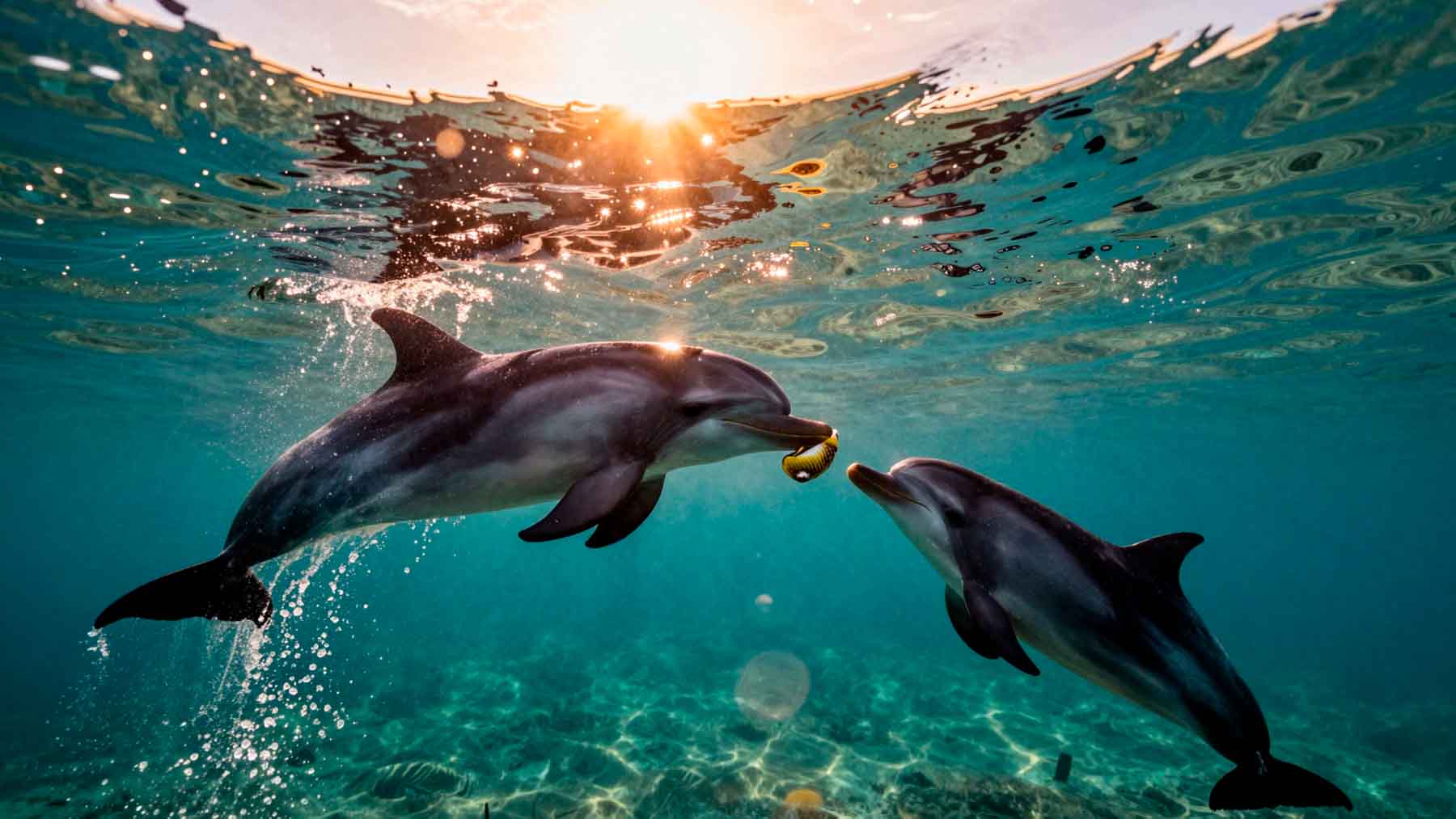
Off the coast of Hervey Bay, Australia, a bottlenose dolphin named Maserati surfaced clutching a large bailer shell — a fish visibly trapped inside. When her prey escaped and she dropped the shell to give chase, her calf Bentley didn’t hesitate: he scooped it up and mimicked her technique, move for move.
What researchers formally documented in that October moment wasn’t just a curious behavior. It was a precisely choreographed hunting method — and evidence that dolphins may be passing down tool use the way human cultures pass down skills.
A four-step hunt unlike anything else in the ocean
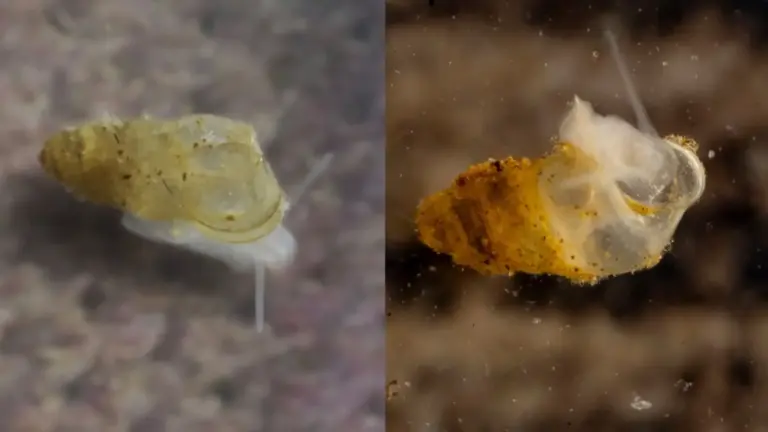
Shelling isn’t a single action — it’s a sequence with four distinct steps. The dolphin herds a fish into an empty bailer shell on the seafloor, inserts its rostrum into the opening, lifts the shell, and carries it to the surface. There, it tips and shakes the shell upside down until the fish slides out directly into its mouth.
Researchers compare that shaking motion to tipping the last chips from a bag. The dolphin has to drain water from the shell while keeping the fish inside — a balance of angle, force, and timing that requires real physical coordination.
What stands out is the planning involved. The dolphin treats the shell as a container, transports live prey without losing control, then executes a specific manipulation to separate fish from shell. That’s not instinct. That’s a multi-step strategy — and the distinction matters.
The behavior also shows real-time flexibility. In one documented encounter, a fish escaped mid-surface. The dolphin dropped the shell immediately and gave chase. That kind of in-the-moment problem-solving is exactly what makes shelling so striking to researchers.
How scientists finally caught it on camera
Shelling is extraordinarily difficult to document. The entire sequence unfolds in seconds at the water’s surface, often far from shore. Researchers now combine high-resolution photography with drone footage — hovering directly overhead, aerial cameras can confirm trapped prey before the dolphin even surfaces.
In 2025, scientists published the first formal documentation of shelling in Hervey Bay. On July 6, an adult female named Stevie Nicks was observed repeatedly maneuvering a large bailer shell above the water to extract prey. Then came the October encounter with Maserati and her calf Bentley — captured in high-definition video and drone footage — which provided the clearest evidence yet of both the technique and its transmission.
The behavior didn’t begin in 2025, though. Archived photographs from local ecotour operators, including Blue Dolphin Marine Tours, show Hervey Bay dolphins practicing shelling well before scientists arrived with cameras. The formal record is new. The behavior is not.
Learning from mom — and from the crowd
Bentley’s immediate mimicry of Maserati is about as clean an example of vertical social learning as researchers could hope to observe. He watched his mother, retrieved the shell she dropped, and replicated her technique move for move — skills passing from parent to offspring, in real time, on camera.
Mothers aren’t the only source. A 2020 study tracking Shark Bay dolphins over 11 years documented 42 shelling events across 19 individuals from distinct genetic lineages. When researchers used social network analysis to identify what predicted whether a dolphin would shell, the answer wasn’t genetics or shared habitat — it was peer group. Both mother-to-calf and peer-to-peer transmission appear to operate simultaneously, suggesting dolphins learn by watching others rather than simply inheriting a tendency.
How a marine disaster accidentally created better hunters
In 2011, a severe marine heatwave hit Shark Bay, triggering a massive die-off of fish and giant marine gastropods — and leaving the seafloor covered in empty shells. Shelling incidents spiked in the aftermath. More shells meant more opportunities to experiment, and once a few dolphins mastered the technique, peers could observe and copy rather than discover it independently.
Even so, shelling remains rare — fewer than 2% of the Shark Bay population practice it. Having shells nearby clearly isn’t enough. The skill demands practice, coordination, and sustained effort. The heatwave may have opened a door, but most dolphins still haven’t walked through it.
What shelling tells us about dolphin culture — and animal minds
The fact that shelling appears in both Shark Bay and Hervey Bay — separated by thousands of miles — raises a question researchers haven’t yet resolved. Did these populations invent the same technique independently? Or are there other dolphin communities along Australia’s coastline quietly doing the same thing, unobserved?
Shelling doesn’t stand alone. Alongside “sponging” — where dolphins wear sea sponges over their beaks while foraging on the seafloor — it points to a broader capacity for incorporating objects into complex, multi-step strategies. These aren’t isolated quirks; they may reflect something more systematic about how certain dolphins engage with their environment.
Taken together, shelling traces a full arc: individual innovation becomes shared practice, which becomes community tradition, passed to the next generation. If culture means a body of learned behaviors transmitted across individuals and generations, dolphins appear to have it — and that raises genuine questions about how we define intelligence and where we draw the line between human and animal minds.
Read the whole thing?
Get the week's signal, not the noise
Our sharpest reporting on energy, climate and nature — free, once a week.