The conditions arrived before the equipment did.
Somebody at the state wildlife agency read the site plan, looked at what that ground already does in winter, and wrote back with a list.
It was not a rejection.
It was a set of things the project had to carry, and the developer agreed to all of them.
The most expensive item is 1,900 acres that will never hold a panel.
The strangest one runs straight through the middle.
What that ground is already doing
The site sits in Klamath County, east of Diamond Lake and north of Crater Lake, on 1,560 acres of private timberland. The plan puts 406,000 panels on it for roughly 200 megawatts.
None of that is unusual on its own.
What made it complicated is that the parcel is big game winter range. When snow closes the high country, mule deer and Rocky Mountain elk drop onto exactly this kind of low forested shelf, and they come down the same way every year.
A fenced rectangle in the middle of that is not a neutral object. It is either a wall or it is not, and which one it turns out to be comes down to details nobody used to write into a permit.
Why the fence has to be taller, not shorter
The intuitive assumption is that a lower fence is the kinder one. It is not.
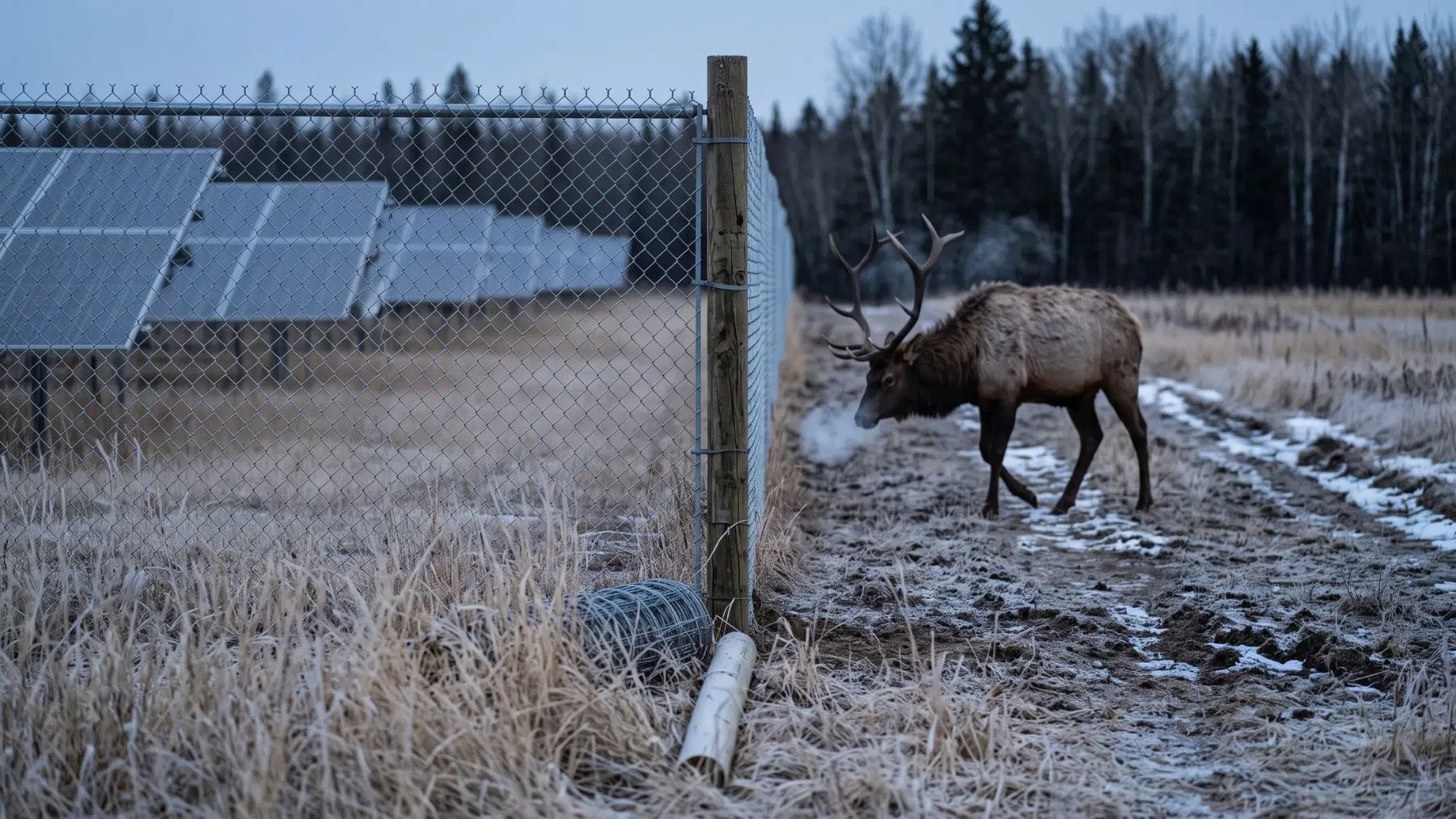
State guidance asks for a perimeter fence at least 8 feet tall, and the reason is entrapment. An elk can clear a shorter fence going in, then fail to clear the same fence going out, and spend whatever strength it has left walking the inside of a square.
So the rule is to make the barrier unambiguous. Either an animal cannot get in at all, or it can get back out the way it arrived.
Two smaller clauses ride along with it. Gates on opposite sides of the facility, so anything that does end up inside has a route out, and deliberate gaps left between the fence and the ground at intervals, sized for the small animals that were never the problem in the first place.
The clause that costs the most
Then there is timing, which runs up a bill and almost never gets written about.
The guidance asks that construction inside big game winter range stop between December 1 and April 30. That is five months a year when the machines have to be somewhere else, or idle.
The logic behind it is plain enough. An animal that has already burned through its summer fat has nothing spare to spend on running from a scraper, and the same disturbance in February costs it far more than it would in July.
Local biologists can shift those dates for a specific site, and often do. The starting position is five months off.
The window is not arbitrary either. It tracks the months when the animals are on that ground and nowhere else, which is the same reason the corridor has to sit where the trail already runs rather than wherever the layout happens to leave room.
The gap and the acreage
The corridor is the part that draws attention. 600 feet straight across the middle of the array, with no panels in it and no fence across it, so the herd can keep using the line it was already using.
The acreage is the part that costs more. Alongside the fenced 1,560 acres, the project carries roughly 1,900 acres set aside as replacement habitat, and state guidance points at a 2 to 1 ratio for ground in that category, aiming at a net gain rather than a wash.
The local reporting lays out how the corridor was arrived at, and we covered the corridor itself earlier this month. It is the same instinct that lets a fox move in under a fenced solar field, except written down in advance instead of noticed afterward.
Nobody has finished one of these yet
Which is the honest limit on all of it. The 600 feet is a number somebody chose, and there is no completed facility anywhere to check it against.
So the plan is to watch. Collared deer and game cameras at the mouth of the corridor, measuring whether animals walk it, avoid it, or pile up at the entrance in numbers that stall.
The state guidance behind these conditions is only a couple of years old, which is why this site reads like a first draft rather than a settled standard.
The facility is not expected to be finished before 2029. The answer lands after that, and it will apply to every solar farm that comes down on a migration route from then on.
What is different here is the order. The list came first, and the panels have to fit around it.
Read the whole thing?
Get the week's signal, not the noise
Our sharpest reporting on energy, climate and nature — free, once a week.