

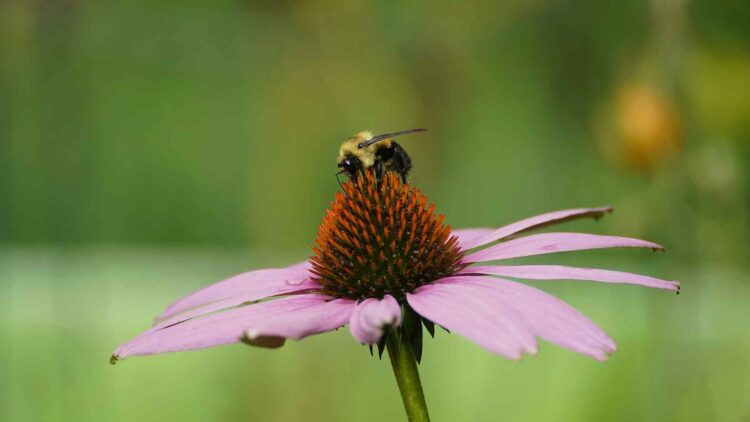
Honeybees can spot movement from astonishing distances.
Now, some researchers believe flowers may be taking advantage of this ability.
In controlled environments, scientists found consistent behavior.
The discovery suggests something profound and unknown.
Researchers found that honeybees consistently detected moving flowers before stationary ones.
Instead, movement may help gain attention from bees.
How are some flowers able to move to catch the bees’ attention?
How some flowers are now putting petal to the metal
Experts have been studying bee vision for decades now.
Most experiments focused on flowers that stood still. That’s where this study was different.
Flowers in nature normally remain perfectly motionless.
But wind patterns can change that. That one detail pushed researchers in a specific direction.
Experts now think that movement is key and have tested the idea.
To test this theory, the researchers put honeybees inside a controlled Y-maze. The insects were shown several shapes and visual targets.
Some stayed still, as most flowers do.
But a few were purposely moved during the testing. Thats were this story became almost unbelievable.
The bees repeatedly chose the moving targets instead of the still ones. And that matters far more than you might be thinking.
Thanks to moving flowers, the bees’ buzz stopped here
Flowers and trees acting with purpose is something we never expected.
And these honeybee experiments revealed something even more amazing. Movement did more than just attract bees.
It actually improved their vision altogether.
Honeybees seemed to have a new ability to distinguish shapes and sizes. Stationary objects appeared much larger at first.
This visual effect is affecting bees in ways never thought possible.
As any object moves, it creates visual information across the bees’ eyes. That one specific detail would prove to be paramount for the experiment.
Motion cues appear highly attractive to pollinators.
The bees ignored familiar shapes once motion appeared nearby. Movement itself can become a biological advertisement for the flowers.
That one biological truth raised another question for the researchers.
Was the insect seeing something that we as humans can not? Perhaps the flowers were the key in this story.
The researchers suspected something else was influencing this new reality.
What they found has been detailed in the study, “Effects of object motion on visual acuity in honeybees,” published in the Journal of Experimental Biology.
A moving flower that has reshaped the biology around honeybees
The findings of the study will have profound implications for global bee populations.
The research pointed to one new reality. Some flowers may use movement to catch bees’ attention before other competing plants.
This flowery motion is not intentional in the conscious sense.
Instead, something else may be at play. Evolution.
Why are these honeybees targeting moving flowers instead of stationary ones
The researchers think evolution favored flowers that sway with more visibility in the wind.
That evolutionary motion makes the plants easier for the bees to identify. They found moving targets consistently overrode stationary ones during their study.
Even when bees have learned a particular preference for certain shapes.
Meaning motion itself became the dominant biological signal for the honeybees. Something completely misunderstood by science until now.
In evolutionary terms, it may function like a natural competitive advantage for some flowers.
The bees can identify moving flowers far more easily. Making them the first stop on a pollinating journey.
This could reshape our understanding of plant-pollinator relationships.
Bees are delicate and can become disoriented easily. But with a few moving flowers, they can pollinate much faster and far more efficiently.
A new reality of honeybees preferring moving flowers has now emerged.
And it could change the way we look at flowers and bees altogether.