
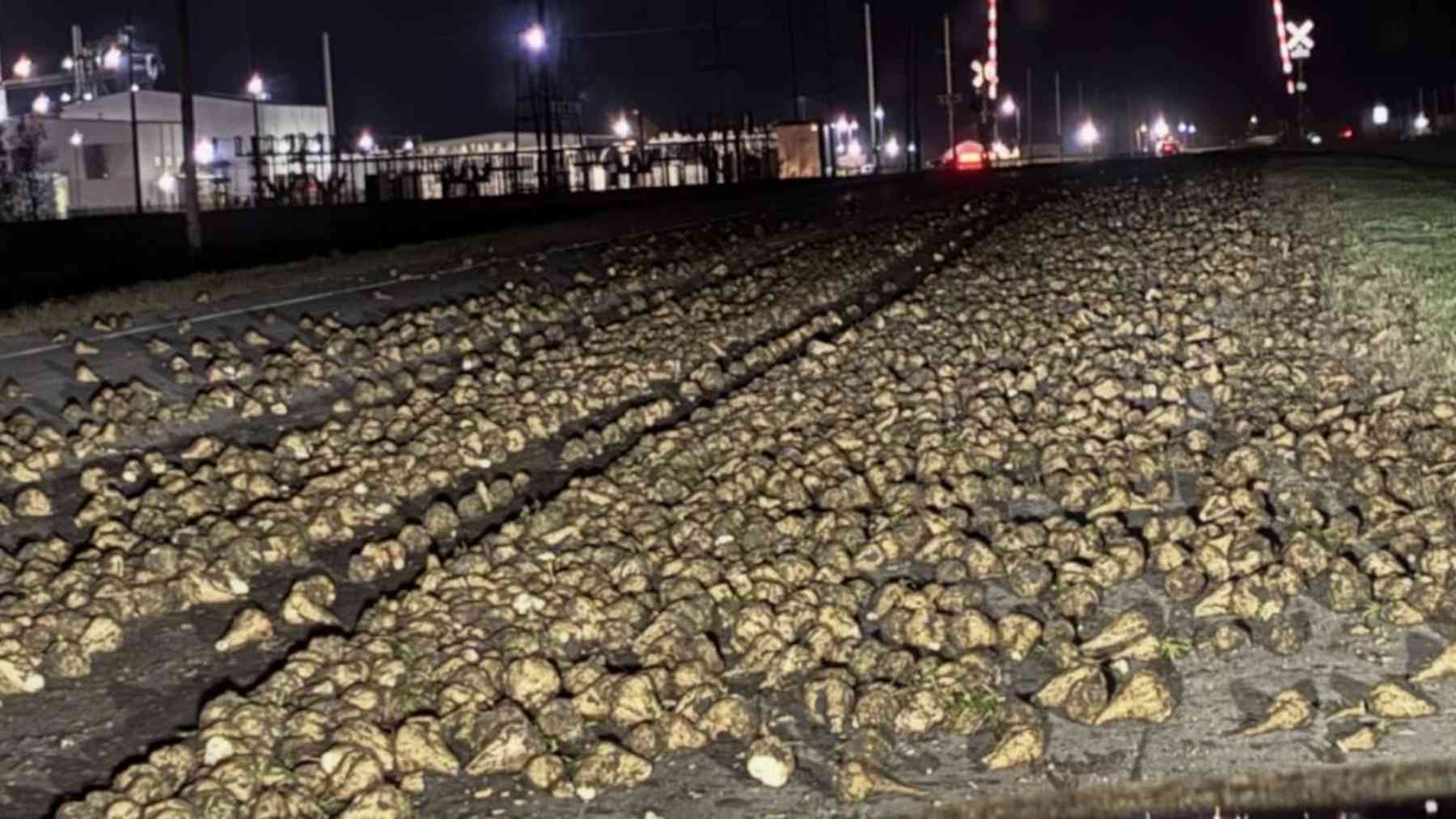
Late on a Wednesday night in October, a North Dakota trooper came upon something odd on a county road west of Casselton.
The pavement was covered in round reddish lumps.
Close to a full truckload of sugar beets.
No truck, no driver, just the load.
The road reopened in about five minutes.
So what makes a beet load come off a truck all at once?
Why a beet truck can lose everything at once
A loaded beet truck in harvest season is not hauling a tidy stack of produce. It carries loose root vegetables piled high in a trailer built to empty through a gate rather than be unloaded piece by piece. Beets are heavy and roughly round, and they roll against one another easily, so once the pile starts moving there is not much inside the trailer to stop it.
That is close to how the North Dakota Highway Patrol describes these incidents. A sergeant told Farm Progress, “We see something like this almost every year,” adding that drivers will take a corner too fast and the beets will roll over and spill.
He also described a second way loads end up on pavement. A driver unfamiliar with a particular truck can reach for what they think is the turn signal and release the trailer gate instead. He was careful to say he did not know whether that explained this particular spill. Either way the physics are blunt: round cargo, fast turn, or an open gate, and gravity does the rest.
The scene on County Road 10
The spill happened on County Road 10 near the Tharaldson Ethanol Plant, west of Casselton. The patrol’s photo shows the road near a set of railroad tracks covered in sugar beets. That is a rural crossing on a county route, not a divided highway with a wide shoulder to catch anything.
A spill here is not an abstract hazard.
The Highway Patrol said a truck lost its load and left “quite the mess” on the roadway. The load had scattered widely enough to block the road outright, turning a quiet rural stretch into a genuine traffic hazard in the middle of the night.
What happened next is the part that made the story travel. No cleanup contractor was called out. A local farmer used a tractor to assist a trooper in moving the beets off the road, and the highway reopened within minutes, the patrol said.
What the hard numbers actually show
The timeline here is unusually tight for a roadside spill. The patrol officer found the mess late on Oct. 14, and the photo caption describes close to a full load of sugar beets across the road. That five minute window is the number worth sitting with.
A load heavy enough to cover a full lane of county road was cleared with a piece of farm equipment that was already close by. No specialized response was needed, and authorities were still working to identify the truck and driver after the road was open again.
The hauling itself is a seasonal surge. North Dakota waives some licensing restrictions during harvest, letting more people haul under a temporary Class D license to meet the jump in trucking demand, a sign of how deeply harvest season infrastructure and public roads overlap in Cass County for weeks every fall.
When a spill becomes routine, and when it does not
What makes this spill different from a chemical tanker rollover is how unremarkable it was to the people who deal with it every year. The same patrol sergeant said these losses happen almost annually along beet routes, and that familiarity is part of why the response was so quick. Nobody had to wait for equipment, because the equipment was already doing harvest work nearby.
But the routine quality cuts both ways. A county road built for ordinary traffic was never meant to double as overflow storage for loose produce, and when a load comes off at speed the margin for a close call narrows fast.
A similar mechanism, unsecured shifting cargo, produces far messier outcomes when the cargo is alive. A truck hauling beehives that overturned in rural Washington is the obvious contrast, a load nobody can simply push to the ditch with a loader.
Why the small fixes still matter
There is a reason stories like this travel farther than their size suggests. A load spill is rarely glamorous, but the gap between the mess and the fix is what makes it stick.
It is the same instinct behind other oversize load mishaps this desk follows, where the aftermath says more about a region’s daily rhythms than the incident itself does. Whether the load came off through a gate or a corner taken too fast has not been established.
The beets themselves are long gone now, pushed clear of the lane. What remains is a patrol photo, an open request for information, and a farmer’s five minutes of unplanned public service.
Read the whole thing?
Get the week's signal, not the noise
Our sharpest reporting on energy, climate and nature — free, once a week.


