

Sea turtles are among nature’s most accomplished navigators — capable of crossing entire ocean basins by reading Earth’s magnetic field, the sun, and ocean currents. Scientists have long assumed that most populations follow this same restless blueprint.
So when researchers attached satellite trackers to a group of yellow-morph green sea turtles in the Galápagos, they settled in to watch the data unfold across three full years and 76,000 square miles of marine reserve. What they saw — or rather, what they didn’t see — stopped them short.
Built for long journeys — or so scientists thought
Sea turtles have earned their reputation as ocean wanderers. They navigate by reading Earth’s magnetic field, tracking the sun, and riding ocean currents — a biological toolkit that lets them cross entire ocean basins with surprising precision. Green sea turtles, in particular, are famous for traveling vast distances between feeding grounds and the beaches where they were born.
That long-distance pattern is consistent enough across the species that researchers studying the Galápagos population of yellow-morph green turtles simply assumed they’d see the same behavior. The central question driving the study was straightforward: where do these turtles actually go?
The answer turned out to be far less dramatic — and far more interesting — than anyone predicted.
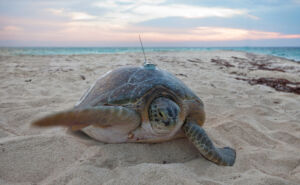
Two turtles in one archipelago
Not all green sea turtles are alike. Scientists recognize two genetically distinct forms relevant to this story: yellow morphs, generally found across tropical and subtropical parts of the western Pacific, and black morphs, which occur in the eastern Pacific, west of the Americas and south of southern California.
The Galápagos is the only known place on Earth where both forms share the same waters, mingling in the same coastal habitats and grazing on the same seagrasses and algae — a dietary shift that happens as green turtles mature from omnivorous juveniles into primarily vegetarian adults.
The two forms aren’t identical, though. Young yellow morphs tend to grow faster than young black morphs, hinting at physiological differences that haven’t been fully characterized yet. That distinction matters, because it suggests the two forms may relate to their environment in subtly different ways.
Tracking nine turtles across 76,000 square miles
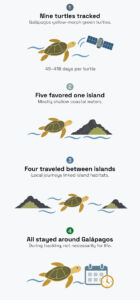
In 2015, researchers carefully captured nine adult yellow-morph turtles in shallow water near four different Galápagos islands — seven males and two females. Each turtle received a nickname and was fitted with an electronic transmitter linked to the low-orbit Argos satellite network.
Tracking continued for as long as 418 days per turtle, with the overall study spanning three years. Data collection ended when a tag detached or stopped transmitting.
The data revealed a strong preference for shallow coastal habitat. Turtles occasionally ventured up to 15 miles from shore, but most stayed much closer. Five of the nine spent nearly the entire study period near a single island. Bernardo and Sara moved between Isabela and San Cristóbal; Leandro traveled between Isabela and Española.
The most wide-ranging individual was Ainoa. Tagged near San Cristóbal, she later moved to Santa Cruz and then on to Isabela — the most ambitious itinerary in the group, and still entirely within the archipelago.
A seasonal rhythm hidden in the data
The turtles didn’t move randomly. Island-to-island travel happened only during the cooler season, from April through October. Outside that window, individuals tended to stay anchored to their preferred spots.
On average, each turtle used a home range of about 578 square miles — though that figure varied considerably from one animal to the next, reflecting genuine differences in individual behavior. Some ranged widely; others barely strayed.
The most striking finding was what didn’t happen. Not a single tagged turtle left the Galápagos Marine Reserve during the entire study period. For a species celebrated for crossing ocean basins, that level of site fidelity was unexpected. Researchers were careful to note that their observation window captures only a slice of these turtles’ lives — longer migrations, particularly for females not known to nest on Galápagos beaches, may still occur outside the study period. As coauthor Dr. Juan Pablo Muñoz Pérez noted, female yellow morphs are believed to eventually return to natal beaches in the western Pacific to reproduce, a journey that simply may not have fallen within the tracking window.
What staying home means for conservation
The findings reframe how scientists and policymakers should think about protecting this population. Because individual turtles rely on coastal waters around multiple islands — not just one — protecting a single favored feeding site isn’t enough.
Lead researcher Dr. John W. Rowe put it plainly: “Since individual turtles may rely on waters around multiple islands, the quality of habitat that is available for foraging should be maintained intact across all islands, and not allowed to degrade anywhere.”
The seasonal corridors turtles use to move between islands also need attention. A degraded stretch of coastal habitat between two islands could effectively cut off routes these animals depend on — a quiet threat that aggregate protection statistics would easily miss.
More broadly, the study positions the Galápagos Marine Reserve not as a waypoint in a longer journey, but as a year-round refuge in its own right. Future research — especially longer tracking studies that could capture potential nesting migrations — will be essential for building a complete picture of how yellow morphs use their world across a full lifetime.
Learn more about these findings here: Juan Pablo Muñoz-Pérez, Daniela Estefania Alarcón-Ruales, Lyndsey K. Tanabe, Catherine E. Hart, Maike Heidemeyer, Todd Steiner, Randall Arauz, Carlos A. Valle, John W. Rowe. Movements of yellow-morphotype green turtles (Chelonia mydas) in the Galápagos Marine Reserve. Frontiers in Amphibian and Reptile Science, 2026; 4 DOI: 10.3389/famrs.2026.1837921
Read the whole thing?
Get the week's signal, not the noise
Our sharpest reporting on energy, climate and nature — free, once a week.




