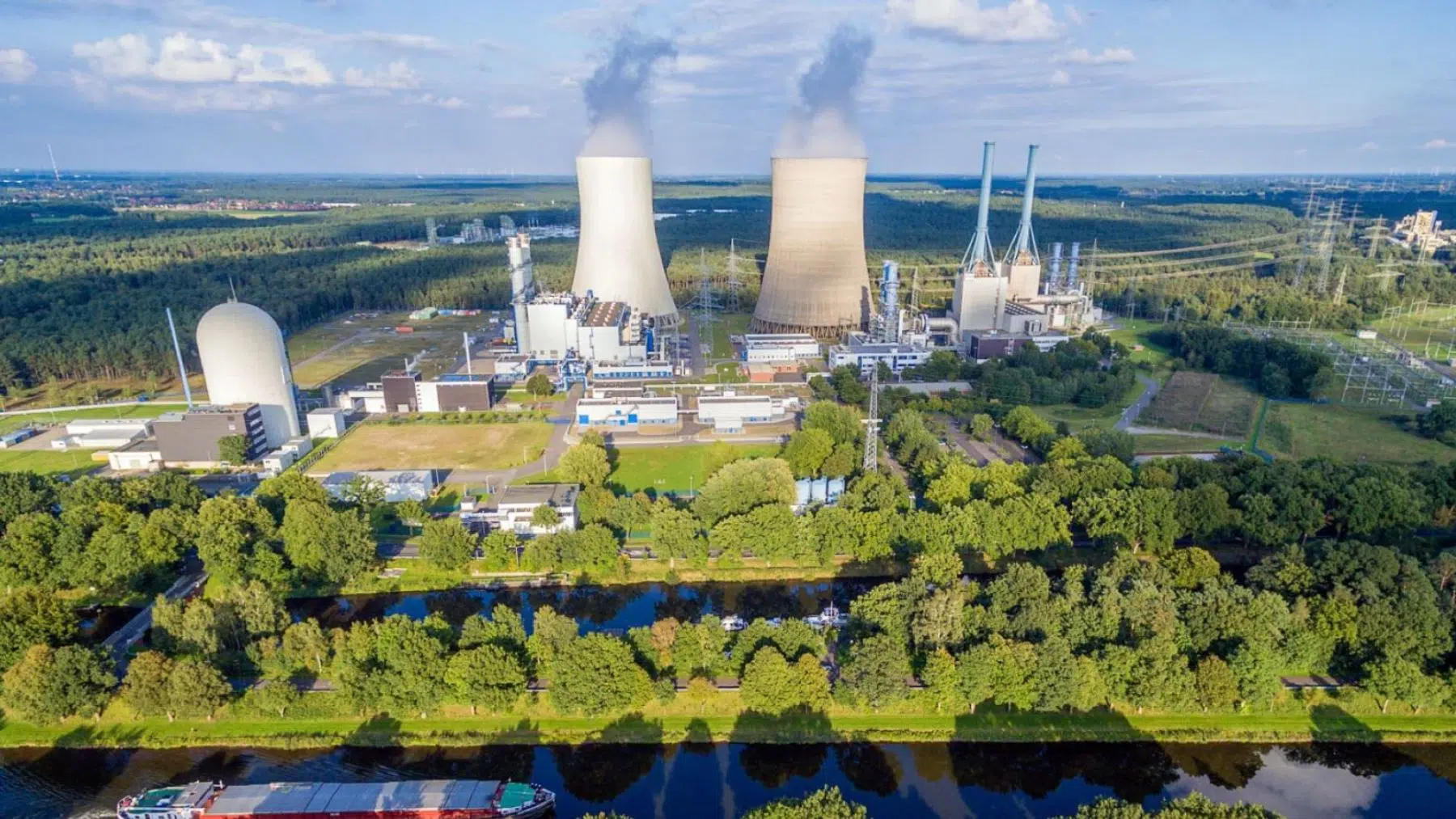
Companies around the world are seeking new clean-energy sources as countries move towards the transition from current energy sources to a sustainable one. With technological advances, devices capable of generating energy from different sources are being developed and implemented. With a lot of technology and sometimes an impressive structure, these types of equipment are not always what they seem to be. In this case, Germany’s new energy monster looks like a nuclear plant, but it is far from it.
This German monster is the third phase of a huge project
The company responsible for this creation is Sunfire, a German company specializing in industrial electrolyzers. Last September 2024, the company received a contract to build a new megastructure featuring a 100 MW electrolyzer at RWE’s site in Lingen. The order came just days after RWE’s final investment decision for its largest hydrogen project to date.
Due to its size and capacity, the site will be seen as a reference for industries that aim to utilize clean energy resources. It is part of a larger plant with a total capacity of 300 MW.
At first sight, the structure reminds one of a nuclear plant due to its design, but it does not generate energy through radiation. In fact, it does not even emit smoke or any direct residue into the environment. The structure is composed of a 100 MW pressurized alkaline electrolyzer — 10 modules of 10 MW each — consuming energy to produce green hydrogen, and helping Germany to rank among the countries with the most impressive clean energy projects ever seen.
The structure may represent an advancement for the green hydrogen industry
The structure, developed by the German company that specializes in electrolyzers, is part of the third construction phase of RWE’s hydrogen site in Lingen. With the deployment, the production capacity will increase to 300 MW. For Nils Aldag, Sunfire CEO, the project is enough to prove that Sunfire is leading the technologies necessary for large-scale projects:
“With the realization of major projects such as the 100 MW order from RWE, Sunfire is underlining its leading position once again”.
The Sunfire CEO also reinforced that the company is one of the few capable of delivering electrolyzers on an industrial scale, with an order book totalling over 800 MW.
It is not what it seems to be
The structure, part of RWE’s hydrogen site in Lingen, Germany, has a design similar to a nuclear reactor. Besides the similarities, it does not use nuclear energy and houses a 100 MW pressurized alkaline electrolyzer provided by Sunfire. Sunfire will also be responsible for the installation and commissioning of the electrolyzer, which is scheduled to go into operation by the end of 2027.
After it is done and fully operational, RWE will connect the Lingen plant’s green hydrogen production facilities to industrial consumers around Germany. It is expected that the hydrogen produced — up to two tons per hour — will be delivered to companies in the Lower Saxony and North Rhine-Westphalia regions.
With projects like this, Germany may be pointed to as a reference in the clean energy industry
The project developed by Sunfire and RWE should be taken as a strong role model for the clean energy industry, especially for the companies that plan to change their processes to green hydrogen. Besides the development of the green hydrogen industry, Germany is also evolving in the solar energy industry and is being recognized for its advancements. But these achievements do not reflect the crises the country faced in recent years. After some recent problems related to photovoltaic energy, Germany had to seek help to avoid another huge crisis.
Read the whole thing?
Get the week's signal, not the noise
Our sharpest reporting on energy, climate and nature — free, once a week.