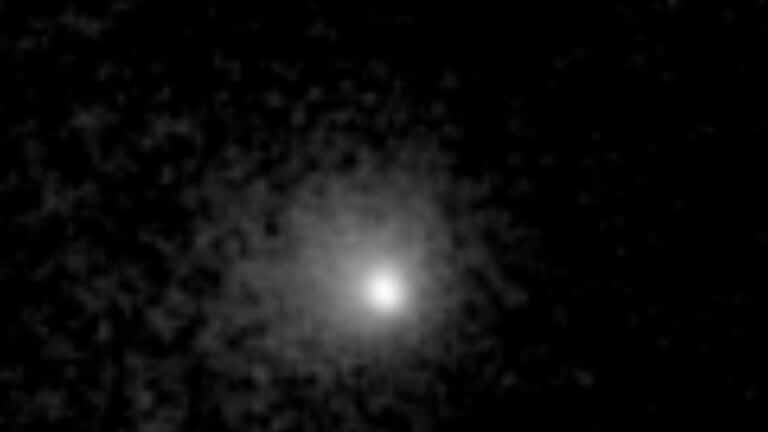
Astronomers pointing NASA’s James Webb Space Telescope at Beta Pictoris had a specific target in mind: a giant planet the scientific community had already catalogued and studied for years. Then something unexpected showed up in the data — a distinctive series of peaks and troughs, spread across the spectrum like a barcode, in a region where the team expected nothing but the smooth glow of scattered starlight.
No one had been looking for another planet. But the signal was unmistakable.
A signal no one was looking for
The team was using Webb’s NIRSpec — the Near-Infrared Spectrograph — to study the atmosphere of Beta Pictoris b, a planet astronomers know well. Then, inside the data from NIRSpec’s Integral Field Unit, an unexpected bright source appeared. With it came that barcode-like pattern: a series of carbon monoxide absorption peaks, exactly the kind of spectral signature you’d expect from a giant planet’s atmosphere.
Researchers didn’t immediately celebrate. They’ve learned to be skeptical of bright blobs in images, which can be instrumental artifacts or simply structures within the debris disk catching starlight. “We’ve learned not to trust bright blobs in images,” said Jean-Baptiste Ruffio, a research scientist at the University of California, San Diego and principal investigator of the observations.
What shifted the picture was the simultaneous spectrum. Because NIRSpec’s Integral Field Unit captures both an image and a full spectrum from every pixel at once, the team could cross-check the visual signal against its chemical fingerprint in real time. That combination — bright source plus distinctive molecular absorption — let researchers confirm a planetary atmosphere without waiting for separate follow-up observations.
Meet Beta Pictoris d: the system’s smallest known giant
Beta Pictoris sits 63 light-years from Earth and is roughly 23 million years old. In cosmic terms, that’s young — young enough that its planets are still settling into their orbits, making it one of astronomy’s most valuable laboratories for studying how planetary systems form.
The newly confirmed planet, Beta Pictoris d, is estimated to be at least twice the mass of Jupiter. That makes it the smallest of the three known giants in the system, though “smallest” is relative when you’re talking about worlds larger than anything in our own solar system. Its orbit sits at approximately 30 astronomical units from its star — comparable to Neptune’s distance from the Sun, and the widest of the three known planets — yet it still falls inside the inner edge of the debris disk.
With this discovery, Beta Pictoris becomes only the second planetary system known to host at least three directly imaged planets.

Hidden in plain sight: how the debris disk concealed a world
Beta Pictoris hosts one of the brightest debris disks ever observed. That disk is both a scientific treasure and a practical obstacle — scattering starlight in all directions, acting like fog around a streetlamp: diffuse, pervasive, hard to see through.
Traditional coronagraphic imaging works by blocking a star’s direct light. When a debris disk floods the surrounding field with scattered light, separating a planet’s glow from that background becomes extremely difficult. That’s why Beta Pictoris d stayed hidden for years, even as astronomers repeatedly studied its neighbors.
Webb’s spectroscopic approach cut through that problem by filtering for narrow molecular signatures — the kind only a planetary atmosphere produces. The disk’s diffuse glow doesn’t generate those signatures, so it effectively disappeared from the analysis. Interestingly, astronomers had already suspected something was there; the debris disk has a sharply defined inner edge and structural quirks that are hard to explain without an unseen gravitational influence. Beta Pictoris d may be exactly the missing piece those predictions called for.
Reading a planet’s atmosphere like a fingerprint
This is the first directly imaged exoplanet discovered primarily through moderate-resolution spectroscopy rather than traditional imaging. That distinction matters. The planet wasn’t found by spotting a dot of light — it was found by reading chemistry.
NIRSpec’s Integral Field Unit made that possible by delivering image and spectrum simultaneously. “A spectrum contains an incredible amount of information,” Ruffio said. “You don’t just learn that something is a planet; you immediately begin learning about its temperature, chemistry, and motion.” From the very first observation, the team already had a partial atmospheric portrait.
The carbon monoxide signal was just the beginning. Follow-up observations using Webb’s MIRI instrument detected water vapor and methane, adding further layers to the planet’s atmospheric profile. Spectroscopy also revealed the planet’s radial velocity — its speed along the line of sight — which confirmed it was orbiting Beta Pictoris rather than being a distant background object that happened to align with the system.
What this means for finding worlds beyond our solar system
The implications reach well beyond this one system. Debris disks and bright stellar environments have long been blind spots for planet hunters, and if spectroscopy can identify planets through atmospheric chemistry alone, those blind spots shrink considerably.
Confidence in the discovery is reinforced by an independent confirmation. A separate study, led by researchers at the University of Edinburgh and the European Southern Observatory, used data from the Very Large Telescope and Webb’s NIRCam instrument to confirm Beta Pictoris d’s existence through imaging — a parallel path arriving at the same destination.
The discovery team plans to continue analyzing Webb’s data to refine the planet’s temperature, full atmospheric composition, and orbital parameters. Each new measurement sharpens the picture of a world that, until recently, no one knew existed.
More broadly, this result suggests that the next major exoplanet discoveries may not come from building bigger coronagraphs or waiting for clearer skies. They may come from listening more carefully to what planetary atmospheres are already broadcasting — in systems astronomers thought they already understood.
Read the whole thing?
Get the week's signal, not the noise
Our sharpest reporting on energy, climate and nature — free, once a week.