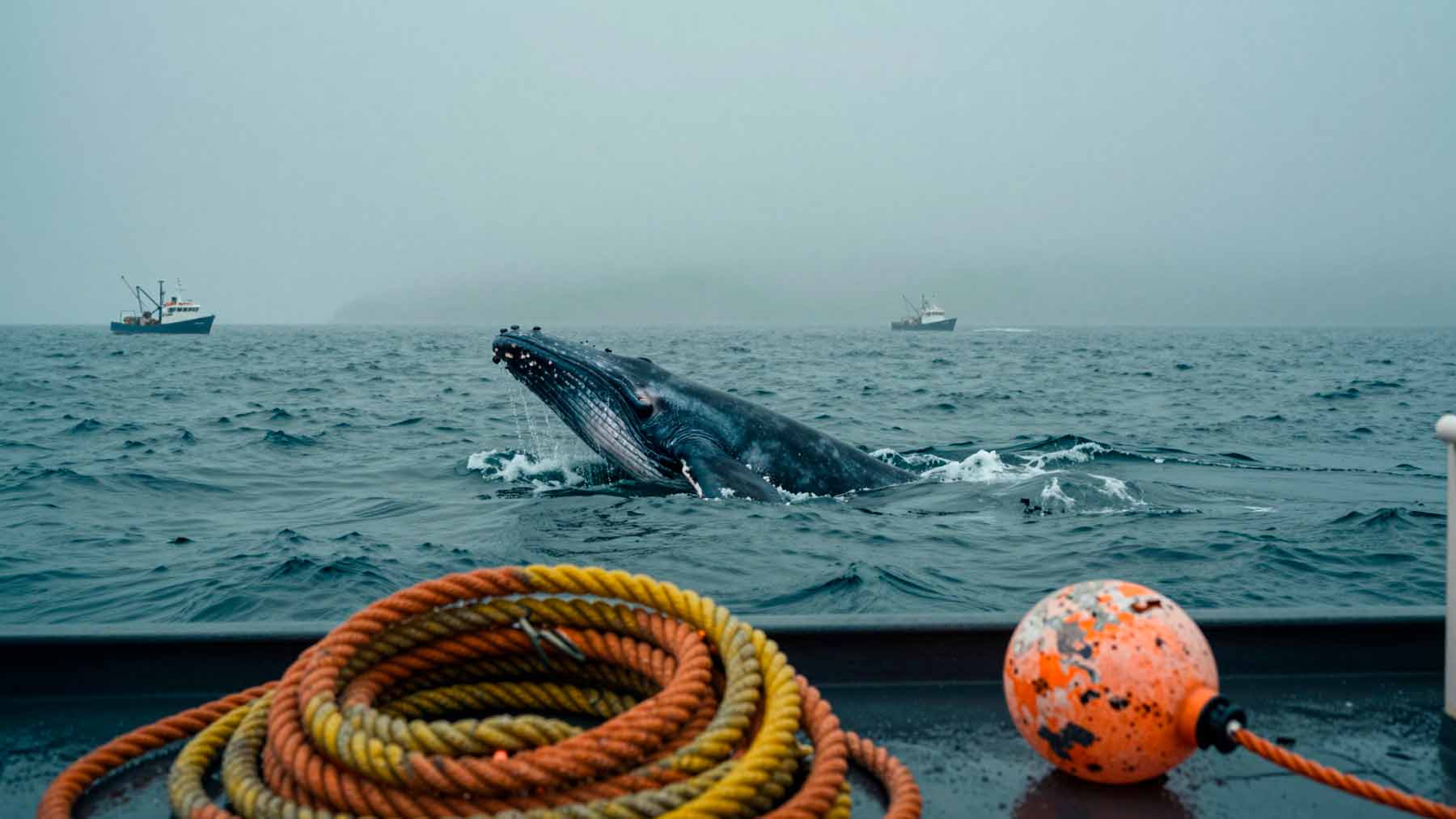
Off the West Coast, at least 400 whales have been caught in fishing gear over the past decade. In Oregon alone, 2025 is already the worst year on record for humpback entanglements in the Dungeness crab fishery — four confirmed cases, and counting.
The pattern isn’t random. Warming waters are drawing humpbacks closer to shore, where commercial crab traps blanket the seafloor, each tethered to the surface by a vertical rope. In late July, a humpback was found entangled roughly 20 miles off the Oregon coast — so severely it was left unable to feed. What happens next to a whale in that condition is rarely good.
A growing collision between crab traps and whales
Between 2015 and 2025, at least 400 whales were caught in fishing gear off Washington, Oregon, and California, according to the National Marine Fisheries Service. Humpbacks account for the largest share — not by coincidence, but by biology. Their feeding season runs almost perfectly parallel to crabbing season, putting them in direct contact with commercial gear at the worst possible time.
Warming ocean temperatures are shifting humpback feeding grounds closer to shore and into zones where crab traps are most densely concentrated, compounding an already difficult situation.
Why vertical ropes are so dangerous — and so hard to eliminate
During crabbing season, hundreds of traps sit on the seafloor, each connected by a vertical rope running straight up to a surface buoy. Whales moving through those waters — feeding, diving, surfacing — can swim directly into those lines, suffering severe injuries, losing the ability to feed, or drowning.
Oregon’s two humpback populations can’t absorb those losses: one is listed as threatened under the Endangered Species Act, the other as endangered. There’s a legal wrinkle on top of all that — current Oregon law requires all pot and trap gear to be marked at the surface with a buoy, making ropeless gear technically unlawful. For now.
How pop-up gear works — and what California already learned
Pop-up, or ropeless, gear stores the rope and buoy with the trap on the seafloor. When a fisherman is ready to retrieve the catch, a timer or remote trigger releases the line, which uncoils upward to the surface, leaving the water column clear most of the time. California began issuing experimental permits in 2023 and later expanded authorization for wider use.
San Francisco fisherman Brand Little initially wanted nothing to do with it — he went out specifically to prove the gear wouldn’t work. It did. Now fully converted and using a long-lining technique with two pop-up units anchoring 25 traps, Little estimates the average investment came to around $30,000, and says every fisherman who spent that amount recouped it within the first few weeks.
Oregon’s cautious path toward ropeless crabbing
Oregon is moving in the same direction, but more slowly. The Oregon Fish and Wildlife Commission adopted rules that would allow experimental pop-up gear permits as early as spring 2027, with broader authorization possible if early tests go well. Because Oregon’s crabbing season hasn’t been shortened the way California’s has, fishermen face less immediate pressure to switch.
The commission also adopted a separate requirement: starting in February, fishermen must share vessel location data with state managers via cellular networks. Several small-boat fishermen pushed back on cost and equipment fragility. The state has secured federal funding to reimburse permit holders up to $800 for equipment, though critics say that figure may not cover the full burden.
Conservationists say the rules don’t go far enough
Conservation groups welcomed the new gear rules but raised serious objections to Oregon’s draft conservation plan, which proposes allowing up to 67 humpback entanglements over 15 years — roughly four per year. Critics argue that figure simply codifies 2025’s record-worst outcomes rather than setting any higher bar.
The confirmed numbers may also understate real harm by a wide margin. Ben Enticknap, a senior scientist at Oceana, noted that NMFS scientists estimate only about one in five entanglements is ever detected — meaning the four confirmed 2025 cases could represent a fraction of what actually occurred. Advocates are pushing Oregon to formally incorporate unobserved entanglements into its conservation planning, a step the state has not yet taken.
Read the whole thing?
Get the week's signal, not the noise
Our sharpest reporting on energy, climate and nature — free, once a week.