
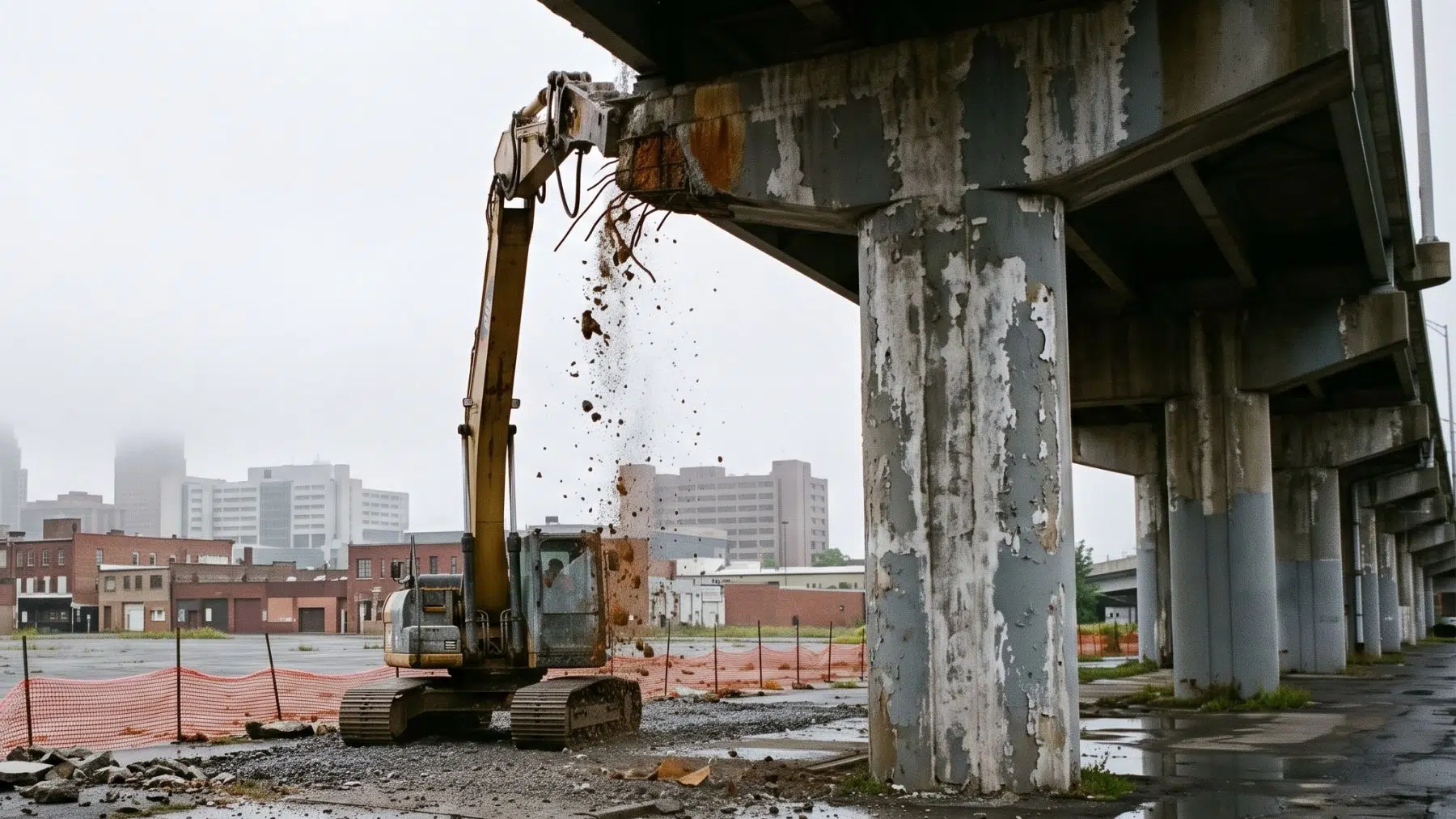
The I-81 viaduct has run through the middle of Syracuse for more than half a century.
It is coming out, and the figure attached to that job is widely repeated and no longer accurate.
The neighborhood it replaced is the reason anybody argued about the thing for four decades.
The arithmetic underneath is the part that has changed most recently.
Both belong in the same story, and usually only one of them gets told.
The number everyone quotes is the old one
The project has been described as a 2.25 billion dollar job for years, and that figure was the budget rather than the bill.
Then the contracts started landing. Five phase one contracts came to over a billion between them, and three of those are already finished.
They covered the interchanges, the ramps and the conversion of the old route through town, and none of them touched the viaduct itself.
The demolition contract went out at the end of July, and it was awarded at just over 2 billion dollars on its own.
That single award is the largest roadbuilding contract the state transportation department has ever signed, by a wide margin.
Put the two phases side by side and the job is already well past three billion, which is not the number in circulation.
What stood there first
The neighborhood was the 15th Ward, and it was where almost the entire Black population of the city lived and worked.
By the middle of the century, eight of every nine Black residents of Syracuse were inside its boundaries.
The viaduct went up across the second half of the sixties, alongside a separate urban renewal program clearing the same ground at the same time.
Between the two of them, somewhere between 1,300 and 2,200 families lost their homes.
Roughly nine in ten of the ward’s buildings came down over those years, which reads closer to erasure than to redevelopment.
Most of those households resettled just to the south of the new road, meaning they ended up living in its shadow rather than anywhere away from it.
The same shape in other cities
Syracuse was not unusual in any of this, which is the uncomfortable part of the story.
More than 40,000 miles of interstate were laid across the country, and the cheapest land to take repeatedly turned out to run through the neighborhoods with the least leverage.
In Detroit, the road that became I-375 went through Black Bottom and Paradise Valley and displaced an estimated 130,000 people.
That stretch is being converted into a surface boulevard under exactly the same reasoning being applied here.
In Buffalo, an expressway was cut down the middle of a parkway laid out by the designer of Central Park, taking the tree canopy with it.
Three cities, one template, and in every case the concrete outlasted almost everybody who had objected to it going up.
What goes in its place
The replacement is called a community grid, and the name is a good deal duller than the change it describes.
All 1.4 miles of elevated structure come out. Nothing is being kept as a monument, a walkway or a linear park.
Through traffic moves to the eastern bypass, which is redesignated as the main route, while the old line becomes a slower street along a rebuilt Almond Street corridor.
That corridor gets sidewalks, shared paths, planting and lighting, plus rebuilt utilities under 25 local streets, as the project summary lays out.
Federal money is attached to the repair framing specifically, including 180 million dollars from a program built to reconnect divided neighborhoods, as the grant announcement states.
The same logic turns up around an offshore array or a fenced solar site, which is that the land underneath the infrastructure is the actual asset.
What has not been settled
The viaduct is expected to close to through traffic late this year, and demolition could begin before the year is out.
Full completion is scheduled for 2029, which still means several more years of heavy construction straight through the middle of a working city.
A local hiring rule requires at least 15 percent of work hours to go to city residents or to Onondaga Nation workers.
By late 2024 that rule had put 136 people onto the job, which is a real number and a small one.
What remains unresolved is who ends up living on the reconnected blocks once that land is worth something again.
Property values along a torn out highway tend to move fast, and the households still there are the ones with the least room to absorb it.
Taking a wall down is the straightforward half of it. Deciding who gets to stay afterwards is the part still being argued over.
Read the whole thing?
Get the week's signal, not the noise
Our sharpest reporting on energy, climate and nature — free, once a week.


