The call came in at 1:45 on a Sunday afternoon, northeast of Point Judith, Rhode Island.
A tugboat crew noticed something wrong behind them.
Their barge was tilting.
It was loaded with steel and concrete pilings bound for an airport job in Boston.
Water was getting in somewhere below deck.
What the crew did next kept a sinking barge out of a shipping channel.
Two flooded compartments on one side tipped the loaded barge
A deck cargo barge floats on sealed void spaces, empty compartments built into the hull that do nothing at all until one of them floods. Coast Guard accounts describe flooding in the barge’s port void spaces, with the crew observing the barge listing to port while under tow from Virginia to Boston. Water on one side alone takes away buoyancy on that side, and the deck leans toward it, the way a bathtub toy tips once one corner goes under.
Once that lean starts, it tends to feed itself. The low side sits deeper, and any opening on it takes on more water still.
Pumps can fight it, but only if they move water faster than the hull admits it. Putting the hull onto a known patch of shallow bottom trades a possible uncontrolled sinking for a stable rest in water too shallow to swallow the barge whole. Coast Guard officials said the tug decided to intentionally soft ground the barge near Bonnet Shores in Narragansett so that it would not sink or block the channel. It is less a wreck than a controlled parking job, and it buys time without closing a lane other vessels rely on.
Pilings slid loose during the lean toward Bonnet Shores
As the barge tilted, some of its cargo did not stay put. The Coast Guard said the barge was successfully grounded with no pollution risks, but that some steel and concrete pilings did fall overboard. Picture a flatbed trailer braking hard enough that boxes slide off the back, except the trailer is floating and the boxes are pilings meant to anchor airport infrastructure.
Those pilings are not small objects. They are long steel and concrete pilings, shafts driven deep into seabed and foundation material to carry heavy loads above them.
Losing even a handful over the side turns a cargo delay into an underwater hazard that has to be tracked down one piece at a time. The Coast Guard advised boaters to keep clear of the area while it worked to locate and mark the submerged pilings, since a piling resting just under the surface is nearly invisible to a passing hull.
Crews pumped the hull dry within a day
By Monday morning, the operation had shifted from crisis to cleanup. The barge was dewatered Monday morning and taken under tow to a commercial facility at Quonset, a peninsula in North Kingstown, where crews would resecure the remaining cargo and the vessel would be inspected. Pumping those compartments dry reversed the exact imbalance that had caused the list.
Even so, the barge could not simply carry on to Boston. In a public update, the Coast Guard said initial assessments showed no visible indication of structural damage to the barge itself, but that a full inspection would be required. A hull that nearly went under gets a thorough inspection before anyone trusts it with another load of heavy pilings.
The official language stayed deliberately flat. The release described the barge as successfully grounded with no pollution risks and remaining in a non distress status, a classification that kept the response at the level of salvage rather than rescue. The reason the barge began taking on water remained under investigation.
Contractors had to find and mark every sunken piling
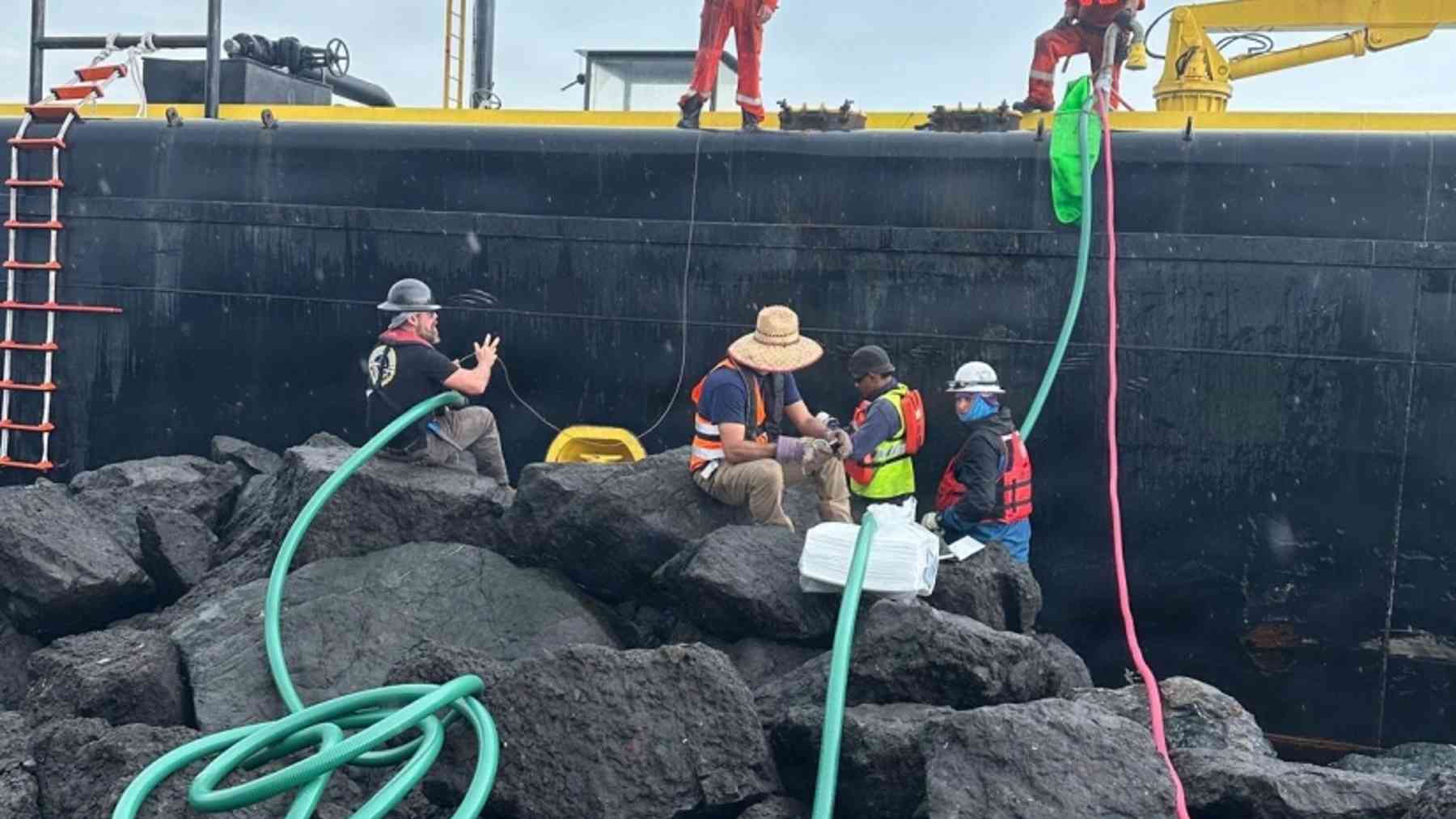
Locating scattered pilings on a seabed is slower work than it sounds. The Coast Guard said it was working with a contracted salvage company to locate and mark the submerged pilings and warn boaters of the underwater obstructions. Each one has to be pinpointed individually before the area can be treated as clear.
According to a report on the refloating, the barge was successfully refloated and placed under tow to the Quonset facility once the void spaces were cleared. That detail connects this incident to a wider pattern on American transport routes, where heavy cargo loosened mid transit becomes its own hazard long after the vessel or truck has moved on. It echoes a scattered load cleared on a North Dakota road, except here the debris sits underwater and has to be swept rather than shoveled.
Elsewhere on the water, a towboat pushing barges shows how thin the margin can be between routine and emergency, as in this grounding near an Ohio River jetty.
The barge was cleared to finish the run to Boston
With the hull pumped dry and an inspection ahead of it, the barge was not written off. The Coast Guard said that once all the required inspections were completed and the cargo recovered, the barge would continue on its way to Boston. The pilings that stayed aboard still had an airport construction project waiting for them.
It is a reminder that mundane construction cargo can turn into a multi day operation involving a tug crew’s quick judgment and a long list of parties ashore. The Coast Guard said it continued to coordinate response efforts with the barge operator, the American Bureau of Shipping and the designated salvage company.
No pollution was reported, and the channel stayed open. The lasting trace is a patch of seabed near Bonnet Shores that boaters were asked to approach carefully while the lost cargo was found and marked.
Read the whole thing?
Get the week's signal, not the noise
Our sharpest reporting on energy, climate and nature — free, once a week.