On a mild March night in Keene, New Hampshire, a constellation of flashlights bobs along a darkened street as rain falls on a crew of volunteers in reflective vests. Their mission: escort hundreds of wood frogs, spring peepers, and salamanders across a two-lane road before the next car comes.
This nightly ritual repeats every spring across New England — and it points to a problem no volunteer brigade can fully solve. As wild lands grow more fragmented, communities are beginning to ask whether there’s a more permanent answer buried just beneath the asphalt.
A road stands between salamanders and survival
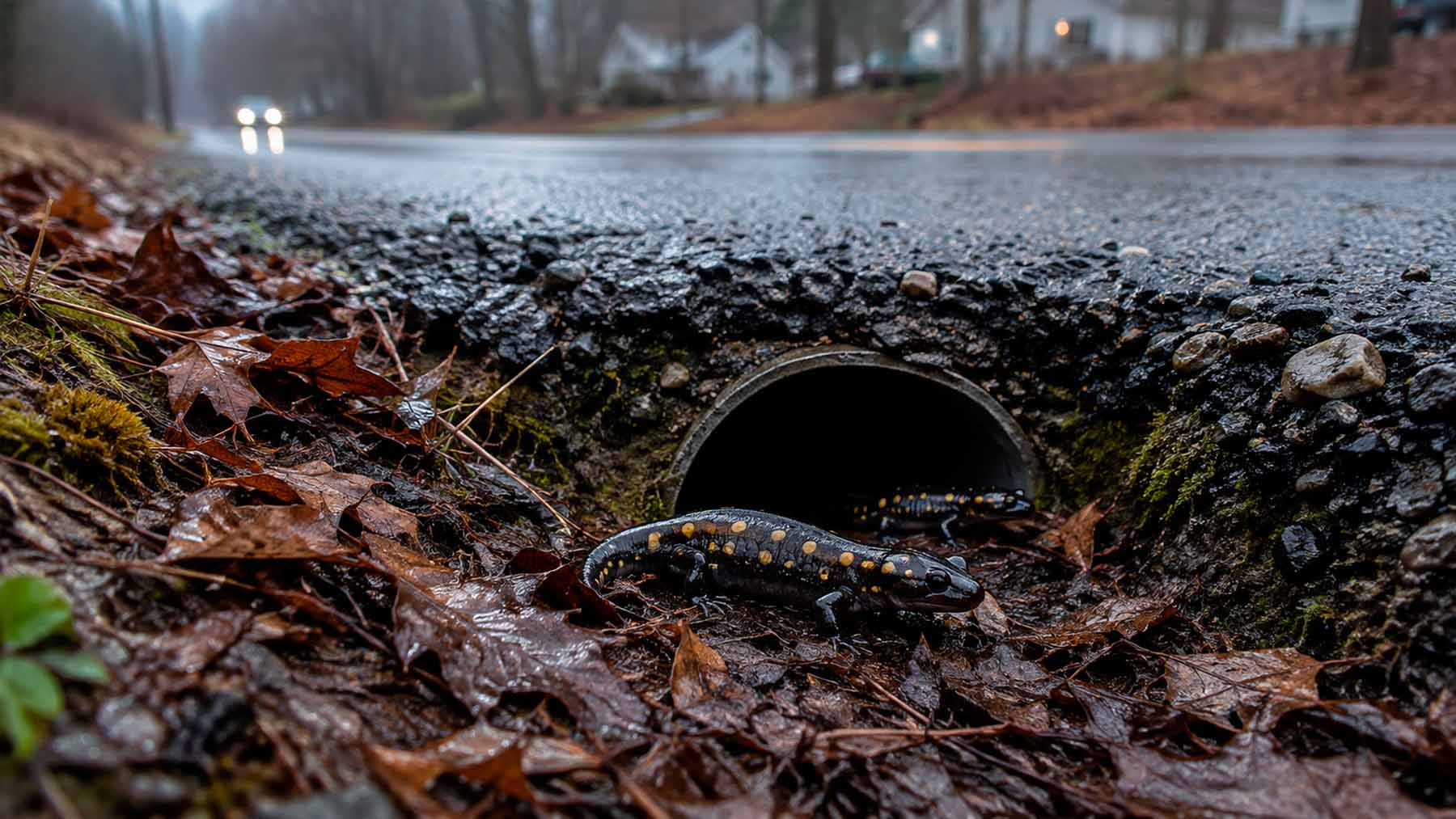
North Lincoln Street and Jordan Road in Keene aren’t busy by any urban standard. But for wood frogs, spring peepers, red-backed salamanders, spotted salamanders, and the imperiled Jefferson complex salamanders, they represent a gauntlet run every spring. These animals must cross the asphalt to reach the wetlands where they breed — the same wetlands their ancestors have used for thousands of years.
Volunteer crossing brigades help, but the approach has real limits. It depends on who shows up, how long they can stand in the rain, whether the road can be closed at all. Brett Amy Thelen, science director for the Harris Center for Conservation Education, has organized these efforts for years. Brigades are “the first step, not the last step,” she said — a stopgap, not a solution.
The stakes are real. Bryan Windmiller, former director of field conservation at Zoo New England, says road impacts and fragmentation are “overwhelmingly number one” among threats facing New England amphibians. Roads will keep hollowing out local populations and blocking the recovery of those already diminished, according to Mongabay.
Keene’s plan: tunnels purpose-built for amphibians
The answer taking shape in Keene is literal and physical: tunnels under the road. The Harris Center, the city of Keene, and the New Hampshire Fish and Game Department are partnering to build two or three small underpasses beneath Jordan Road. Fencing along both sides will guide amphibians directly into the passages — no road closures, no volunteer escorts required.
Jordan Road was chosen deliberately. When the state wildlife agency asked the Harris Center to identify sites with at-risk species and significant enough numbers to justify the investment, Jordan Road was the only location with a meaningful population of Jefferson complex salamanders, a hybrid classified by New Hampshire as most in need of conservation.
The numbers have been growing. This past spring, brigades counted 108 Jefferson complex salamanders at Jordan Road — nearly double the previous seasonal record. Funding comes from a National Fish and Wildlife Foundation grant, with construction targeted for summer or fall of 2026 and the tunnels ready for the spring 2028 migration.
Vermont’s proof of concept: 80% fewer deaths
Roughly 100 miles northwest of Keene, the town of Monkton, Vermont, already has the data. In 2015, Monkton installed box-shaped underpasses on Monkton Road — a site where more than 1,000 amphibians were killed trying to cross in just two nights in 2006. A study published last year found the tunnels reduced amphibian deaths at that location by 80%.
The tunnels are modest in scale — about five feet wide, with varying heights. What uses them goes well beyond the target species.
“We have thousands of pictures of mice and squirrels and small mammals,” said Chris Slesar, environmental resources coordinator at the Vermont Agency of Transportation. “We’ve got bobcat going through it, ermine. We even have bear, which was a surprise.”
Vermont’s experience makes a quiet but important point: infrastructure designed with the smallest, most vulnerable species in mind tends to work for everyone.
From fringe science to mainstream infrastructure
Wildlife crossings aren’t a new idea — France built the first ones for deer in the 1950s. What’s changed is the scale and seriousness with which transportation planners now pursue them. Colorado has built one of the largest wildlife overpasses on the planet, near the town of Greenland. California is preparing to open the Wallis Annenberg Wildlife Crossing, a major bridge over the 10-lane 101 Freeway.
The intellectual foundation shifted in the 1990s, when scientists began recognizing that isolated patches of habitat couldn’t sustain wildlife on their own. Beth Pratt, president and CEO of the Wildlife Crossing Fund, put it plainly: “We follow the science, and the science shows us we were wrong.” Road ecology has since moved from a niche academic concern to an increasingly standard consideration for transportation agencies worldwide.
Why connectivity matters beyond the road
Animals need to move. They cross landscapes to find food, water, and mates — and increasingly, to escape disruptions caused by climate-driven extreme weather. A road that interrupts that movement doesn’t just kill individual animals. It fragments populations, limits genetic exchange, and chips away at a species’ long-term resilience. The harm compounds quietly, over generations.
Habitat fragmentation driven by expanding human development is a primary reason amphibians worldwide have become rare or endangered, Windmiller noted. Public awareness of road ecology remains limited — roadkill is so routine that most people don’t register it as a policy failure. But advocates believe high-profile projects like those in Keene, Monkton, and California are shifting how people think about roads and the living world around them.
Windmiller draws a long historical comparison. Many people now look back on 19th-century whaling with genuine unease — a practice once normalized that caused enormous harm. He hopes future generations will view mass roadkill the same way: not as an unavoidable cost of getting around, but as a problem that, once understood, demanded a better answer. The tunnels going in under Jordan Road are a small piece of that answer.
Read the whole thing?
Get the week's signal, not the noise
Our sharpest reporting on energy, climate and nature — free, once a week.