The search for water in outer space is nothing new for NASA, but the liquid state is. The presence of water heavily influences the formation of giant planets, being essential for their formation, and can also be delivered to a planet by comets. On the other hand, frozen water is not fresh news outside the Solar System – Mars, Mercury, Uranus, and Neptune also have ice at their poles, just like Earth. However, recently, astronomers have wondered if more of it exists in different states.
Water is not exclusive to Earth
The moon and planets are not the only things in the cosmos that contain water in another state, and with the James Webb Telescope, new discoveries are made almost every day – including finding out a young star, slightly more massive and hotter than the sun, and younger as well, with an estimated age of 23 million years. The sun is approximately 4.6 billion years old.
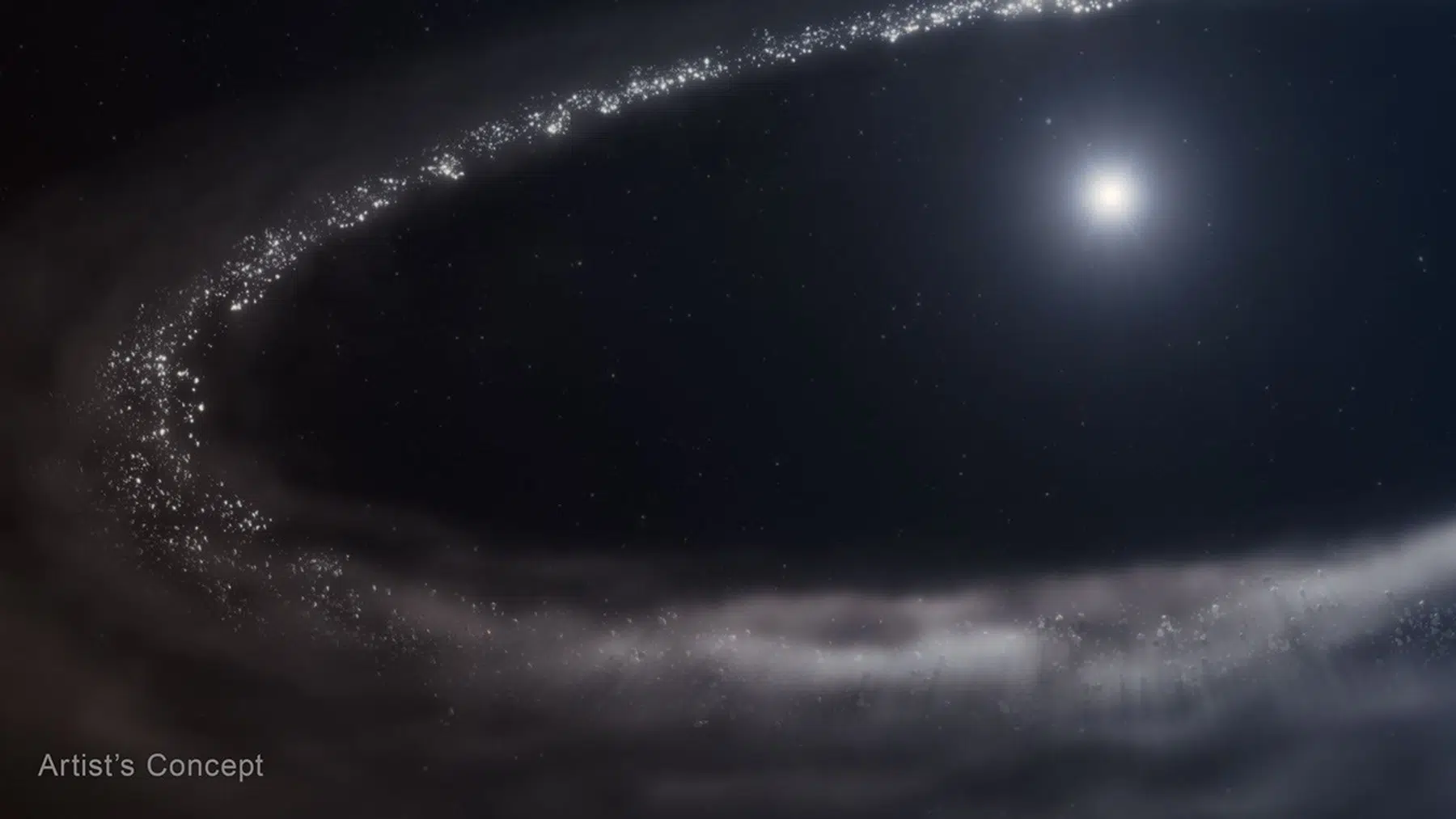
However, there’s more to it. The star, named HD 181327, is approximately 169 light-years away. While taking a look at it, the NASA’S James Webb Telescope was able to capture something strange: a significant gap between the star and the debris disk that surrounds it, and the team detected the presence of crystalline water ice in the dust-filled disk that orbits HD 181327, a theory that has never been proven until now.
NASA confirms crystalline water around distant star
The assistant research scientist at Johns Hopkins University in Baltimore and lead author of the study, Chen Xie, revealed the discovery in an article in the journal Nature, sharing that the James Webb Telescope detected crystalline water ice. Usually, it can be found in Saturn’s rings and other planetary bodies in our solar system.
Water in the solid state in the disk surrounding young stars is common and plays a major role in the formation of giant planets. It can also be delivered to fully formed rocky planets by small bodies like comets and asteroids. The discovery paves the way for scientists to study how these processes manifest in different situations, helping NASA to advance in this direction of research.
The Kuiper Belt is a common phenomenon
The belt is a region in a disc format, much further from the cosmic structure. The closest example we currently have is the Kuiper Belt, formed by ice bodies and dwarf planets like Pluto.
In the middle of the debris disk, the NASA telescope detected only about 8% water ice. The closer they got to the star, the less there was because of its heat – the star’s ultraviolet radiation vaporizes the closest water particles. Sometimes the debris disks might collide with others too. In our solar system, this can be observed on dwarf planets and comets.
James Webb’s tools made the discovery possible
To be able to observe the star, the researchers had to use NASA’s James Webb’s NIRSpec (Near-Infrared-Spectrograph), a super-sensitive structure to find dust particles detectable only from space, making this study even more precise, but it could only be discovered because of the collision of icy bodies in the debris disk.
Another co-author of the study, an astronomer at the Space Telescope Science Institute in Baltimore, shared her excitement to confirm something NASA scientists have been waiting for the definitive answer to for decades.
“When I was a graduate student 25 years ago, my advisor told me there should be ice in debris disks, but prior to Webb, we didn’t have instruments sensitive enough to make these observations. What’s most striking is that this data looks similar to the telescope’s other recent observations of Kuiper Belt objects in our own solar system.”
Read the whole thing?
Get the week's signal, not the noise
Our sharpest reporting on energy, climate and nature — free, once a week.