The race to reinvent the car engine hasn’t just been about efficiency — it’s been about identity. For over a century, combustion defined performance and culture. Then came the electric vehicles’ revolution, sweeping the industry with promises of silence, speed, and sustainability. But even as electric vehicles multiply on the road, challenges around cost, range, and infrastructure keep the door open for alternatives. In that growing space between electric and traditional fuel, a new kind of powertrain is quietly becoming popular.
The electric vehicle industry is about to change
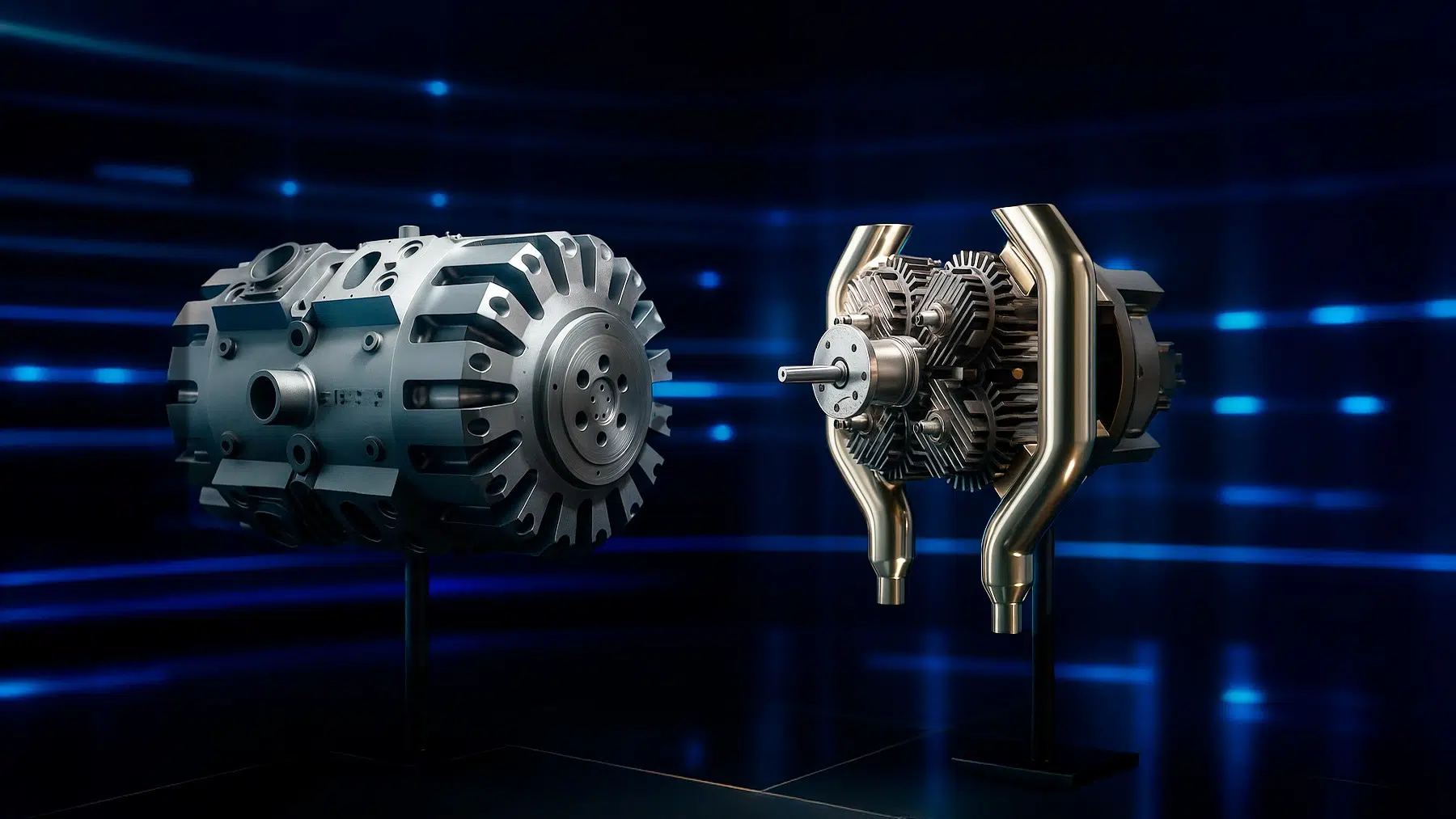
While big automakers push battery tech and government subsidies shape the electric vehicles’ timeline, smaller engineering firms are looking sideways, reimagining the engine itself instead of replacing it outright. Spain-based startup INNengine is one of them, and their creation, the e-Rex, is grabbing attention. Compact and lightweight, it’s a one-stroke rotary-style engine designed to act as a range extender for electric vehicles — a bridge between two worlds, not a full leap into one.
Now, thanks to a new partnership with U.S. manufacturer Horse, the e-Rex may be headed for American roads. The two companies are moving toward production, bringing the possibility of a third option in a debate long stuck between electricity and gas.
INNengine new engine: The e-Rex
INNengine, a company based in Granada, Spain, has introduced the e-Rex engine, which it markets as a “Patented 1Stroke” design. Despite the name, the engine operates on a conventional two-stroke combustion cycle. The terminology refers to the way the pistons complete both compression/combustion and exhaust/intake functions within a single back-and-forth motion per half revolution of the output shaft. According to the company’s logic, this cycle is counted as one “stroke,” distinguishing it from traditional two-stroke definitions.
The engine layout is an opposed-piston configuration, similar in concept to designs developed by EcoMotors and Achates Power. Instead of using two crankshafts, the e-Rex employs two interlinked swash plates—referred to as cam tracks—which deliver power to a central output shaft. This design simplifies mechanical construction, but increases internal friction and reduces low-end torque compared to crankshaft-driven systems.
A system working in perfect coordination
Each piston moves via a roller-guided mechanism that converts linear motion into rotary output through the cam tracks. A third roller engages with a secondary cam to assist in completing the piston’s return stroke after combustion gases are expelled. The engine relies on port-based gas exchange rather than poppet valves.
As the piston uncovers the exhaust and intake ports near the bottom of its stroke, spent gases are expelled, and fresh air is drawn in. This process can be assisted by the high velocity of the exhaust gases, which may create a vacuum effect to help charge the cylinder. Forced induction, such as turbocharging or supercharging, is also compatible and often necessary to optimize scavenging.
An adjustable gear system allows the cam tracks to alter their phase relationship by up to 12.8 degrees. This mechanism changes the timing between intake and exhaust events, effectively modifying the engine’s compression ratio. Lower compression settings can support boosted performance, while higher ratios are suited for naturally aspirated operation aimed at improved thermal efficiency. Compression ratios range from 9.1:1 to 16.7:1, depending on configuration.
The engine is compact and powerful
The engine’s compact dimensions—approximately 19 inches in length, 11 inches in height, and a weight of 84 pounds—make it suitable for a range of applications. INNengine claims that the e-Rex delivers 120 horsepower and 180 lb-ft of torque, with minimal vibration and emissions output. However, due to the nature of its gas exchange process, which does not utilize traditional valves or controlled combustion chamber separation, it may have trouble keeping efficient catalytic conversion without the use of additional emission control technologies.
Read the whole thing?
Get the week's signal, not the noise
Our sharpest reporting on energy, climate and nature — free, once a week.