
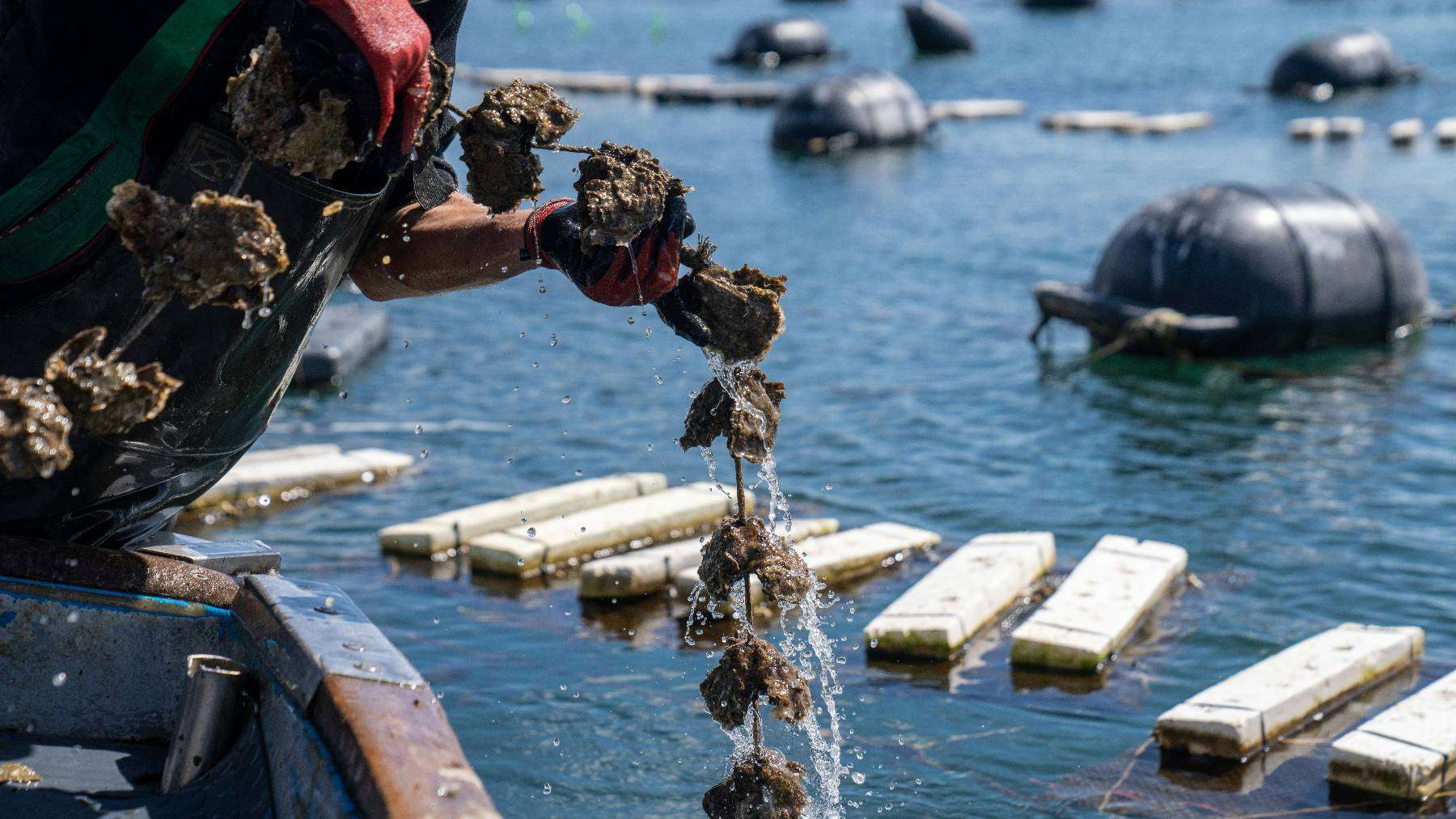
On a busy Friday night along Florida’s Gulf Coast, the shells pile up fast — dozens of oysters shucked per table, hundreds across a full house. By closing time, the bins overflow. For most of the restaurant’s history, those shells went straight to the trash.
Not anymore.
The Gulf of Mexico supplies half of all oysters eaten in the United States, anchoring a $250 million industry that stretches from fishing boats to seafood processors to the dinner table. But the wild reefs that make it possible have been quietly disappearing for decades — and an unlikely solution has been sitting in restaurant bins all along.
A $250 million industry built on vanishing reefs
The Gulf of Mexico isn’t just a place to catch fresh seafood — it’s the foundation of an entire economic ecosystem. It hosts the largest wild oyster fisheries in the world, supplying half of all oysters consumed in the United States and supporting a $250 million industry that connects commercial fishermen, oyster farmers, seafood processors, and the restaurants that plate the final product.
The stakes go well beyond dollars, though. Oyster reefs act as natural storm barriers, absorbing wave energy before it reaches shore. They filter enormous volumes of water, pulling out harmful pollutants and excess nutrients in the process. When reefs disappear, those services vanish with them — and coastal communities feel the loss in ways that never show up on a seafood menu.
Decades of damage: oil spills, floods, and habitat loss
The decline didn’t happen overnight. All five Gulf states — Texas, Louisiana, Mississippi, Alabama, and Florida — have lost a majority of their oyster reefs over time, through a combination of habitat degradation, overharvesting, and large-scale ecological disasters.
The 2010 Deepwater Horizon oil spill was a turning point, devastating reef ecosystems across the Gulf at a scale that recovery efforts are still working to address. Flooding along the Mississippi River Basin has pushed abnormal volumes of freshwater into saltwater habitats, disrupting the salinity balance oysters need to survive. A 2020 study published in Biology Letters found that most of the world’s oyster reefs have been lost over the past 200 years, and nearly one-third of those remaining are functionally extinct. The Gulf is one of the few places where reefs still function near historical levels — which makes conservation here especially urgent.
From dinner plate back to the ocean floor
The recycling initiative that emerged from this crisis is straightforward in concept. In 2007, NOAA’s Community-based Restoration Program and the Southeast Aquatic Research Partnership (SARP) launched efforts to rebuild reefs using the one material already available in abundance: used oyster shells from restaurants.
Execution is more involved than simply tossing shells back into the water. After collection, they cure outdoors for three to six months while harmful bacteria and excess tissue break down — scavengers help speed things along. Only then are the shells ready for the next step. Workers pack them into mesh bags and place them strategically along the coast, where submersion allows a thin biological coating called biofilm to develop, giving oyster larvae something to attach to and grow on. Florida alone has returned roughly 500,000 tons of recycled shells to the ocean floor this way.
More than oysters: a habitat for 170 species
Rebuilt reefs don’t just benefit oysters. Research supported by the National Science Foundation shows that restored shell reefs provide habitat for approximately 170 species of fish, crab, and shrimp — a single recycled shell becoming part of a living structure that supports an entire food web.
The math also works in the program’s favor. Shells make up 75 percent of an oyster’s total biomass, meaning the raw material for reef reconstruction is already embedded in every oyster served at a restaurant. Returning those shells to the water restores structure and function both — including the shoreline protection and water filtration that collapsed reefs can no longer provide.
Community involvement as the engine of change
None of this works without people. Restaurants, local volunteers, and conservation organizations have spent nearly two decades building the infrastructure that makes shell recycling scalable. Early concerns about disease transmission and unregulated dumping were addressed through the curing protocols and coordinated placement systems now standard across the program.
Serra Herndon, Habitat Restoration Director for Tampa Bay Watch, described the broader impact to NOAA: “When community members are involved, they realize that actions have impact. And when they go home and they tell their neighbor or friends or whomever and the positive story reverberates.”
That ripple effect is exactly what the program depends on. More restaurants joining means more shells recovered; more shells returned to the water means more reefs rebuilt. The Gulf’s oyster populations won’t recover in a single season, but with recycling programs expanding across all five Gulf states, the trajectory is shifting. The shells have always been there. Now, more communities are choosing to use them.
Read the whole thing?
Get the week's signal, not the noise
Our sharpest reporting on energy, climate and nature — free, once a week.




