
Somebody had to unbolt the street signs first.
Then the lamp brackets came off, and steel plates went down over the roadway, because the thing that was about to come through would not fit otherwise.
It was a bridge.
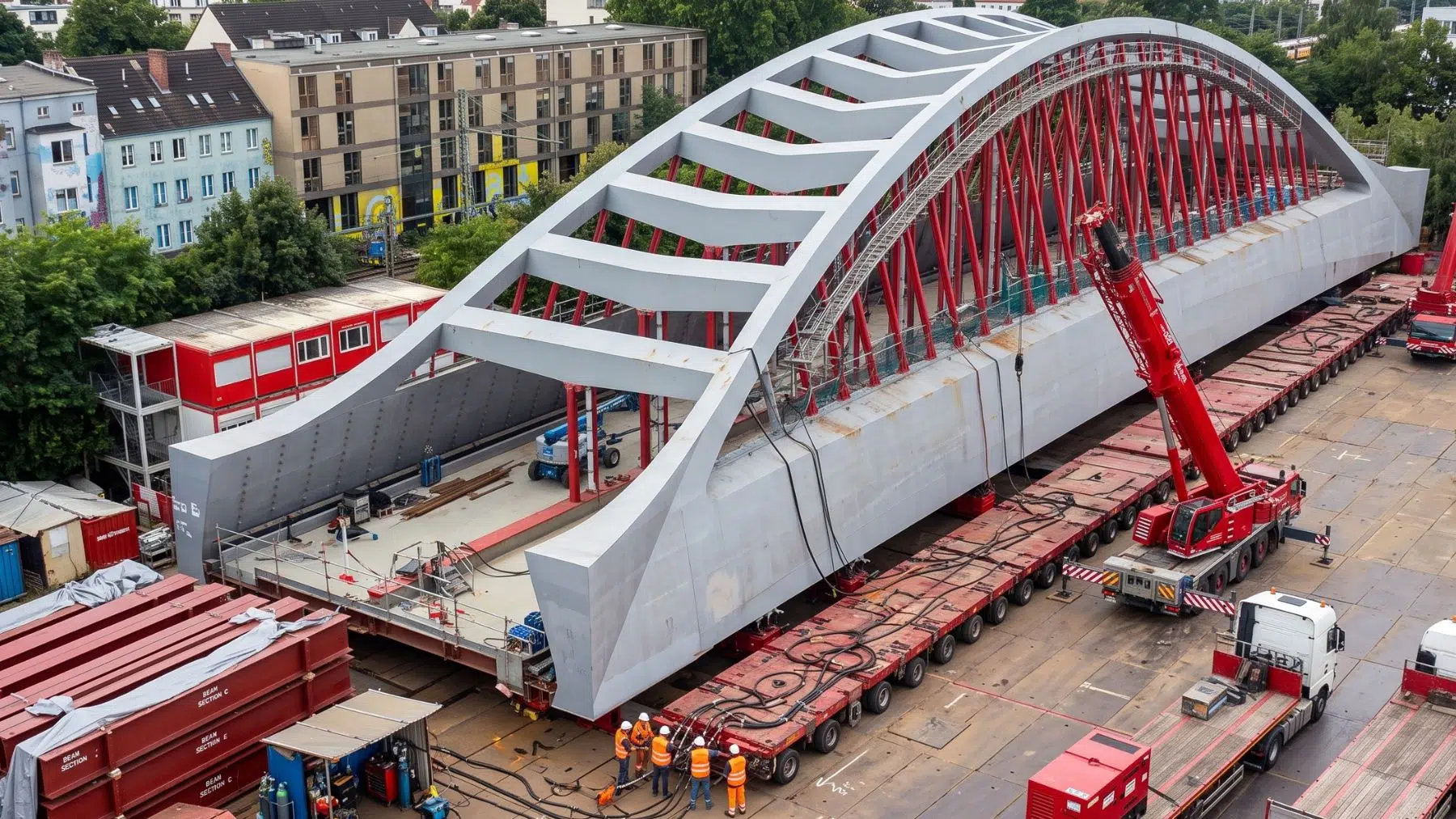
Not a bridge section, not a girder on a trailer, but the entire finished structure, arches and deck and all, driving itself down a residential street.
The whole trip was about 1,600 feet.
It took the better part of a night, and in places there were 16 inches to spare.
What was actually moving
The object is the new Sternbrücke in the Altona district of Hamburg, a tied arch railway bridge whose arches lean inward over the deck. Every part of that steel bridge was finished before it moved. It runs 354 feet long, about 69 feet wide, and it weighs somewhere close to 4,060 tons of steel.
Nothing that heavy is towed.
Instead it rode on 48 self propelled modular transporters, the low hydraulic platforms that carry refinery vessels and ship sections, coupled into one continuous carpet underneath the structure. Between them they put 1,088 wheels on the road, which is what spreads four thousand tons across asphalt that was never built for it.
And the whole convoy was capped at half a mile an hour, slow enough that anyone walking alongside had to keep stopping to wait for it.
Sixteen inches
The route ran through a dense old neighborhood, past apartment blocks that were standing there long before anyone drew this plan. At the tightest points the gap between the moving steel and the front walls was about 16 inches.
That is the width of a laptop.
Because the tolerance was that small, the transporters steer every axle independently and the whole assembly can crab sideways, rotate about its own center, and correct itself continuously as it goes. Survey marks were chalked onto the asphalt in advance and the position was watched the entire way.
Which is also why it went at night. The move began in the evening and finished the following morning, with over 100 specialists from different trades working the route in shifts.
Why nobody builds these in place any more
Here is the reasoning, and it is entirely about the railway underneath rather than the bridge above. The corridor between the main station and Altona is one of the busiest stretches in northern Germany, carrying regional, long distance, commuter and freight traffic through the same few tracks.
Every day it is shut costs real money.
So the bridge was assembled complete on a prepared site a few hundred yards away, while trains kept running underneath the old one. Only then was the line closed, the old structure taken out, and the new one driven in, which compresses years of disruption into a single planned window.
It is the same logic as prefabricating anything, applied at four thousand tons. Build the thing beside the hole, then move a year of disruption into one night of work.
The last 20 feet went straight up
Arriving is not the same as being installed. The bridge traveled the entire route riding about 20 feet off the ground, held up on the transporters so it would clear its own abutments when it got there.
Then it was set down and the transporters drove out from underneath, which is the moment an oversize load turns back into a building.
The project manager on site, Janna Widmaier, described the lift afterwards as having gone smoothly, and said the structure would now become a permanent part of the city after what had been a long public argument about replacing the old one. That last part is worth keeping in, because these projects are rarely popular with the street that hosts them, the way an urban viaduct never is.
What came out was a bridge from 1926, and the haulage trade gives the dimensions of what replaced it.
What happens after the steel stops
A bridge in position is still not a railway. Crews then bolt and grout the steel to the concrete at both ends, and only after that does the track go back on, sleeper by sleeper, with ballast and overhead wire behind it.
That work ran through the end of the month.
None of it makes a video, which is exactly why the spectacular part gets remembered and the useful part does not. The transport is eleven hours of theatre; the reconnection is weeks of fitting in a hole in the ground, and the city report follows that side of it.
Still, the image is the thing that stays. Four thousand tons of painted steel creeping between two rows of apartment windows at walking pace, at night, with a hand’s width on either side, because somebody worked out that this was cheaper than closing the railway for a year.
Read the whole thing?
Get the week's signal, not the noise
Our sharpest reporting on energy, climate and nature — free, once a week.


