
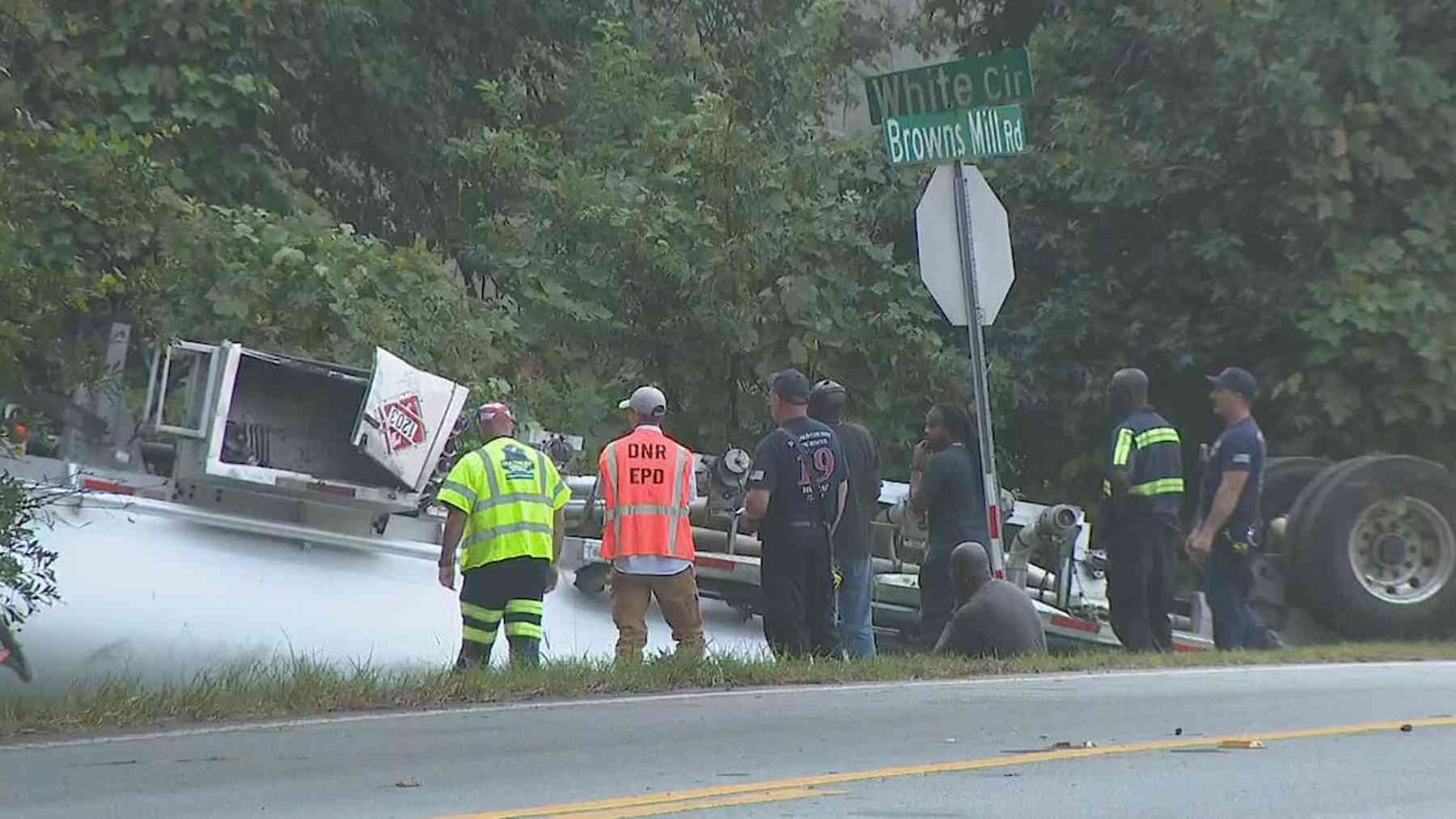
An oily film crossed the asphalt before most of the neighborhood was awake.
It found the curb, then the slot in the grate, then the dark pipe below.
The driver walked away uninjured.
Emergency crews were already moving.
That pipe, built to keep roads dry during a downpour, had just become the most efficient delivery channel the spill could have asked for. What did it connect to?
What a storm drain actually does to a spill
Most people picture storm drains as the slots in the curb that swallow rainwater. What they rarely picture is where that water goes next. In a suburban county like DeKalb, the storm drain network runs underground for miles and empties into local creeks and the broader South River watershed, with no treatment step in between. Rain goes in at the curb and comes out in the creek.
Diesel fuel is lighter than water and spreads fast across a wet surface. When it reaches a drain opening, it follows the same gravity gradient as rainfall and can travel the full length of the pipe. A thin surface sheen needs no pressure and no pump to keep moving. That is not a failure of the drain; it is exactly what the drain is engineered to do.
So the same system that protects roads from flooding became, in minutes, a potential delivery channel running straight toward the water below. That is precisely why crews raced to intercept it.
The road, the drain and where they both empty
Browns Mill Road sits in the southeastern corner of DeKalb County, in the Lithonia area close to the Rockdale County line. Stormwater from that corridor drains toward a nearby pond and creek that feed Browns Mill Lake and ultimately the South River. That is a warm water creek system, the kind that supports fish and the insect life those fish eat.
County fire crews reported that runoff was entering a storm drain and a nearby large pond, and set to work on containment immediately. The spill did not need a gap in the boom or a failure in the response. If anything reached the water, the gap was already built into the landscape, in the form of every drain opening between the rollover and the pond beyond.
The question responders faced in the first hours was how much fuel had moved through that system before crews arrived. Answering it meant sealing drains and sampling downstream rather than waiting for a sheen to appear on open water.
The sequence that matters most
The tanker rolled shortly after 4 a.m. on August 28th. Police said the driver had been attempting a turn, miscalculated and ran the truck off the road onto its side. Fire officials’ testing found no contamination in nearby waterways; most of the diesel had remained inside the tanker or soaked into the soil immediately surrounding the crash site near White Circle.
The remaining fuel was offloaded before late morning, crews uprighted the tanker, and the road reopened that afternoon while contaminated soil was hauled away.
Even so, the initial hours illustrated what response teams call a leading edge problem: the front of any plume travels faster than the information about it, and the margin between a contained spill and a contaminated creek can close in minutes. Diesel carries compounds toxic to gill breathing animals at low concentrations, and fuel can bind to sediment and persist in a streambed long after the visible sheen is gone.
A pattern hiding in plain sight
This kind of incident is not rare. What makes the geography specific is that the drain opening is the one piece of infrastructure that highway planners, trucking routes and environmental permits almost never consider together. Hazardous load routing tends to be framed around road width, bridge clearance and turning radius rather than around which curb inlet sits above a live creek tributary.
The distance between a drain and a spawning reach can be a few hundred feet of underground pipe. A loaded Virginia barge that pushed a rail lift span six feet out of line is a reminder of how often the gap in a system turns out to be structural rather than incidental.
On Browns Mill Road, the gap was the drain. Fire officials notified the U.S. Environmental Protection Agency and the Georgia State Patrol, along with the fuel company whose load the truck was hauling. That multi agency escalation follows whenever a petroleum release threatens a storm sewer. The road side of the cleanup resolved within a day; the creek side, had fuel reached it, would have taken considerably longer.
What the watershed does next
Creek health in systems like the South River is commonly tracked through macroinvertebrate populations, a standard proxy used by state and local monitoring programs. A fuel event that reaches the streambed can set those numbers back sharply, because the insects that fish eat are among the first to disappear from oiled gravel and among the slowest to return.
Recovery of invertebrate communities in a small warm water creek is measured in seasons rather than days. The sooner a boom goes in at the storm drain mouth, the smaller the zone that needs to heal. That calculus is what every hour of the early response is actually deciding.
That time pressure has a parallel in open water, where a grounded freighter that struck an uncharted shoal in the Northwest Passage faced a season closing around it. On a suburban creek, the deadline is quieter but the biology is just as impatient.
The soil went to a landfill and the road went back to carrying commuters. The storm drains will outlast the tanker’s memory by decades, still pointed at the same watershed, still waiting for the next downpour to show what is in them.
Read the whole thing?
Get the week's signal, not the noise
Our sharpest reporting on energy, climate and nature — free, once a week.


