
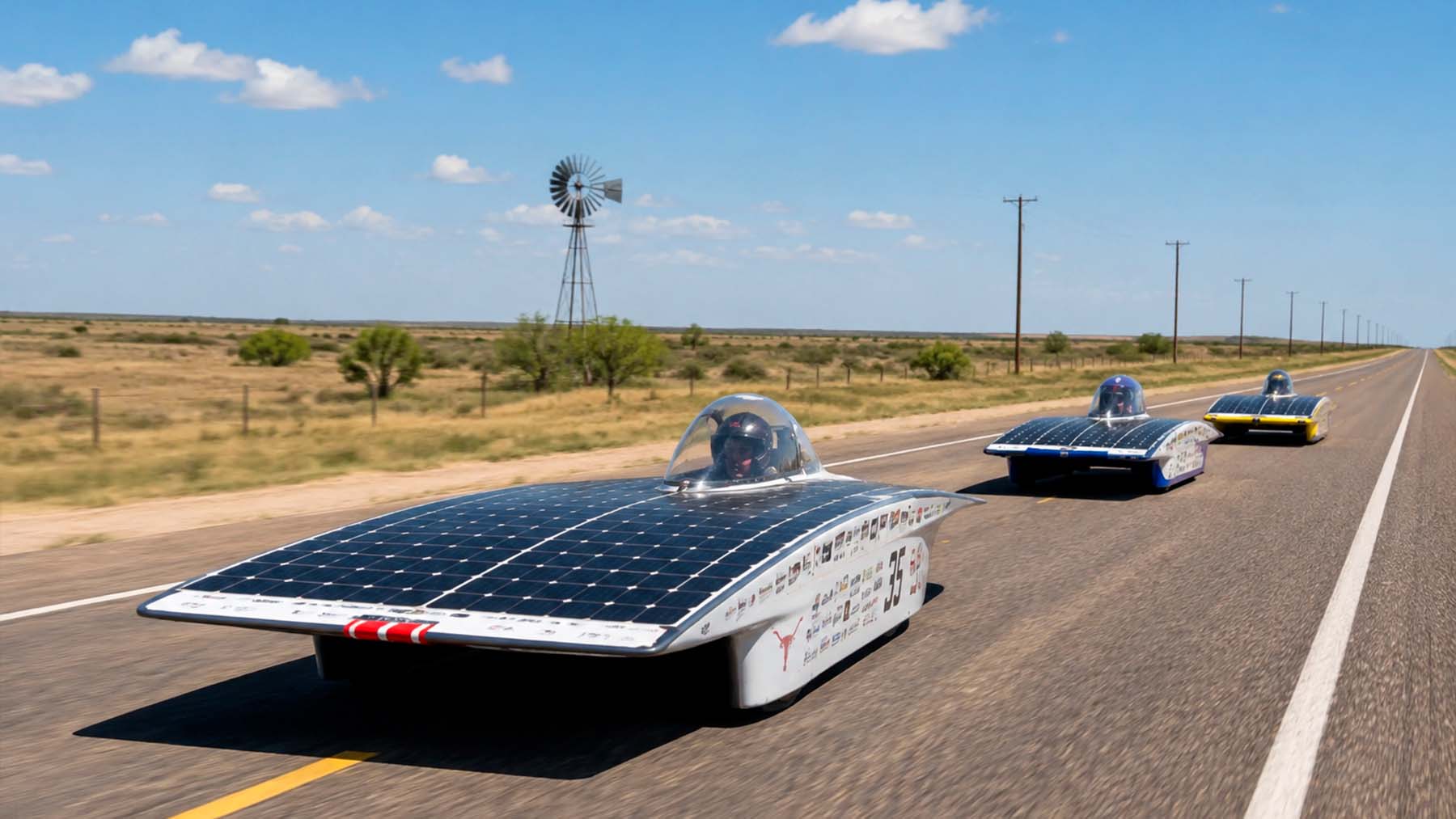
Dozens of strange-looking vehicles line up in Fort Worth, Texas — part spacecraft, part go-kart, entirely built by teenagers. No gasoline. No professional engineers. Just solar panels, off-the-shelf parts, and months of work by high school students who turned sketches into road-legal machines.
They are about to drive them 630 miles across the state.
The Solar Car Challenge, now in its 30th year, sends student-built solar vehicles on a five-day trek from Fort Worth to Fort Stockton. For the teams competing, it is one of the most demanding things a high schooler can attempt — and that is exactly the point.
A race unlike anything on the road
The Solar Car Challenge is a five-day, 630-mile race across Texas, starting in Fort Worth on July 19th and winding through Palestine, Round Rock, Fredericksburg, and San Angelo before finishing in Fort Stockton. The winner is the team that drives the most miles.
This year marks the 30th anniversary. Since its founding, the program has engaged more than 85,000 students across 39 states and multiple countries — Canada, Mexico, Spain, and Singapore among them. There are currently over 260 active high school solar car projects.
Three traditional divisions have always structured the race: classic, advanced, and electric-solar power. This year, organizers added a fourth — the cruiser division. Every category shares the same basic constraint: the only fuel allowed is sunlight.
The vehicles are flat, aerodynamic, and low to the ground, closer to wind-tunnel prototypes than anything you would park in a driveway. That tension between form and function turns out to be one of the more revealing things about the competition.
The educator who got tired of textbooks
Dr. Lehman Marks founded the competition in 1993, driven by frustration with STEM education in the late 1980s and early 1990s. His students were disengaged. Then a friend at the University of North Texas invited Marks’s class to see a collegiate solar car being built.
“We went up there and the kids were just mesmerized by the intricacy of the solar project,” Marks recalled. On the drive back, they would not stop asking him to let them build one too.
He agreed — but recognized that high schoolers could not fairly compete against college teams. So Marks created a separate competition for teenagers. The educational program launched in 1993, with the first national race held in 1995, and his mission was always about developing students: teaching project management, budgeting, fundraising, engineering, and commitment.
Building a car from scratch — and learning everything along the way
Blake Wood is 17 and already knows what it feels like to weld something, take it apart, and weld it again. As co-captain of Old Rip Racing — one of the few independent teams in the competition — he has spent the past year turning paper sketches into an actual solar car.
Old Rip Racing draws its 14 members from three different schools, a cross-school structure Wood sees as a genuine strength, one that mirrors how professional work actually functions.
The team studied successful previous cars, sketched early concepts by hand, then built CAD skills to translate those ideas into digital models. The build process is relentless. “It feels like we’re always fixing something or making something and then putting something back on,” Wood said. “And then we’re like, ‘Oh no, we need to weld in that area. Let’s take that electrical component back off.'” Marks tells every team to log 500 miles of test driving before race day.
The cruiser bet: making solar cars look real
A persistent criticism has followed the Solar Car Challenge for years: the cars do not look like cars. The flat, ultra-aerodynamic designs dominating the classic and advanced divisions leave spectators questioning their practical relevance.
The new cruiser division responds directly to that skepticism. Cruiser vehicles must seat four passengers, have four doors, include a trunk, and integrate solar cells into the body panels — requirements that force teams to think about usability alongside efficiency.
Marks is candid about why this matters. “People would say, ‘Oh, this is really neat, but it’s not reality,'” he said. “Now we can show them what it could be. And I think that’s a step up.” The cruiser division does not abandon engineering rigor so much as redirect it toward practicality and aesthetics at the same time.
Solar cars and the long road to viability
Battery-electric vehicles are now mainstream. Solar cars are not. Several startups that pursued the solar car concept have pivoted or shut down entirely.
Wood knows this but is not discouraged. “We’re making progress,” he said. “I mean, we have a whole lot of high school students making them, and I think with the right equipment and a little more expertise than maybe all of us have, I think it could definitely be possible.”
Marks points to companies like Aptera as evidence the pursuit continues professionally. He is also clear-eyed about what the challenge is actually designed to produce. “People say, ‘Well, are you trying to build a better solar car?’ Between you and me, I’m not,” he said. “I’m trying to build a student who is capable, who learns about commitment, dedication to a project, to learn about teamwork, to learn about engineering and battery technology.”
Whether solar cars ever become practical transportation is still an open question. Whether the students building them are learning something real is not.
Read the whole thing?
Get the week's signal, not the noise
Our sharpest reporting on energy, climate and nature — free, once a week.


