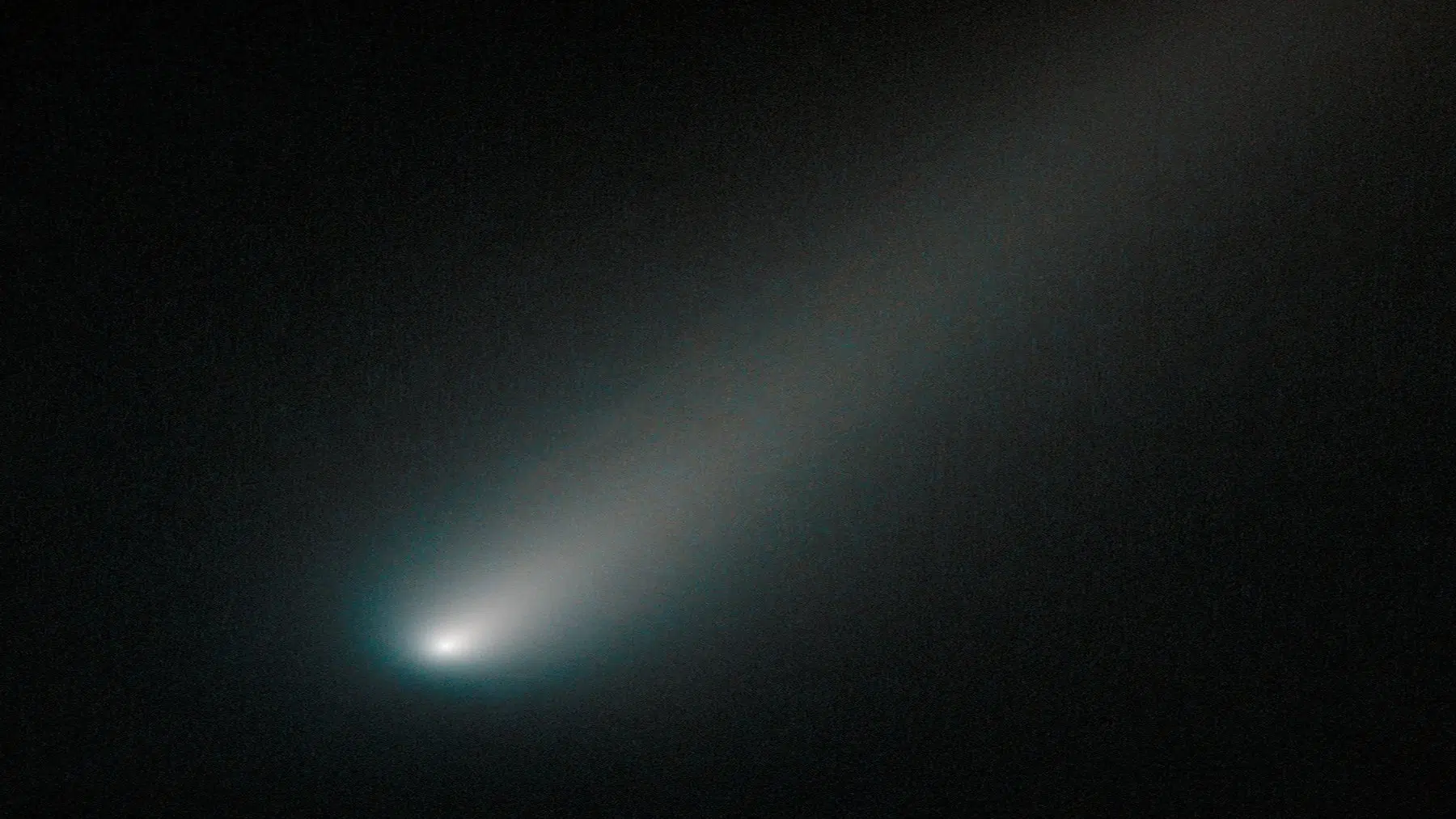
On Thanksgiving Day in 2013, a comet had an encounter with the sun, becoming one of the most talked-about space events of the 21st century. It was identified as Comet ISON and was discovered to be older than Earth. This comet appeared on Thanksgiving Day and was thought to be a once-in-a-lifetime experience for those who witnessed it, however, the comet briefly seemed to reappear, leaving scientists in awe.
Comet ISON’s history and its interaction with the sun
Based on deep research data NASA did on the comet, its approximate age is 4.5 billion years old, and it can be classified as an ancient relic in space. Its age is quite significant as it aligns with the history of our solar system. 4.5 billion years ago, the Sun was just a young protostar circled by a disc of gas and dust. In the freezing conditions of space, comet ISON formed, unlike a planet that goes through massive environmental changes, this comet remained small and cold. So when scientists observed the comet in 2013, it was not just a mere piece of ice passing by, but a capsule of time being reopened.
The Thanksgiving surprise centered around the orbital path the comet followed on that day, the analytical data recorded that the comet shot around the sun at a “dangerous trajectory”, to be specific, the comet came within 700,000 miles from the Sun’s surface. That distance might seem huge to us on Earth, but in space, this meant it was flying through the Sun’s outermost atmosphere, the corona. The sun itself is nearly a million miles wide, and at that range, the Sun’s heat is intense enough to vaporize solid rock. The Sun’s gravity alone is so powerful that it is able to tear apart anything, as its differential force is a tidal force that pulls bodies in space towards it.
The path ISON took and its miraculous reappearance
ISON followed a dangerous trajectory around the sun, being 700,000 miles away from its surface. It reached the edge of the Sun’s blinding glare, and it disappeared. Researchers had waited for hours to see if the comet would emerge from behind the Sun, but they doubted that the comet even survived. It was assumed that the comet had been disintegrated or obliterated by the heat and gravitational force, considering the distance it was traveling at from the Sun.
However, this was not the case. They observed a faint but visibly bright light streak appear from behind the Sun, it was the ISON comet, which had appeared to be intact. Many spacecraft models predicted that the comet’s survival percentage would be zero, but the comet emerged from behind the Sun, defying most pessimistic predictions. For a brief window, it seemed as if the 4.5 billion-year-old comet was tough enough to face the Sun.
Analysis of the comet after the encounter with the sun
Unfortunately, the “intact” nature of the comet was just an illusion of the original body; the surprise was short-lived, and the comet had, in fact, not fully survived the encounter with the sun. What really emerged from behind the sun was, in fact, a cloud of debris traveling together that used to be a part of the comet. The once defined structure was now a blurry cloud of debris and slowly diffused in space as its tail of light died out. The comet had not survived in a meaningful sense; it had been reduced to a mere illusion.
The 10-year Anomaly of the disappearing and reappearing comet
The Thanksgiving surprise took place on November 28, 2013, and the latest update was made on May 3, 2023. This does not mean that the comet appeared in 2013 and reappeared in 2023; this relates to the interval between the event and the analysis of data released. Even though the surprise was short-lived, the information gained from the event is still valuable and will help improve comet observations and the spacecraft models.
Read the whole thing?
Get the week's signal, not the noise
Our sharpest reporting on energy, climate and nature — free, once a week.