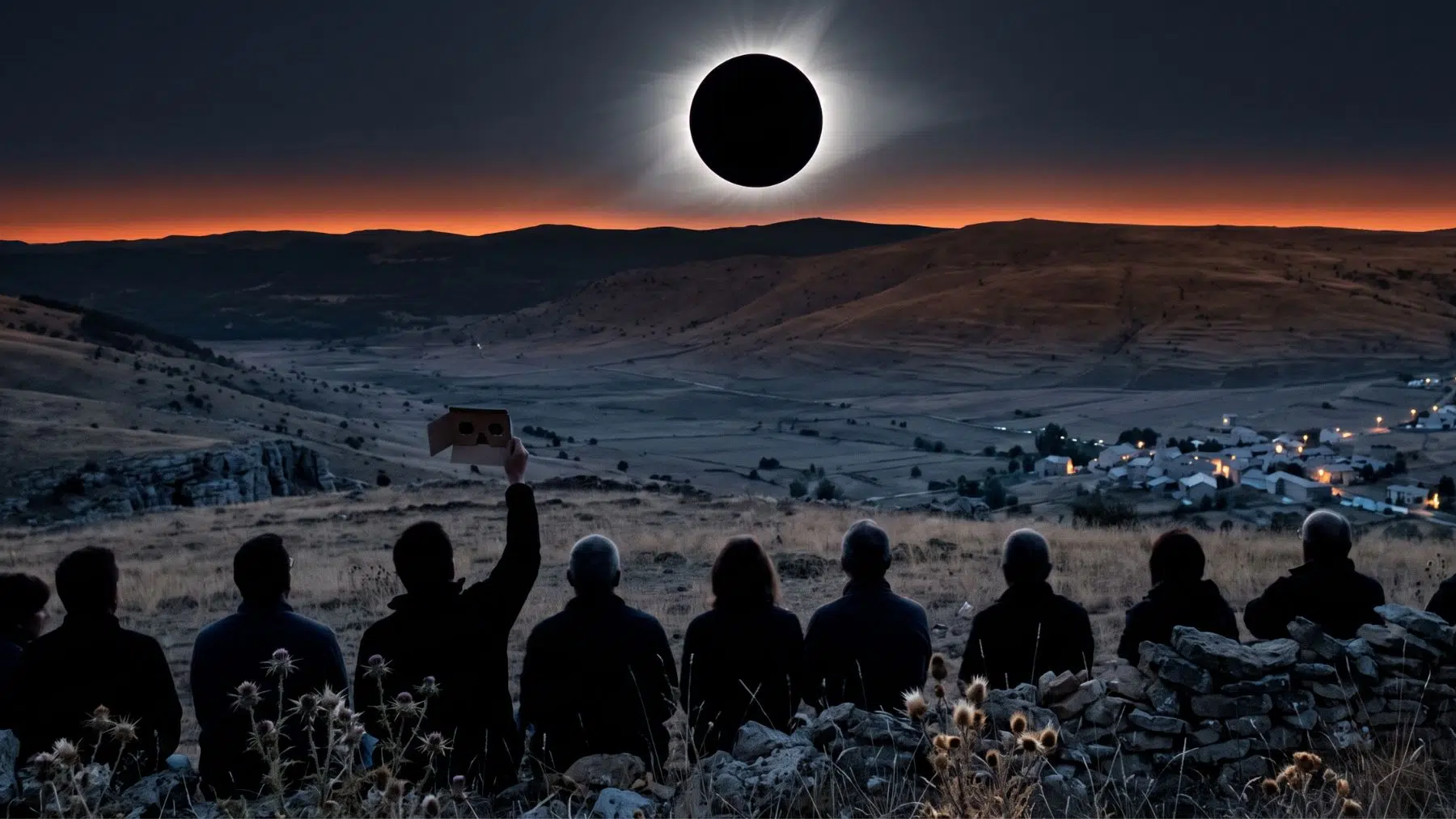
Somewhere on a ridge in northern Spain, several thousand people are standing very still.
They are all facing west, and the light is wrong.
It is late evening, an hour before sunset.
What they are watching is not down on the skyline where it should be, it is a hand’s width above it, and it is going out.
The whole horizon turns orange at once.
Then it is dark, and a ring appears.
Why it is happening almost on the skyline
This is the strange part, and it shapes everything else. Across Spain totality arrives with the sun extremely low. In A Coruña it sits at 12 degrees of altitude, in Burgos at 8, and out in Palma it is down to roughly 2, which a distant hill can hide.
Low means short.
A Coruña gets 76 seconds inside the shadow. Burgos, further along the track, gets 104 seconds. The greatest duration anywhere is 2 minutes and 18 seconds, and it falls in the Atlantic west of Iceland where nobody is standing.
A low shadow is also a visible one. A steep shadow drops on you from overhead, but a flat one can be watched coming across the ground, a wall of darkness moving over the valley toward you.
The wait, and the two that follow
The path runs from the Arctic across Greenland and Iceland and makes landfall on the Spanish coast. It crosses the country west to east through A Coruña, León, Burgos, Bilbao, Zaragoza and Valencia, and reaches the Balearics.
Madrid and Barcelona are outside it.
The last time the moon’s shadow crossed mainland Spain was in the summer of 1905, which puts 121 years between the two. Anyone alive in Spain is seeing this for the first time.
Except that Spain is about to get spoiled. There is another total eclipse in August of next year, and an annular one the January after that. Three solar eclipses inside eighteen months, then a gap running to 2053, which is the way geometry works rather than luck.
What the filter in front of your eye has to do
Here is where the evening turns from astronomy into ophthalmology. During every second of the partial phases, which is nearly the whole event, the surface of the sun is still up there and still unfiltered.
Sunglasses do nothing. Neither do two pairs.
A certified eclipse filter is not a dark lens, it is a different category of object, cutting the light by a factor of about one hundred thousand. Through a real one you see nothing except the disc itself, no landscape, no street lights, no hand in front of you.
That is the test people skip. If you can make out anything else through the filter, or the disc looks bright and comfortable rather than dim and sharp edged, the filter is wrong.
What happened in the back of one eye
There is a documented case that makes this concrete. During the American eclipse of 2017 a 26 year old woman in Staten Island watched the partial phase for 15 to 20 seconds through borrowed glasses she had been handed by a stranger.
She noticed they seemed too bright, which is the whole tell, because a filter that looks the part and behaves nothing like it is the same trap as a plastic lawn. She looked anyway.
Six hours later a dark spot appeared in her central vision, and by the next day the middle of her left eye was gone. She drew the shape of the hole she was seeing, and it came out as a crescent.
Then the imaging caught up with the drawing. Doctors at a New York eye hospital used adaptive optics to look directly at her photoreceptors and found a crescent of damage in that layer, matching the shape of the partly covered sun she had been looking at. The case report describes it plainly, and the damage is permanent. There is no treatment.
The 104 seconds when everything else notices too
None of that is a reason to stay indoors. The retina has no pain sensors, which is exactly why this injury is possible and why the rule is simple rather than a matter of judgment. Filter on for every partial second. Filter off only inside totality, when the disc is fully covered and the corona is out.
Then look up, and also look around.
Animals answer the shadow. Researchers who put microphones out in flower patches during the last American totality found that the bees stopped flying entirely for the duration and started again as the light returned, which is an animal habit nobody taught them.
Birds settle, crickets start, and the temperature drops. All of it inside a minute and a half, with the corona sitting in a band of sunset color running the whole way around the horizon, because you are standing in a shadow small enough to see the edges of. The national tables give the second by second timing for every town in the path.
Read the whole thing?
Get the week's signal, not the noise
Our sharpest reporting on energy, climate and nature — free, once a week.