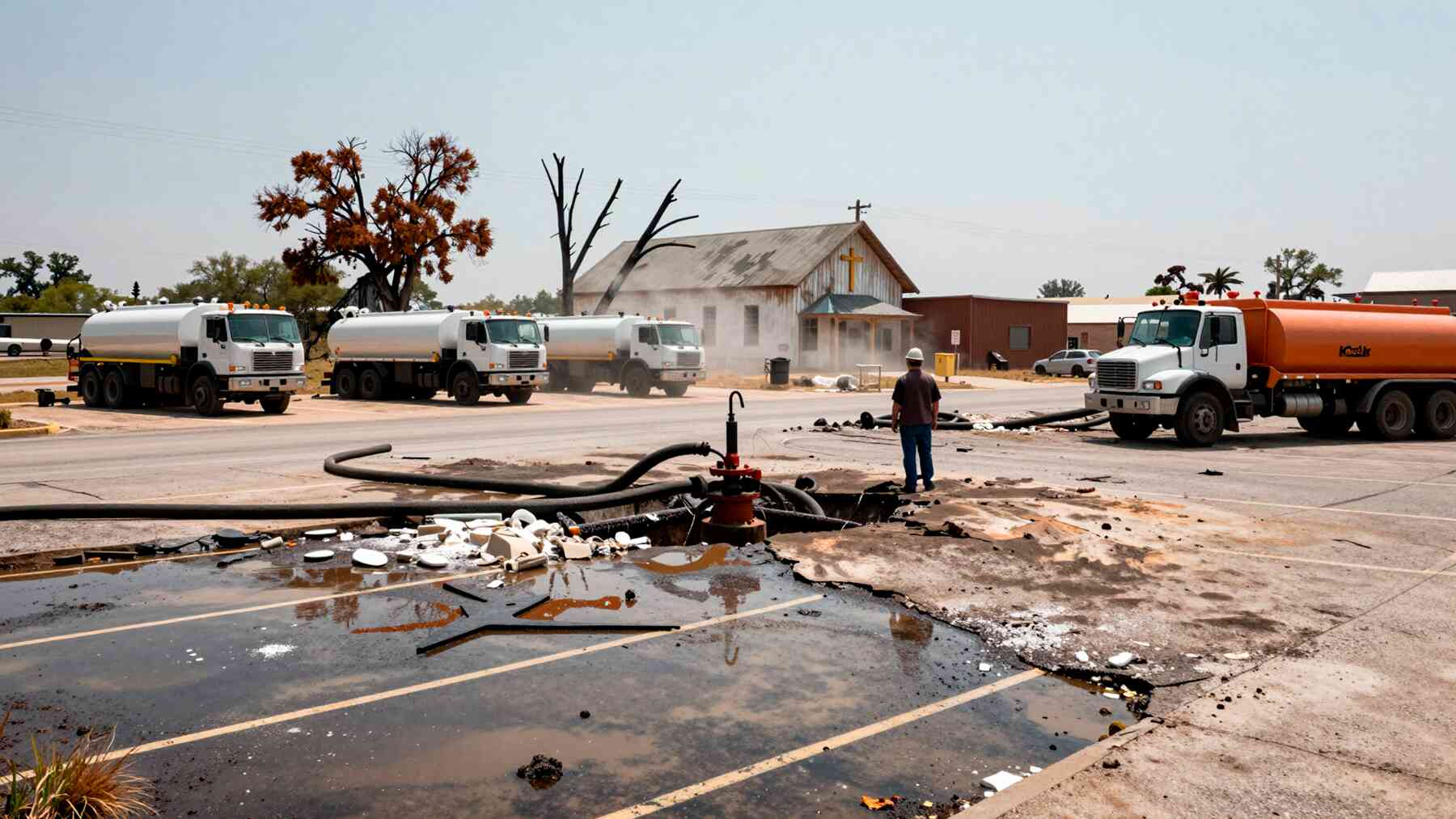
On the morning of April 21, the parking lot of First Baptist Church in Grandfalls, Texas — a town of 375 people on a quiet West Texas main street — began pushing wastewater up from the ground. Over the next eight days, more than 1.5 million gallons of toxic, salt-laden liquid poured out of an old well no one could identify. Vacuum trucks rotated in and out around the clock. The brine killed trees on church property. And the congregation’s interim pastor, an oil and gas veteran, started fielding calls from frightened neighbors who had never thought to wonder what lay beneath their feet.
A parking lot that became a geyser
At peak flow, the well was releasing seven barrels of wastewater per minute. Twenty-one vacuum trucks rotated through the First Baptist Church parking lot just to keep up. In a single 24-hour stretch between April 22 and 23, crews hauled away 6,600 barrels — roughly 277,200 gallons — of brine-laden liquid.
Lab testing in Midland confirmed what the smell and color already suggested: this was produced water. Total Dissolved Solids measured 138,771 parts per million — four times the salinity of seawater — along with elevated concentrations of chlorides and sulfates.
The well’s identity remains unresolved. Railroad Commission maps mark its location, but the agency has not confirmed when it was drilled, and records suggest it may date to the 1930s. “The RRC has located historic well records for wells in the area,” an agency spokesperson said, “but we have not yet been able to positively identify the well in question.” By April 29, crews had located the wellbore and sealed it with concrete. The final bill came to $1.49 million to plug the leak, and another $1.16 million to dispose of the wastewater.
The pastor who knew what was underground
David Tucker did not expect to become the public face of a wastewater crisis. He stepped in as interim pastor at First Baptist last summer, focused on replacing an aging air conditioning unit. Tucker is also an oil and gas industry veteran who had dealt with leaking legacy wells on his own property outside Grandfalls, so when the parking lot started pushing water, he recognized it immediately.
He praised the Railroad Commission’s response while being direct about its limits. “They’re trying to do a good job. But they don’t have the money to do it. They’re overwhelmed,” he said. “The state needs to turn loose some more money.” The saltwater killed several trees on the property, and crews accidentally cut the church’s sewer line during containment efforts. Tucker described insurance coverage for a small rural congregation as “practically nonexistent.” First Baptist is currently meeting in the Union Church across the street. Still, he sees something worth noting in the disruption. “This was kind of a good thing,” he said, “because it brought attention to what’s happening.”
Why old wells keep blowing out in the Permian Basin
The Permian Basin produces enormous quantities of oil — and even larger quantities of wastewater. For every barrel of oil extracted, operators bring up multiple barrels of “produced water,” the salty, chemical-laden liquid that surfaces with it. That water gets injected back underground into disposal wells, raising subsurface pressure over time. Pressure has to go somewhere, and increasingly it finds pathways upward through old, unplugged, or poorly documented wells.
Tucker describes the cumulative effect plainly. “We’ve turned a lot of the shale play into just one big crack,” he said. “Everything’s communicating.” The Grandfalls incident is not isolated — ranches in Crane, Pecos, and Ward Counties have experienced surface leaks, geysers, and sinkholes in recent years. What set April’s event apart was its location: directly beneath a populated town center.
A town in the crosshairs — and a wider risk
Grandfalls is a low-income community. More than 20 percent of its 375 residents live below the poverty line, and nearly half the population is Hispanic. The church sits across the street from the town’s only K-12 school. Advocates note the obvious: the next blowout may not happen under a parking lot.
Surveyor Jackie Portsmouth, who works with the firm G-Forensic, has spent months researching legacy wells beneath Midland neighborhoods and found plugged oil wells sitting under house foundations — unknown to the homeowners above them. “I’m not trying to scare anybody,” he said. “But they should at least know that these wells exist.” In Oklahoma, ProPublica reported on a family displaced by a similar leak from an old well beneath their home.
Policy responses — and unresolved tensions
State Rep. Brooks Landgraf visited the church on April 24 and has since pushed for permits allowing treated produced water to be spread on land rather than injected underground. His argument: every gallon applied on the surface is one fewer gallon pressurizing the subsurface.
Commission Shift, a nonprofit focused on oil and gas oversight in Texas, urges caution. “It’s time to stop injecting in areas that are overpressurized, where we keep seeing these problems,” said policy manager Julie Range. “The combination of overpressurized fluids and unplugged conduits is creating these very expensive messes.”
There is also a circularity problem worth naming. The 1.5 million gallons vacuumed from the First Baptist parking lot were trucked to other injection wells and pumped back underground. Well control specialist Hawk Dunlap noted the irony plainly: “You’re taking it out of one and putting it in another.” Advocates say the path forward requires sustained funding to plug legacy wells and stricter limits on new injection near homes and schools.
Read the whole thing?
Get the week's signal, not the noise
Our sharpest reporting on energy, climate and nature — free, once a week.