Wildlife workers searching for rare native insects in Hawaii did not expect to find an endangered moth surviving on islands where it was thought to have vanished. Recent field surveys proved otherwise.
Observing this species in the wild has long been remarkably rare.
Decades of habitat loss, non-native predators, and invasive competitors severely reduced its numbers.
Because the species is listed as Endangered, any confirmed sighting is crucial.
New evidence of its survival gives state wildlife officials invaluable insight to protect Hawaii’s fragile ecosystems.
Unexpected sightings on Lānaʻi and Molokaʻi
In May 2026, Division of Forestry and Wildlife (Department of Land and Natural Resources) employees identified ten Blackburn’s Sphinx Moth caterpillars in Lānaʻi City. That was unusual due to the rarity of observing the species, as well as its status as an endangered insect.
On Lānaʻi City alone, there have only been two prior record sightings of Blackburn’s Sphinx Moth since 2009, including 2025 when a single caterpillar was reported.
Collectively, these sightings suggest that there continues to be a viable population of Blackburn’s Sphinx Moth on Lānaʻi.
However, the news didn’t stop here. During May and June, the same crews discovered Blackburn’s Sphinx Moth caterpillars in Halawa Valley and Kalae on the island of Molokaʻi.
Those were the first recorded instances of the species being found on the island of Molokaʻi since the 1940s.
Observing multiple sites for caterpillars suggests that the moth had likely remained present but undiscovered.
Blackburn’s Sphinx Moth: a species resisting extinction
Blackburn’s Sphinx Moth used to exist throughout most of the main islands in Hawaii. Native insects in Hawaii continually experience pressures from habitat destruction, predation, and non-native competitors.
At the close of the 1970s, scientists concluded that the species was extinct. In 1984, the species was rediscovered on the eastern side of Maui.
Afterward, additional populations were located on Kahoʻolawe and the Big Island.
Other islands had seemingly eradicated the moth entirely. Therefore, these recent finds made them noteworthy.
Officials with Hawaii’s Department of Land and Natural Resources referred to the discoveries as surprising yet exciting.
They demonstrated that endangered insect populations can remain intact for long periods of time without documented confirmations.
The newly recorded sightings also updated researchers’ knowledge of where the moth currently exists, providing state wildlife officials with insight to inform future monitoring and recovery efforts.
This ultimately led to an inquiry as to what this elusive insect was like.
Hawaii’s giant, fast-moving native pollinator
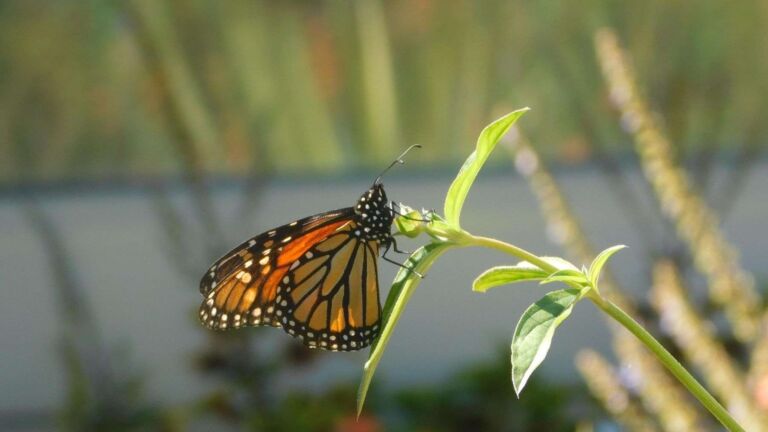
The moth is commonly referred to as Blackburn’s Sphinx Moth. It is regarded as one of Hawaii’s larger native insects.
Adult moths possess a wingspan nearing five inches.
Many describe flying patterns similar to that of hummingbirds. The moth has the ability to hover while consuming nectar from flowers.
The brown and gray coloration allows it to easily blend into its surroundings.
Due to its size and camouflage capabilities, spotting this moth is typically uncommon.
Similar characteristics apply to its larvae.
Each caterpillar features a horn projecting from its posterior area. The horn is characteristic of many sphinx moth species.
Sphinx moth caterpillars consume only specific host plant material.
Adult moths are able to obtain nutrition by consuming nectar from flowers as they travel between various food sources, helping to pollinate native plants along the way.
A new direction for island conservation
Prior to its discovery on East Maui in 1984, Blackburn’s Sphinx Moth was believed to exist across all major Hawaiian Islands.
Recent discoveries indicate that it continues to inhabit areas where officials believed it had completely disappeared.
Confirming that these populations persist on Lānaʻi and Molokaʻi changes the outlook for island conservation. It gives wildlife crews concrete target zones to focus host-plant restoration and habitat protection moving forward.
Read the whole thing?
Get the week's signal, not the noise
Our sharpest reporting on energy, climate and nature — free, once a week.