
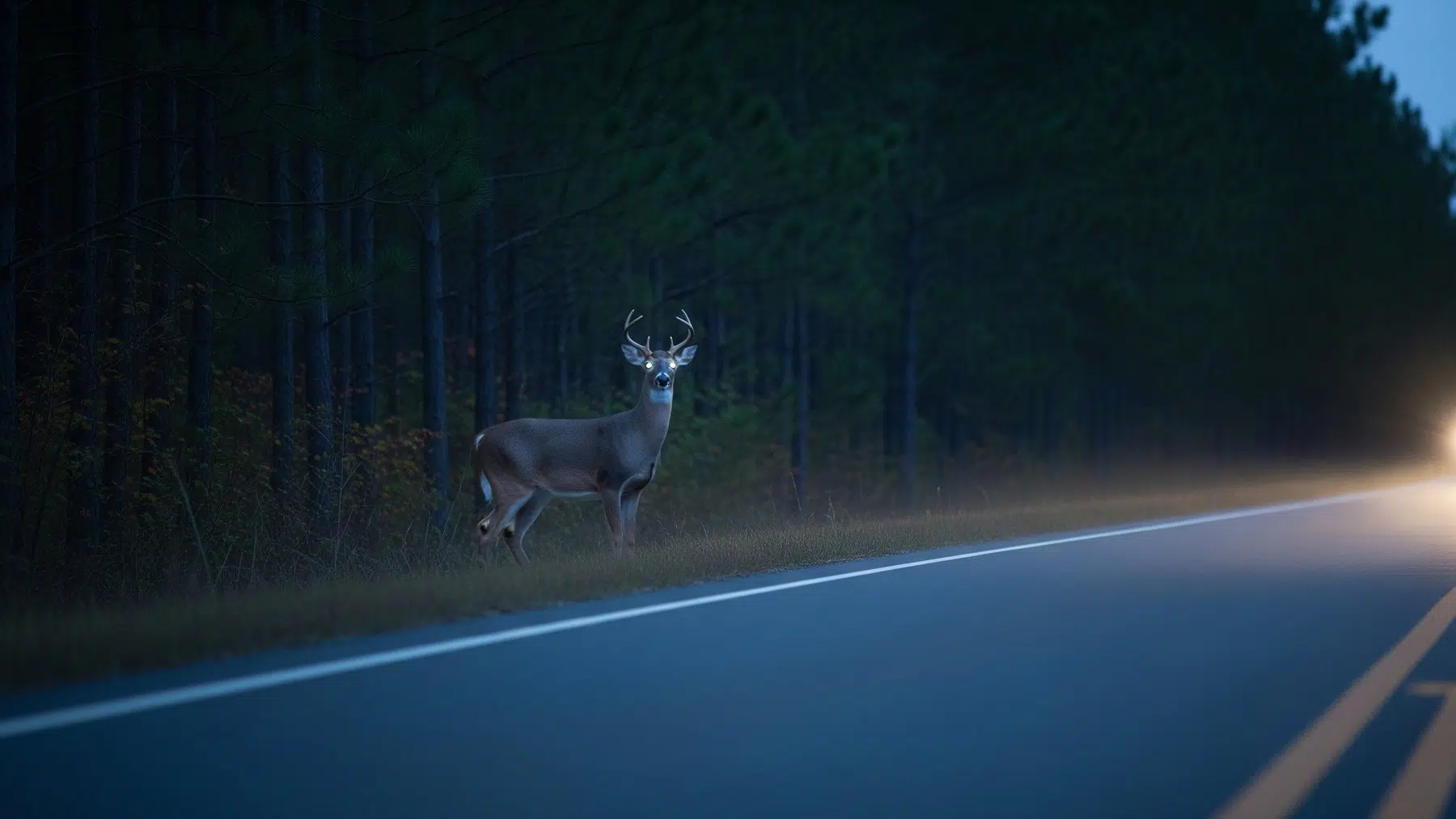
Picture a highway at dusk somewhere upstate New York, the kind of two-lane road where the tree line closes in on both sides and something large moves through the shadows at the edge of the asphalt.
Most drivers never see it coming.
Not because the animal is invisible, but because the driver’s eyes are somewhere else entirely, fixed on a small glowing rectangle in their lap.
Distracted driving has a consequence almost no road safety campaign ever puts on a poster, and it reaches far beyond the driver’s windshield, all the way into the forest.
New York drew a line that most states didn’t dare draw
In 2001, New York became the first state to enact a statewide law that bans talking on a handheld cell phone while driving.
No other state had gone that far at the time.
The law was clear: any driver caught holding a phone to their ear or tapping a screen behind the wheel faced a fine and points on their license.
Over the years, the rules tightened further, eventually covering texting, browsing, gaming and almost any physical contact with a device while the engine was running.
A first offense now carries a fine of between $50 and $200, and a conviction adds five points to a driver’s record; repeat offenses within 18 months can result in up to $450 in fines. A driver who accumulates six or more points within an eighteen-month period risks additional financial penalties and potential licence suspension.
The phone went down, but the problem found new shapes
Enforcement campaigns pushed the numbers in the right direction at first.
During a crackdown campaign in April 2025, New York State Police issued more than 22,800 tickets statewide, including 4,607 for distracted driving violations.
Yet the underlying behavior proved stubborn.
An NHTSA survey found that at any given daylight moment, approximately 660,000 drivers were using cell phones or other electronic devices on U.S. roads.
Reading a single text takes about five seconds of attention.
At 55 miles per hour, that five-second gap covers the full length of a football field.
The law changed the habit for many, but not for all, and the ones who kept glancing down were about to create a problem no traffic court could fully account for.
The football field of blindness and what lives at the edge of it
Most people picture a rear-end collision when they think about distracted driving.
A fender bender, a crunched bumper, an insurance headache.
But American roads do not run through empty concrete canyons.
They cut through forests, meadows, river corridors and the feeding ranges of tens of millions of wild animals.
At dusk on a rural stretch of highway, the creature at the greatest risk is not another driver.
It is a deer stepping out of the tree line, or a bear crossing to reach a stream, or a family of raccoons moving between a pond and a wood lot on the other side of the road.
Every lost second of attention is a window in which the animal never had a chance.
1.7 million claims and the deer that keeps the count
Here is the number that lands differently once you understand what causes it.
American drivers filed an estimated 1.7 million animal collision insurance claims in a single recent twelve-month period, according to State Farm data covering July 2024 through June 2025.
Deer top the list, followed by rodents, dogs and raccoons.
State Farm’s own survey found that just one risky driving behavior, such as speeding or using a phone, raises the chance of an animal collision by 23 percent.
That dynamic plays out on every wooded highway in the Catskills, the Adirondacks and the Finger Lakes, where deer are dense and dusk comes early in autumn.
The five-second gap of blindness removes the one element the deer was counting on: a driver who sees it in time to slow down.
Eyes back on the road, and what that restores
The hopeful turn is that the fix is the same for both problems at once.
A driver who puts the phone away protects themselves, protects other people, and gives the animal at the edge of the asphalt a fighting chance.
Wildlife crossings and fencing, where installed, have been shown to substantially reduce animal collisions on the roads they serve.
Projects like the wildlife highway corridor in North Carolina show what engineered solutions can do at scale, with green bridges and tunnels taking years and millions of dollars to build.
The cheapest wildlife crossing in existence is a driver whose eyes are on the road.
New York’s law was never just about tickets and fines.
It was, from the beginning, a bet that human attention is worth protecting, and that everything sharing the road, or the forest beside it, benefits when a driver is truly present.
The evidence from 1.7 million claims suggests the bet still needs more takers.
Read the whole thing?
Get the week's signal, not the noise
Our sharpest reporting on energy, climate and nature — free, once a week.


