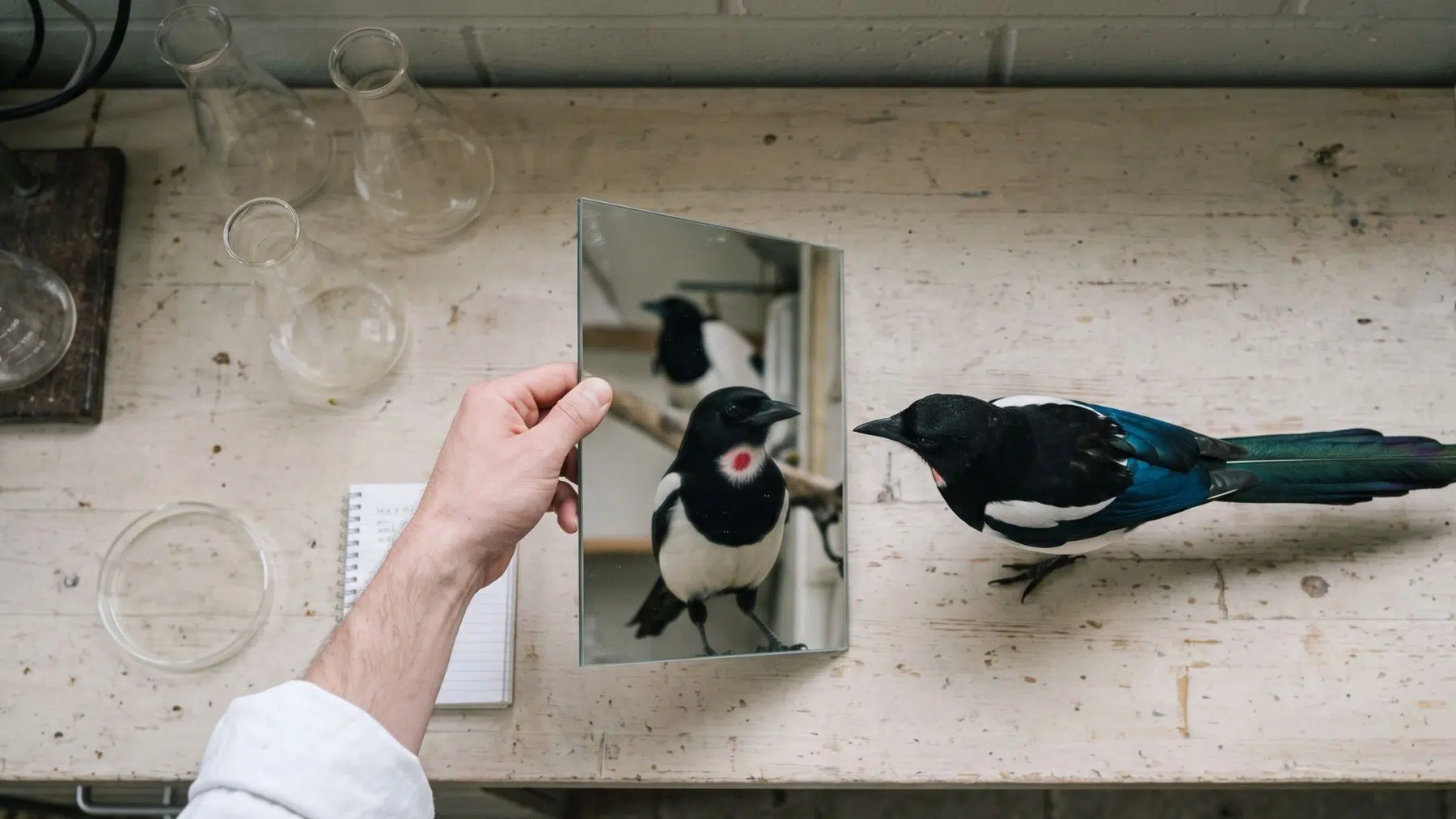
A bird stands on a bench in a German laboratory, looking at a pane of glass.
On the feathers of its throat sits a small colored dot it cannot see directly.
The bird tips its head, shifts its weight, and then reaches up with one foot and scratches at exactly that spot.
What happens in the next few seconds gets written up as evidence that this animal knows itself.
Eighteen years later, researchers are still arguing about whether it did anything at all.
The test that was built for chimpanzees
The setup goes back to 1970 and a psychologist named Gordon Gallup.
He put a mirror in front of chimpanzees, let them adjust, then anesthetized them and painted a mark on the brow.
When they woke, the animals touched the mark on their own bodies rather than reaching for the glass.
The logic is narrow and rests on one point.
Touching your own body means the reflection has to stand for you and nothing else.
Great apes passed, and over the following decades so did bottlenose dolphins and Asian elephants.
Monkeys did not, and neither did dogs, and the list of species that cleared it stayed very short.
Everything on that list had one thing in common, which was a large mammalian brain.
Why anyone put a bird in front of a mirror
The bird brain was written off for most of the last century.
Anatomists could not find a neocortex in it, the layered outer sheet of tissue that mammals use for higher processing.
Birds have a different structure entirely, called the pallium, built without those layers.
That difference is where the phrase bird brain came from.
By the 2000s the behavior was making that dismissal look ridiculous.
Corvids, the family that includes crows, ravens and jays, were caching food and remembering where.
They were bending wire into hooks and planning ahead.
So a group at the Ruhr University in Bochum picked the European magpie and set up the mirror.
The point was never the bird, it was the missing cortex.
What the five birds actually did
Helmut Prior, Ariane Schwarz and Onur Güntürkün published the work in August 2008.
Five hand raised magpies took the mirror test, and the design was carefully built.
Each bird got a colored sticker placed on the throat feathers with double sided tape, roughly 8 mm across and weighing 16 micrograms.
The throat is the one spot a magpie cannot inspect without a reflection.
Control birds got a black sticker, invisible against black plumage, to rule out them simply feeling the tape.
Two birds, named Gerti and Goldie, scratched at the colored mark far more often with the mirror present than without it.
A third, Schatzi, did it once and never repeated it.
The other two did nothing of the kind, so the honest count is two of five.
What a larger group of scientists found when they ran it again
The finding traveled fast, because the implication was large.
The authors wrote that the result proves the neocortex is not a prerequisite for self recognition, in the published paper.
That is the opposite of how the study is usually retold.
The magpie has no neocortex, and that absence is the entire point of the experiment.
Then in 2020 a Spanish team led by Manuel Soler ran it again with a larger sample of magpies.
Their conclusion was blunt, that the replication failed to confirm the previous results.
Worse for the original reading, self directed behavior in their birds was more frequent before a cardboard panel than before the mirror.
A bird scratching at a sticker may simply be a bird that noticed a sticker.
Separate work on jackdaws raised the same doubts about the sticker method itself.
Where that leaves a very clever bird
None of this means the 2008 study was sloppy.
It means a result from two birds is thin, which is true of much animal cognition research.
There is also a species problem in how the story gets repeated.
The animal tested was the European magpie, Pica pica.
The magpies in Alaska, California and the Great Plains are different species that were never in the experiment.
Meanwhile the case against the old brain hierarchy has gotten stronger from a completely different direction.
Anatomists have since found layered, cortex like circuitry in the pigeon and owl pallium, along lines nobody expected outside mammals.
The mirror may turn out to be the weakest tool we ever pointed at that question, the way debate around a solar site outlives the technical questions, or the arguments that trail an offshore project.
A test designed around a primate reaching for its own face may simply not translate to an animal that grooms with a beak.
What survives is smaller than the headline and more interesting than the doubt.
A brain built on a different plan does things the textbooks reserved for ours, and the argument over the mirror is still open.
Which is roughly what working science is supposed to look like.
Read the whole thing?
Get the week's signal, not the noise
Our sharpest reporting on energy, climate and nature — free, once a week.